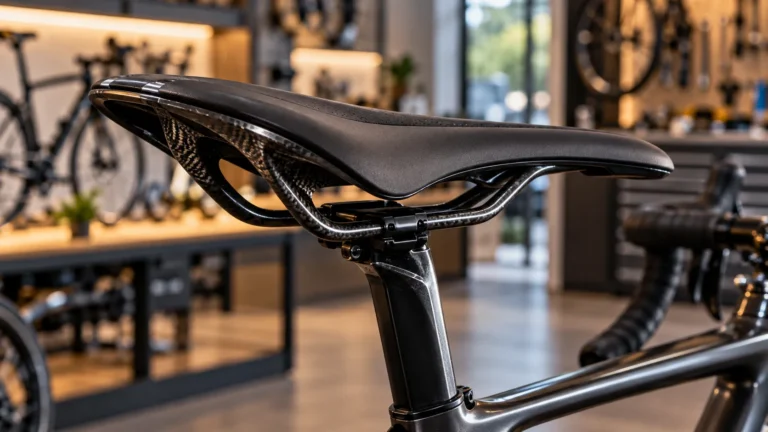
Saving grams is easy to talk about but much harder to justify when the component is the one you sit on. Fabric’s new ALM Halo saddle puts that tension in the spotlight. Introduced in late October 2026, the premium carbon design weighs a claimed 145 grams and carries a US retail price of $329. It also revives a distinctive structural idea from the original ALM: a suspended, leaf-spring-style rear section.
The interesting question is not whether it looks expensive or aerodynamic. It is whether its shape, construction, and pressure-relief options will actually suit a rider. Here is what the manufacturer has confirmed, what remains untested in this guide, and what cyclists should check before ordering.
Why the Fabric ALM Halo Is Making News
Fabric introduced the ALM Halo range on October 29, 2026, updating a saddle platform originally developed more than a decade earlier with inspiration from aerospace engineering. The company says its new structure concentrates carbon material where it is needed to provide support while allowing controlled compliance elsewhere.
Both Fabric’s launch announcement and BikeRadar’s reporting frame this as a premium return to a once-distinctive saddle design, not a low-cost mass-market option. That makes it a useful example of how material engineering, comfort claims, and cycling performance sometimes pull in different directions.
ALM Halo Specs at a Glance
The manufacturer’s published specifications are straightforward, although individual production tolerances and real-world measured weights may vary. According to Fabric’s product page, the listed dimensions and materials are:
- Claimed weight: 145 grams
- Length and width: 265 x 142 millimeters
- Rails: carbon, approximately 7 x 10 millimeter oval section
- Base: carbon-fiber unibody
- Topper: lightweight EVA padding and microfibre cover
- Rider weight limit: 100 kilograms
- Listed retail price: $329 / €329 / £299, depending on market
A 145-gram saddle is unusually light, but lower weight alone does not guarantee greater comfort or efficiency. A saddle has to fit the rider, remain securely mounted, and support a stable pedaling position. For general principles, read our cycling saddle comfort engineering guide.

How the HALO Carbon Structure Works
Fabric describes the ALM Halo as a carbon unibody with a reinforced rear wrap-around section. Instead of treating the saddle shell and rails as entirely independent pieces, the design uses their relationship to control stiffness and movement. Fabric says the rear structure resists unwanted twisting while preserving a springlike feeling through the rails.
The engineering process involved research with the National Composites Centre and experimentation with tailored fiber placement. According to Fabric’s technical development article, that approach allowed engineers to study carbon-fiber orientation and load paths before converting the concept into a production-friendly manufacturing process.
This is an intriguing design argument, but it is important to separate intention from independent testing. The company claims a carefully controlled combination of stiffness and flexibility. Whether that feels better than a conventional saddle will depend on rider position, weight distribution, road surface, and personal preference.
Standard or Ergo: Which Version Makes More Sense?
Fabric offers two versions: the standard ALM Halo and the ALM Halo Ergo. The Ergo has a pressure-relief opening in the underlying base, but the top covering remains continuous. In other words, the cutout is intentionally hidden beneath the saddle’s cover instead of being a visible gap all the way through.
The brand says this arrangement is meant to relieve soft-tissue pressure while limiting spray and dirt entering from below. The standard saddle uses its shell shape and compliance without that hidden opening. Neither design is automatically better for every cyclist, and the presence of a cutout is not a substitute for appropriate saddle width or bike fit.
If you regularly experience numbness, persistent discomfort, or pressure when leaning forward, do not assume that buying the Ergo will resolve it. First check saddle height, setback, tilt, handlebar reach, and shorts. Seek qualified medical advice for ongoing or recurrent symptoms.
Why 142mm Width and 265mm Length Matter
The ALM Halo does not use the very short nose common on some contemporary performance saddles. Its listed 265mm length leaves room for different fore-aft positions, while the 142mm width offers one specific support platform rather than a range of sizes.
A saddle that is too narrow may not support your sit bones properly. A saddle that is too wide can interfere with pedaling or create unwanted rubbing. Body size alone does not determine the correct choice, because riding posture affects which parts of the pelvis carry pressure. Our guide to modern bike fitting explains how movement analysis and contact-point measurements can improve decisions.
Check the Seatpost Clamp Before Buying
The 7 x 10mm carbon rails are a practical detail, not an afterthought. Many bicycle seatpost clamps are optimized for round metal rails, while oval carbon rails can require a compatible cradle or dedicated hardware. Using the wrong clamp may damage the rails or compromise saddle security.
Before installing, confirm the seatpost manufacturer’s supported rail dimensions and follow the specified tightening sequence and torque settings. Inspect the saddle and clamping area after the first rides. An expensive lightweight component is not an upgrade if it cannot be fitted correctly to your existing bike.
Also check Fabric’s stated 100kg rider weight limit against your own situation and confirm any additional use restrictions with the manufacturer. These are component limits, not recommendations for a rider’s body weight.
Is 145 Grams Actually Noticeable on the Road?
Weight savings at the saddle can help reduce total bicycle mass, but a few dozen grams generally have a small effect compared with tire choice, riding position, pacing, and training consistency. For most recreational cyclists, comfort and compatibility deserve higher priority than the advertised number on a scale.
Performance-minded cyclists may still value light components as part of a carefully managed build. The value calculation changes if you are already satisfied with your fit, understand carbon component care, and are working toward a clear bicycle-weight goal.
Bikerumor’s launch report notes the combination of lightweight construction, leaf-spring architecture, and two pressure-relief choices. None of that, by itself, proves a performance gain for a particular rider.

Who Should Consider the ALM Halo?
The best prospective buyer is a road cyclist who already knows that a 142mm-wide saddle suits their position, has a compatible clamp, is comfortable paying for advanced construction, and can ideally test the saddle before committing.
It may make less sense for a rider with unresolved fit issues, a very different preferred saddle width, a limited equipment budget, or a bike used mainly for casual commuting. Often, investing in a professional fit or suitable tires provides a more noticeable improvement. Our bike-fit and geometry guide covers the bigger picture.
What to Check at a Bike Shop
- Measure your current comfortable saddle’s width and profile, not just its weight.
- Ask whether the store offers a demo saddle or a reasonable return policy.
- Check the clamp and oval carbon-rail compatibility before installation.
- Compare the standard and Ergo profiles based on your riding position.
- Confirm the manufacturer weight limit and local warranty terms.
- After installation, test comfort on several familiar ride lengths before changing other fit settings.
Frequently Asked Questions
Does the Fabric ALM Halo have a cutout?
The standard model does not use the Ergo’s hidden relief opening. The Ergo has a cutout in the base, covered by the continuous top material, according to Fabric.
Is the ALM Halo suitable for gravel bikes?
That depends on your comfort, use case, clamp compatibility, and manufacturer guidance. Its light carbon construction and performance-oriented shape do not automatically make it the best choice for repeated rough-surface impacts.
Is the advertised 145g a tested weight?
It is Fabric’s published specification, not an independently measured weight for this article. Individual samples may differ slightly.
Final Verdict: Worth $329?
The ALM Halo is a compelling illustration of how saddle makers can tune carbon structures rather than relying on thick padding alone. Its weight, engineering approach, and concealed Ergo pressure-relief option make it distinctive. But its high price is easiest to justify when the geometry already suits you, and the bike supports the unusual rails.
Prioritize fit, comfort, safety, and test opportunities ahead of weight claims. The right saddle is the one you can ride comfortably for hours, regardless of how impressive it looks in a product photograph.