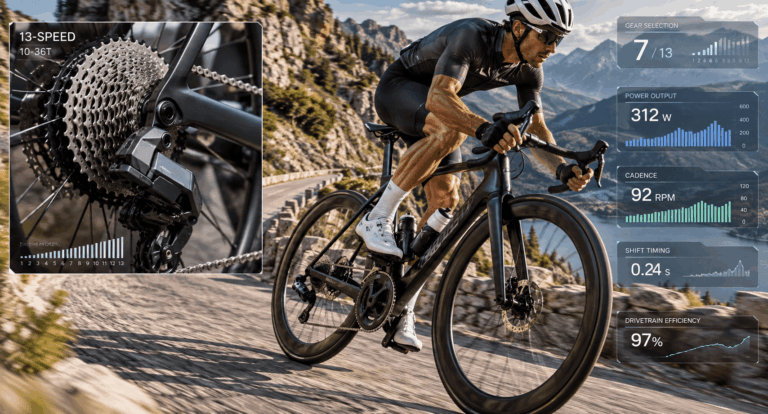
Road-bike drivetrains are entering another gear-count transition. Twelve-speed systems still dominate much of the premium market, but in 2026 the move toward 13-speed road drivetrains is no longer theoretical. Campagnolo already sells 13-speed road equipment, SRAM uses 13 speeds in its RED XPLR gravel platform, and Shimano has been publicly testing an unreleased 13-speed Dura-Ace prototype in major professional races.
The most recent sighting came at the 2026 UCI Road World Championships in Montréal, where Mathieu van der Poel used prototype Shimano controls and a 13-speed drivetrain. The system had previously appeared during the Vuelta a España and Tour de Luxembourg, giving engineers multiple opportunities to evaluate the equipment under race conditions.
Importantly, Shimano has not officially launched the new groupset. That means riders should separate confirmed observations from speculation. What is clear is that 13-speed technology is becoming increasingly important across road, gravel, and high-performance electronic shifting.
Why 13 Speeds Matter on a Road Bike
Adding another sprocket does not automatically make a bicycle dramatically faster. The main benefit is usually the ability to refine gear spacing while preserving overall range.
A road cyclist may want both:
- A high gear for fast descents and sprints
- A low gear for steep climbs
- Small ratio jumps between commonly used gears
- A cadence that stays close to the rider’s preferred rhythm
With more sprockets, drivetrain designers have additional flexibility to balance these goals.
Campagnolo explicitly promotes this advantage with its Super Record 13 cassette, offering multiple ranges while maintaining relatively fine steps through much of the cassette.
Shimano’s 13-Speed Prototype Breaks Cover
The biggest road-drivetrain story of late 2026 is the unreleased Shimano Dura-Ace prototype.
Cyclingnews first documented the prototype at the Vuelta a España, where photographers identified thirteen sprockets, new controls, updated derailleurs, and a revised crank and power-meter system.
Unlike a normal product announcement, this equipment remains in active development. Shimano has not published final specifications, pricing, compatibility information, or a launch date.
That uncertainty matters. A race prototype can change substantially before production.
World Championships Testing Adds Confidence
The prototype continued appearing in competition through September.
Cycling Weekly reported that Mathieu van der Poel raced prototype 13-speed Dura-Ace equipment at the Montréal World Championships. He had also used parts of the new system at the Tour de Luxembourg.
Repeated race use suggests the platform has progressed beyond an early static prototype, but it still should not be treated as finalized production equipment.
This continuing development connects directly with our Electronic Shifting Revolution article, which examines how electronic systems have changed shifting precision, ergonomics, and integration.
The Extra Sprocket Is Only Part of the Story
Gear count attracts attention because it is easy to understand, but the prototype appears to involve broader changes.
Road.cc’s analysis of prototype images points to revised shifter ergonomics, a different rear derailleur electronics package, and a redesigned crank-based power meter.
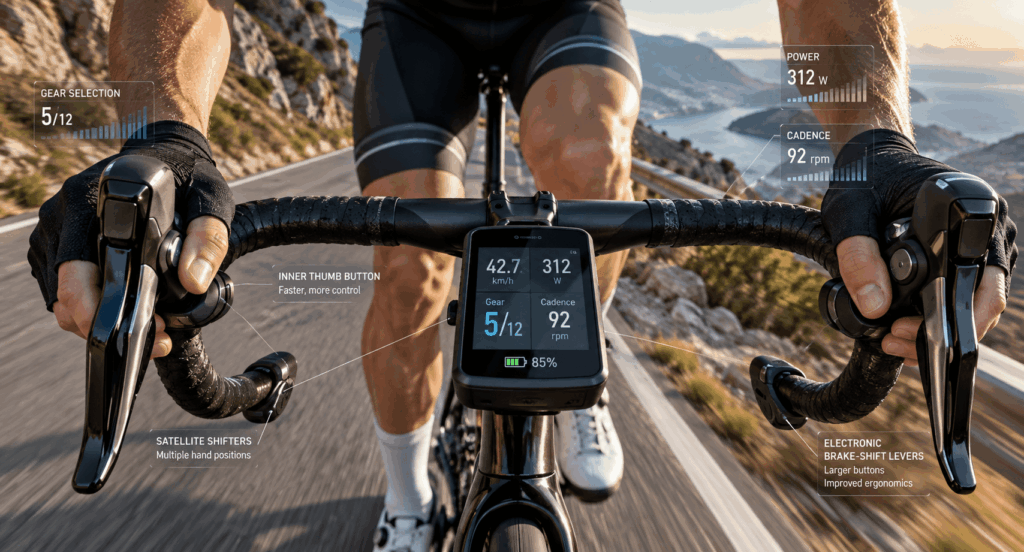
The controls are especially interesting because photographs show additional or repositioned buttons on the inner side of the brake hoods.
Electronic shifting makes this kind of ergonomic experimentation possible because a button does not need a direct mechanical connection to the derailleur.
More Buttons Could Improve Race Control
Modern electronic controls already allow riders to assign different functions to buttons.
Potential uses include:
- Front and rear shifting
- Changing cycling-computer pages
- Controlling compatible accessories
- Operating satellite shifting positions
Placing a more accessible button on the inside of the hood could allow riders to perform additional functions without significantly changing hand position.
The exact behavior of Shimano’s prototype buttons has not been officially confirmed, so any production function remains uncertain.
Why Shimano May Keep a Semi-Wireless Layout
Current Dura-Ace Di2 uses wireless communication between the shift levers and the central drivetrain while the derailleurs share an internal battery connection.
Prototype images suggest Shimano may continue with a similar semi-wireless architecture rather than switching completely to individual derailleur batteries.
That would distinguish its approach from fully wireless SRAM road systems.
Shimano’s current Dura-Ace R9200 platform remains officially 12-speed, so riders should consider the existing generation the current published standard until Shimano announces otherwise.
Thirteen Speeds Are Already Proven Elsewhere
Shimano would not be entering unexplored territory.
Campagnolo already offers 13-speed systems across multiple categories. Its current road cassettes demonstrate that an additional sprocket can be incorporated without necessarily creating an entirely new wheel standard.
Campagnolo says its Record 13 cassette retains the N3W freehub standard while fitting an extra sprocket through optimized spacing and a dedicated 13-speed chain.
Meanwhile, SRAM RED XPLR AXS uses a 13-speed 10–46T cassette for gravel, proving that modern electronic systems can successfully manage thirteen rear ratios in demanding conditions.
Closer Ratios Can Help Maintain Cadence
On the road, riders often care more about small gear jumps than maximum range.
Imagine riding in a fast group where one gear produces a cadence that feels slightly too high while the next feels slightly too low. An additional sprocket can allow manufacturers to reduce that gap.
This can be useful during:
- Time trials
- Long threshold efforts
- Fast pacelines
- Rolling road races
- Sustained climbs
Smaller ratio changes can help riders stay closer to their preferred cadence while maintaining power.
But More Gears Create Engineering Challenges
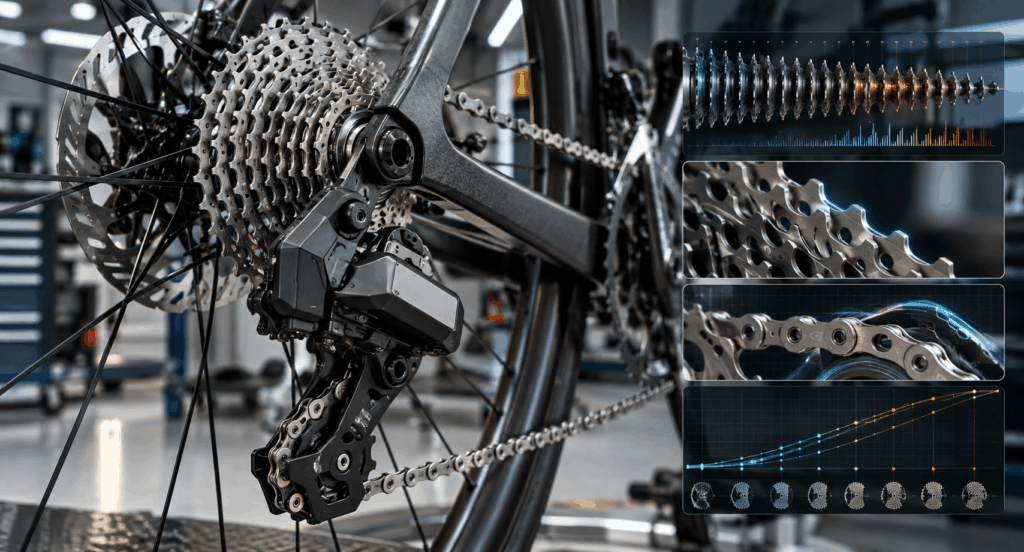
Fitting more sprockets into limited space can require narrower chains, tighter tolerances, and more precise alignment.
Engineers must consider:
- Chain durability
- Cassette spacing
- Freehub compatibility
- Derailleur precision
- Frame clearance
- Shift-ramp design
This is one reason electronic shifting becomes increasingly valuable as gear counts increase. Precise motor-controlled derailleur movement can help maintain consistent indexing across tightly spaced sprockets.
Our Software-Defined Bicycles 2026 guide explores how firmware is becoming increasingly important in bicycle-component behavior.
Will 13-Speed Mean New Wheels?
Compatibility will be one of the biggest practical questions when Shimano finally releases a new system.
Current prototype sightings show a revised cassette and related wheel components, but Shimano has not published a final compatibility chart.
This means riders should avoid assuming existing wheels, chains, cassettes, or freehub bodies will automatically work with the eventual product.
Campagnolo and SRAM demonstrate two different approaches: one retains its own established freehub architecture, while SRAM’s 13-speed gravel system requires specific drivetrain compatibility.
Power-Meter Development Is Equally Important
The prototype crankset has attracted nearly as much attention as the extra sprocket.
Images suggest Shimano is continuing to develop its integrated crank-based power meter. Accuracy, temperature compensation, left-right measurement, battery life, and calibration are all important considerations for elite riders.
Power data is now deeply integrated into professional racing and training, so a flagship drivetrain is judged by far more than shifting quality.
Will Every Cyclist Need 13 Speeds?
No. Twelve-speed groupsets already provide excellent range and small gear steps for most road riders.
An extra sprocket is most valuable when it improves the overall ratio progression rather than simply increasing the number printed on the specification sheet.
Mechanical simplicity, replacement-part cost, durability, and compatibility still matter.
The Future of Road Drivetrains
The wider trend is clear: premium drivetrains are becoming more electronic, more software-driven, and more tightly integrated with power measurement and rider controls.
Thirteen-speed systems are already established enough that the question is no longer whether the technology can work. The bigger questions are how each manufacturer will package it and whether riders will consider the improvement worth the cost of upgrading.
Conclusion
13-speed road drivetrains in 2026 are moving from novelty toward a broader performance trend. Campagnolo already offers 13-speed road equipment, SRAM has demonstrated the format in high-end gravel racing, and Shimano’s latest Dura-Ace prototype is now being tested publicly at the highest level of road competition.
The extra sprocket may provide tighter cadence progression, but the more important changes could be improved controls, electronic integration, power-meter development, and software-based shifting behavior.
Until Shimano formally announces its next-generation groupset, riders should treat prototype details as provisional. Still, the repeated race sightings make one thing increasingly clear: the premium road drivetrain is likely entering its next gear-count era.