Mountain bike suspension has spent years forcing riders to choose between two distinct personalities. Air shocks are lightweight, highly adjustable, and easy to tune for different rider weights, while coil shocks are often valued for their supple initial movement and predictable spring feel. In 2026, next-generation air shocks are increasingly attempting to narrow that divide.
The latest development arrived on September 23, 2026, when EXT introduced the Aria V2 and the downhill-focused Aria V2 DH. Rather than relying on a conventional single positive air chamber with volume spacers, the platform uses independently adjustable positive chambers, a negative chamber, revised friction management, hydraulic bottom-out control, and digital setup guidance.
The result illustrates a broader direction in mountain bike suspension: manufacturers are no longer treating an air shock as simply a lightweight alternative to a coil. They are attempting to shape the spring curve much more precisely throughout the entire stroke.
Why Multi-Chamber Air Shocks Matter in 2026
Conventional air shocks already offer substantial adjustability. Riders can change air pressure to match body weight and often add or remove volume spacers to modify how aggressively the spring ramps up near the end of its travel.
FOX’s current air-shock documentation, for example, explains how volume spacers alter mid-stroke and bottom-out resistance. Adding volume reduction generally increases end-stroke resistance, while removing it makes it easier to use full travel.
Multi-chamber designs create another tuning method. Instead of changing only the physical volume inside one positive chamber, the rider can alter pressure relationships between multiple air chambers.
That approach provides additional control over where and how the spring curve changes during compression.
For a broader look at how spring systems and frame design interact, see our Bike Suspension Technology and Geometry 2026 guide.
How the Three-Chamber Air Spring Works
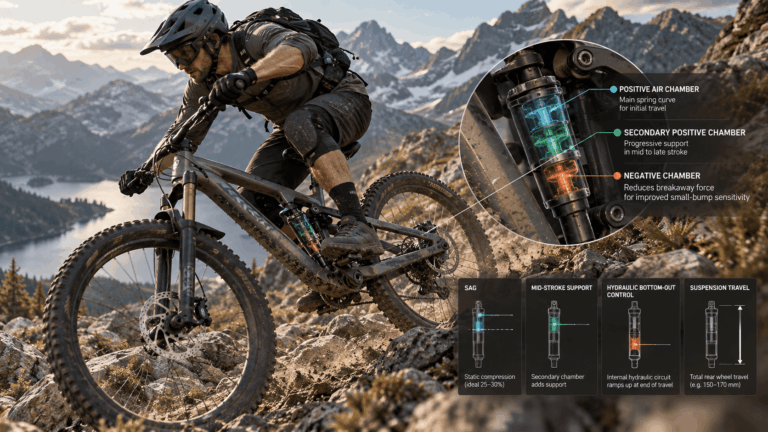
EXT’s Aria architecture uses three functional air volumes: a main positive chamber, a secondary positive chamber, and a negative chamber.
The original EXT Aria technical introduction described this as its AS3 system. The main positive chamber provides the primary spring support, while a second independently pressurized positive chamber changes how the spring behaves deeper in the stroke.
The negative chamber helps reduce the force needed to initiate movement and contributes to small-bump sensitivity.
According to Pinkbike’s first look at the Aria V2, the secondary positive chamber works through a floating piston. Once pressure in the main chamber exceeds the pressure threshold of the secondary chamber, the additional volume begins influencing the spring curve.
Changing secondary-chamber pressure can therefore alter when this transition occurs.
Why It Feels Different From Volume-Spacer Tuning
Volume spacers remain one of the simplest ways to tune a conventional air shock. A spacer reduces available air volume, causing pressure to rise more rapidly as the shock compresses.
The multi-chamber approach behaves differently because pressure can be adjusted externally rather than requiring the rider to physically open the air can and change spacer volume.
More importantly, the secondary chamber can affect the middle of the stroke as well as the final portion.
That matters because suspension feel is not determined only by initial sensitivity and bottom-out resistance. Riders also need enough mid-stroke support to maintain chassis stability during:
- Hard cornering
- Steep compressions
- Jump takeoffs
- Repeated impacts
- Technical climbing
Too little support can make a bike feel vague or cause it to ride too deeply in its travel. Too much support can make the bike feel harsh and reluctant to absorb bumps.
Can an Air Shock Really Feel Like a Coil?
The comparison with coil suspension needs some context. A coil spring naturally has a relatively linear relationship between force and compression, while a conventional air spring becomes increasingly progressive as its air volume decreases.
EXT says the Aria V2 was developed to retain the adjustability of air while reducing some characteristics that can make air shocks feel less sensitive than coil systems. The company’s September 2026 announcement specifically emphasizes sensitivity, support, and spring-curve control.
That does not mean an air shock becomes mechanically identical to a coil shock. The spring media, seals, friction sources, temperature behavior, and force curves remain different.
A more accurate description is that advanced air designs are giving engineers more freedom to target some of the ride characteristics traditionally associated with coil suspension.
Lower Friction Is Critical to Small-Bump Sensitivity
Air-spring architecture is only part of the equation. Seals create friction, and that friction can influence how readily the shock begins moving over small bumps.
EXT says the Aria V2 includes revised sealing and friction management. Pinkbike also reports changes to internal bushings and seals intended to reduce friction relative to the previous generation.
This is significant because a sophisticated spring curve cannot deliver its intended feel if internal friction prevents the shock from responding smoothly to low-force inputs.
Improving seal design, lubrication, surface finishes, and alignment can therefore be just as important as changing chamber pressure.
Singletracks’ Aria V2 overview also notes the revised shock layout and efforts to improve compatibility with more frame designs.
Hydraulic Bottom-Out Control Adds Another Layer
Progressive air springs naturally become firmer near the end of their travel, but aggressive enduro and downhill riding can still generate enormous impact loads.
Hydraulic bottom-out control addresses this by adding damping near the end of the stroke instead of relying exclusively on spring pressure.
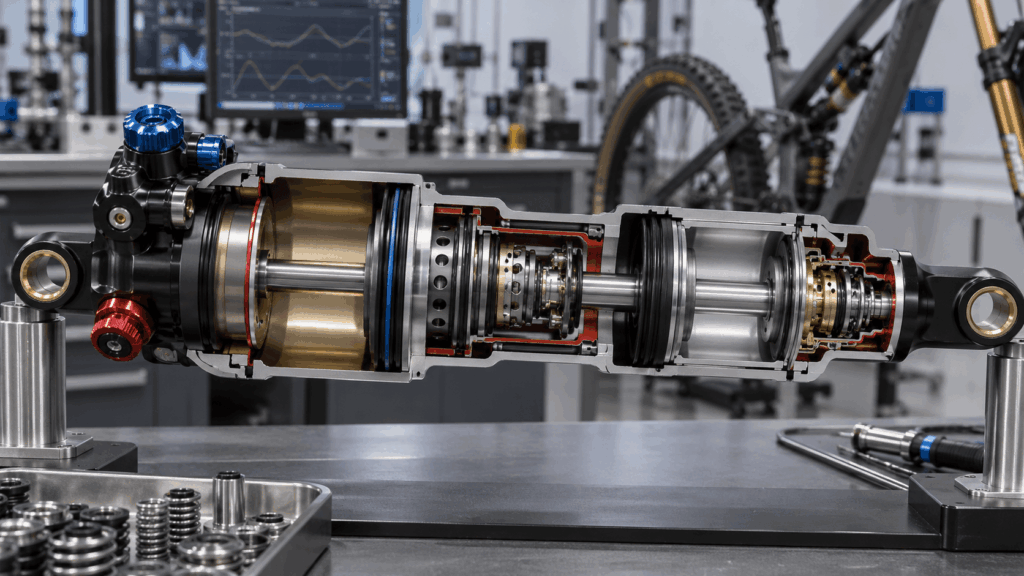
EXT describes its Hydraulic Bottom-Out Control system as a position-sensitive damping circuit. As the shock approaches full compression, a secondary piston restricts oil flow, creating additional damping force.
This approach can allow the air spring to remain more usable earlier in the travel while providing extra resistance during large impacts.
The Aria V2 DH takes that concept further. Pinkbike reports that its downhill-specific HBC valve can generate approximately 20 percent more damping force than the standard V2 system.
Why the DH Version Is Different
Downhill bikes place very different demands on suspension compared with trail and enduro bikes.
A DH shock does not need a climbing lockout, but it does need to handle repeated high-speed impacts, large compressions, jumps, braking bumps, and long descents that can increase damper temperatures.
The Aria V2 DH therefore receives:
- A downhill-specific damping tune
- No lockout lever
- More aggressive hydraulic bottom-out control
- The same multi-chamber tuning philosophy
This illustrates how modern air-shock platforms are becoming increasingly application-specific rather than relying on one tune for every bicycle category.
Digital Suspension Setup Is Becoming More Important
More adjustment also creates a potential problem: complexity.
A shock with two positive air pressures, rebound, compression, sag, and bottom-out adjustment can be difficult to configure without guidance.
EXT is addressing that issue through RideMaster, its web-based setup platform. The company’s suspension support resources already emphasize setup based on rider weight, riding style, sag, and damper adjustments.
Digital setup systems can help convert a long list of technical variables into a usable starting point. A rider may enter information such as:
- Bike model
- Rider weight
- Shock size
- Riding style
- Terrain preference
The platform can then recommend pressures and damping settings that the rider can refine on the trail.
Why Setup Matters More With Advanced Air Springs
More tuning range is useful only when riders understand how each adjustment affects the others.
Increasing pressure in one chamber may improve support but also alter sag or sensitivity. Changing rebound after modifying spring pressure may be necessary because a stronger spring can return faster. Bottom-out control may need another adjustment after changing the spring curve.
This is why modern suspension setup is increasingly becoming a system rather than a collection of independent knobs.
Bike geometry also affects the result. Different frames use different leverage curves, travel amounts, pivot layouts, and shock mounting positions. Our Bike Fit and Geometry Optimization for Performance 2026 article explains why overall bicycle geometry changes how a rider interacts with the machine.
Air Shocks Still Have Practical Advantages
Even as manufacturers chase coil-like sensitivity, air suspension retains several advantages that explain why it remains so popular.
Air pressure can be adjusted without replacing a physical spring. That makes it easy for riders of different weights to tune the same shock. Air systems can also offer substantial control over progressivity while typically avoiding the need to purchase multiple coil spring rates.
For riders who regularly change equipment, terrain, or bike setup, that flexibility is valuable.
A multi-chamber system expands those possibilities further by allowing changes to the spring curve through pressure adjustments rather than relying only on volume spacers.

Are Multi-Chamber Air Shocks Better for Everyone?
Not necessarily. Additional adjustability can increase setup time, and riders who prefer simplicity may be perfectly satisfied with a well-tuned conventional air shock or coil shock.
More valves and settings also mean riders need to understand recommended inflation procedures and pressure limits. Suspension components operate under significant pressure, so manufacturer instructions should always be followed.
The value of multi-chamber suspension is greatest for riders who want precise control over how the bike behaves through different portions of its travel.
Enduro Riders
They may appreciate the ability to combine initial sensitivity with strong mid-stroke support and adjustable bottom-out resistance.
Downhill Riders
DH racers can benefit from tuning range and hydraulic control during repeated large impacts.
E-MTB Riders
Heavier electric bikes can place additional loads on suspension, making control through the middle and end of the stroke particularly important.
The Future of Air-Shock Technology
The Aria V2 is one example of a wider shift in suspension development. Air-shock tuning is becoming increasingly sophisticated through multi-volume chambers, advanced seals, position-sensitive damping, digital setup recommendations, telemetry, and frame-specific configurations.
The next step may involve even closer integration between suspension hardware and data. Riders could eventually combine shock setup recommendations with ride telemetry showing how frequently full travel is used, where the suspension sits during cornering, and how settings influence traction on particular trails.
The result would move mountain bike suspension further from trial-and-error adjustment toward measurable, repeatable setup.
Conclusion
Next-generation air shocks in 2026 demonstrate how quickly the traditional distinction between air and coil suspension is changing. Multi-chamber systems allow engineers to shape the spring curve in ways that conventional single-positive-chamber designs cannot easily reproduce, while revised seals and hydraulic bottom-out control target sensitivity and impact management.
The technology does not make coil suspension obsolete, nor does it guarantee that every rider needs additional air chambers. Instead, it gives riders another way to tune support, progression, sensitivity, and bottom-out behavior around their bike and riding style.
Perhaps the most important development is the combination of advanced hardware with digital setup tools. As suspension becomes more adjustable, software can help riders understand those adjustments and turn complex engineering into practical trail performance.