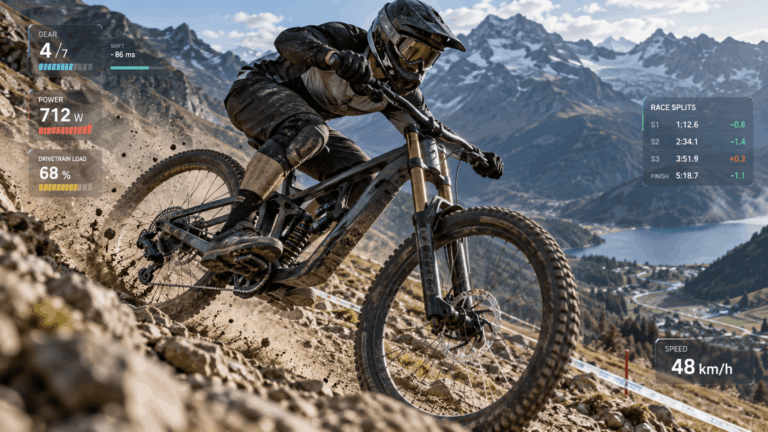
Downhill mountain biking has always demanded specialized equipment. Racers use long-travel suspension, powerful brakes, reinforced wheels, gravity-specific tires, and compact gear ranges designed around short bursts of enormous power rather than long climbs. In 2026, the drivetrain is undergoing an equally significant transformation as electronic downhill drivetrains bring wireless shifting, direct frame-mounted derailleurs, shift-under-load technology, and race-specific cassette architecture to gravity racing.
SRAM’s new XX DH Transmission is the clearest example. Unlike a trail drivetrain adapted for downhill use, the system was developed specifically around the requirements of DH racing. It uses only seven gears, a compact 10–24-tooth cassette, a short Full-Mount derailleur, wireless AXS control, downhill-specific cranks, and software that coordinates exactly when the chain moves between sprockets.
That combination reflects an important shift in bicycle engineering. Electronic shifting is no longer only about eliminating cables or making gear changes more convenient. In downhill racing, software is increasingly being used to preserve momentum when fractions of a second can affect qualifying positions.
Why Downhill Bikes Still Use Seven Speeds
Modern trail and cross-country bikes commonly use wide-range 12-speed drivetrains because riders need very low climbing gears as well as ratios suitable for fast terrain.
A downhill race bike has a very different job.
Riders normally reach the start using a lift, shuttle, or other assisted transport, so they do not need a 50- or 52-tooth climbing sprocket. Instead, the drivetrain needs a compact set of closely relevant ratios for:
- Explosive starts
- Short pedaling sections
- High-speed traverses
- Accelerating out of corners
- Finish-line sprints
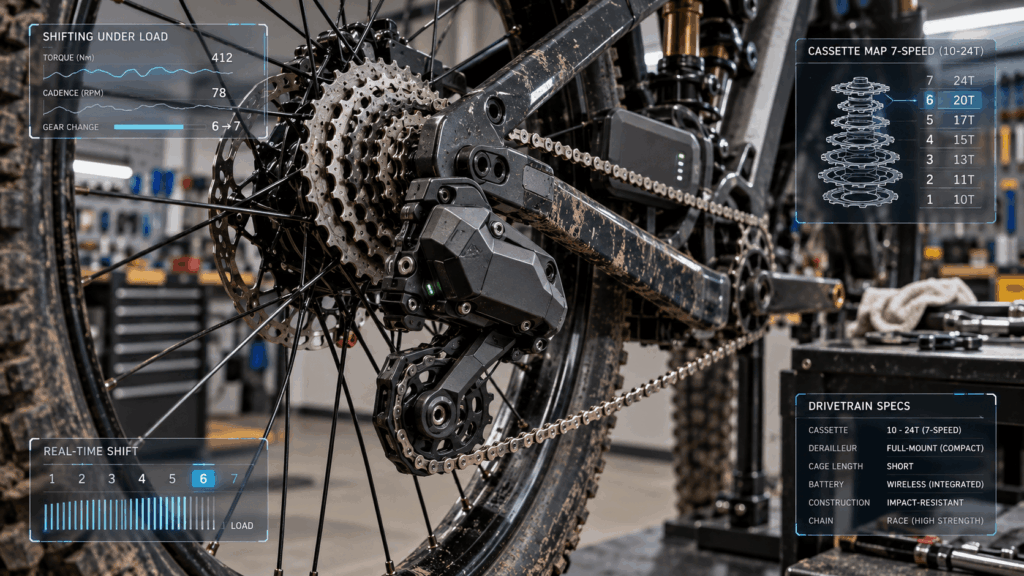
SRAM’s current XX DH cassette therefore uses seven sprockets spanning 10 to 24 teeth: 10, 12, 14, 16, 18, 21, and 24. The company says these steps are specifically optimized for downhill power delivery.
This specialized approach builds on the drivetrain evolution discussed in our Electronic Shifting Revolution guide.
Wireless Shifting Finally Becomes DH-Specific
Electronic shifting has been common in road, gravel, XC, trail, and enduro bikes for years, but dedicated downhill systems remained largely mechanical.
That changed with XX DH AXS Transmission. Pinkbike reported that the production drivetrain uses a seven-speed wireless system with a short-cage Full-Mount derailleur, 10–24T cassette, downhill-specific cranks, and T-Type components.
Wireless control removes the traditional shift cable and housing. The handlebar controller communicates electronically with the derailleur, while firmware coordinates derailleur movement with the cassette’s engineered shift ramps.
For downhill racing, eliminating the cable can also remove one component exposed to contamination, housing damage, cable stretch, and routing complications.
Shifting Under Full Power Is the Bigger Story
The most important development is not necessarily wireless communication. It is what the electronic drivetrain can do while a rider is applying substantial power.
Traditional shifting often encourages the rider to momentarily reduce pedal force. Easing pressure can help the chain leave one cog and engage the next without creating a violent shift.
That brief reduction in power can matter in downhill racing.
SRAM says its Cassette Mapping technology enables riders to continue pushing heavily through the pedals while changing gear. Instead of moving the chain immediately whenever a button is pressed, the derailleur’s firmware coordinates the shift with specific features on the cassette.
The company describes this as maintaining continuous chain engagement while the rider shifts under load.
What Is Cassette Mapping?
Electronic derailleurs can do something mechanical systems cannot easily replicate: control the exact timing of a shift according to software.
The seven-speed cassette has carefully positioned shift ramps and tooth profiles. The derailleur firmware knows where the intended shift points are located and manages chain movement accordingly.
Instead of treating each shift as a simple lateral derailleur movement, the complete system coordinates:
- Electronic shift command
- Derailleur movement
- Cassette position
- Shift ramps
- Chain engagement
BikeRadar reports that this synchronization helps keep the chain engaged while the rider continues producing high power.
It is an example of the broader transition covered in our Software-Defined Bicycles 2026 article, where firmware increasingly determines how mechanical bicycle hardware behaves.
Why Hundredths of a Second Matter
Downhill races are frequently decided by extremely small time differences. That makes seemingly minor drivetrain gains potentially meaningful.
SRAM claims its testing showed riders could cover the first 15 meters of a start approximately 0.05 seconds faster with XX DH Transmission than with the company’s previous cable-operated downhill drivetrain when rider power was held constant. BikeRadar reported the same manufacturer testing during its first ride of the system.
That figure should be understood as a manufacturer test rather than a universal guarantee. Actual differences will depend on rider technique, terrain, gearing, power output, and race conditions.
Still, the concept explains why electronic load shifting makes sense in gravity competition. A downhill racer may only shift a limited number of times during a run, but each shift can happen during an important acceleration zone.
The Full-Mount Derailleur Removes the Hanger
Traditional rear derailleurs attach to a relatively small derailleur hanger. The hanger provides a replaceable connection between the frame and derailleur and is often designed to bend or break during an impact.
Full-Mount architecture uses a different strategy.
The derailleur mounts around both sides of the frame’s rear interface rather than hanging from a conventional separate hanger. SRAM says this allows the derailleur to sit farther inboard and rotate backward when struck.
This is particularly relevant to downhill racing, where derailleurs face:
- Rock strikes
- Crashes
- Roots
- Trackside debris
- High-speed impacts
BikeRadar’s current Transmission guide describes the XX DH derailleur as a short-cage Full-Mount design intended specifically for the durability requirements of downhill use.
A Compact Derailleur Helps Protect the Drivetrain
Because the cassette only needs seven gears and a relatively narrow 10–24T range, the derailleur does not require the long cage associated with a 10–52T trail cassette.
A shorter cage provides greater ground clearance and keeps more of the mechanism away from obstacles.
The derailleur also sits farther inboard than many conventional designs.
For downhill equipment, this type of packaging matters. Saving a few grams is useful, but keeping the drivetrain operational through a violent race run is more important.
XD SLIM Changes More Than the Cassette
One of the most interesting pieces of XX DH Transmission is actually located at the rear hub.
SRAM offers a standard cassette for the established XD driver as well as a narrower cassette designed around its new XD SLIM interface.
The XD SLIM cassette still provides seven gears and a 10–24T range, but its narrower driver architecture allows more space for the hub flange.
SRAM says the resulting flange positioning can produce a more symmetrical spoke-bracing angle and more even spoke tension on compatible 148mm downhill rear wheels.
That illustrates how a drivetrain redesign can influence the entire rear wheel rather than simply changing shifting performance.
Why Wider Hub-Flange Spacing Can Matter
A bicycle wheel gains lateral stiffness partly from the angle between the spokes and hub flanges.
Drivetrain components normally occupy substantial space on the right side of the hub, forcing the drive-side flange inward. This creates asymmetry between left- and right-side spoke angles and tensions.
A narrower drivetrain package can free space for better flange positioning.
For downhill wheels subjected to hard landings, compressions, berm loads, and lateral impacts, improved spoke geometry may be valuable.
This is a reminder that modern component design increasingly treats the bicycle as an integrated system rather than a collection of unrelated parts.
Downhill Crank Length Is Getting Shorter
XX DH also reflects another modern downhill trend: shorter cranks.
The system is available with aluminum crank lengths of 150, 155, 160, and 165mm.
Shorter cranks can provide additional pedal clearance on rough tracks, reducing the chance of striking rocks or roots while pedaling through technical terrain.
They can also influence rider position and cadence, so crank choice remains dependent on bike geometry and rider preference.
Electronic Shifting Does Not Make the Drivetrain Indestructible
Downhill equipment still experiences extreme loads, and an electronic derailleur can still be damaged.
The difference is that modern Full-Mount systems are designed with impact management and replaceable components in mind.
This philosophy prioritizes serviceability in areas likely to encounter damage rather than assuming the complete derailleur will remain untouched throughout its lifespan.
Riders should also remember that wireless drivetrains introduce batteries and electronics. Monitoring battery charge becomes another maintenance responsibility before a race weekend.
Mechanical Downhill Drivetrains Still Have Advantages
Electronic shifting does not automatically make mechanical systems obsolete.
Cable-operated drivetrains remain attractive because they can be:
- Less expensive
- Simple to diagnose
- Easy to repair trackside
- Independent of derailleur batteries
- Supported by widely available components
The 2026 Mondraker Summum illustrates this split clearly. BikeRadar reports that the flagship model uses SRAM’s XX DH AXS electronic drivetrain, while a less expensive version uses a cable-operated SRAM downhill groupset.
For professional racing, the potential gains of electronic shifting may justify the price. Privateers and recreational riders may value simpler mechanical equipment differently.
Electronic DH Drivetrains Are Part of a Bigger Data Trend
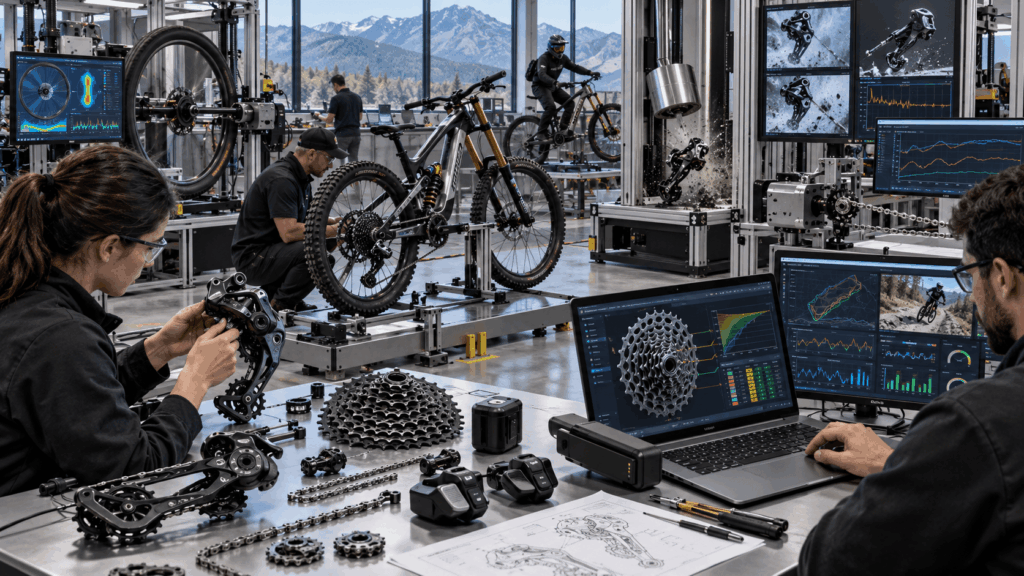
Modern downhill racing is becoming increasingly data-driven. Race teams already use telemetry for suspension, braking, speed, tire behavior, and rider performance.
BikeRadar’s coverage of early 2026 downhill testing showed electronic drivetrains appearing alongside prototype suspension, data-acquisition hardware, oversized brakes, and other experimental equipment.
Electronic shifting fits naturally into that environment because gear selection and shift behavior can potentially become part of the bike’s broader digital dataset.
Our Bike Chain Technology and Drivetrain Efficiency 2026 article provides additional context on how chains, cassette profiles, surface treatments, and electronic systems interact to improve power transfer.
Could Firmware Change DH Drivetrains After Purchase?
Software control means some drivetrain characteristics are no longer permanently fixed at the factory.
Firmware can potentially influence shift timing, wireless communication, cassette synchronization, diagnostic functions, and system behavior.
That does not mean riders should expect unlimited future features, but it changes the relationship between hardware and software.
A derailleur is increasingly both a mechanical component and a programmable electronic device.
Who Benefits Most From Electronic DH Shifting?
World Cup Racers
Elite riders can benefit most from technology aimed at preserving momentum and reducing time lost during full-power shifts.
Competitive Privateers
Racers who want top-level equipment may appreciate the performance and durability benefits, although purchase and replacement costs are significant considerations.
Freeriders
A compact, impact-oriented derailleur architecture can also appeal to riders regularly exposing bikes to large jumps and rough terrain.
Bike Technology Enthusiasts
Even outside competition, XX DH offers a preview of how software, frame interfaces, hubs, wheels, cassettes, and electronic controls may become more integrated.
The Future of Downhill Drivetrains
Electronic downhill shifting is unlikely to stop with a wireless derailleur.
Future systems could potentially integrate drivetrain information with suspension telemetry, race timing, rider power data, and bike setup software.
Software may become increasingly important in determining exactly when shifts happen and how aggressively the drivetrain responds to rider commands.
The launch of a production downhill-specific electronic drivetrain also shows that gravity racing remains an important development laboratory. Technology tested under World Cup conditions can eventually influence enduro, trail, and even e-MTB drivetrains.
Conclusion
Electronic downhill drivetrains in 2026 mark a meaningful change in gravity-racing technology. Wireless control may be the most visible difference, but the deeper innovations involve shifting under load, software-based Cassette Mapping, Full-Mount derailleur architecture, specialized seven-speed gearing, compact cranks, and redesigned rear-hub interfaces.
The drivetrain is becoming a complete race system rather than simply a derailleur connected to a cassette.
Mechanical downhill groupsets remain effective, simpler, and less expensive, so electronic systems will not replace them overnight. But at the highest levels of racing, where hundredths of a second matter, drivetrain electronics now offer something more significant than convenience: the possibility of preserving power and momentum during the moments when racers are pushing hardest.