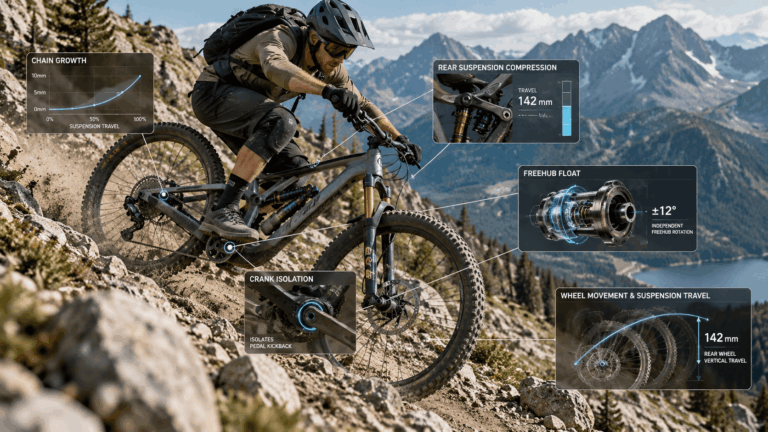
Mountain bike hubs have traditionally been judged by familiar measurements such as weight, durability, bearing quality, and how quickly the freehub engages when a rider begins pedaling. In 2026, another variable is becoming increasingly important: how much freedom the freehub allows before drivetrain forces reach the rider and rear suspension.
Anti-pedal-kickback hubs in 2026 are challenging the long-standing assumption that faster engagement is always better. By deliberately allowing a controlled amount of rotational movement inside the freehub, these systems attempt to isolate the rear suspension from chain forces that can otherwise create feedback at the pedals.
The concept gained fresh momentum in September 2026 when DT Swiss expanded its Degrees of Freedom technology with new upgrade kits for more hubs and additional levels of freehub float. The result is a fascinating new tuning question: should riders prioritize near-instant engagement, or give the suspension more room to move independently?
What Is Pedal Kickback?
Pedal kickback is connected to the interaction between a bicycle’s drivetrain and rear suspension. As many full-suspension bikes compress, the distance between the rear axle and the crank can change. This is commonly called chain growth.
Because a bicycle chain cannot simply stretch to accommodate that change, suspension movement can create tension through the drivetrain.
Canyon’s explanation of anti-squat and pedal kickback notes that chain growth can pull against the chainring and attempt to rotate the cranks backward during suspension compression.
A rider standing heavily on the pedals may experience that interaction as resistance or feedback through the feet.
The effect depends on many factors, including:
- Suspension kinematics
- Chain growth
- Selected gear
- Rear-wheel speed
- Freehub state
- Whether the rider is pedaling or coasting
Our Bike Suspension Technology and Geometry 2026 guide explains how anti-squat, linkage design, and rear-axle movement influence modern mountain bike performance.
Why Freehub Float Can Reduce Drivetrain Feedback
Most high-performance hubs have traditionally chased smaller engagement angles. The idea is simple: when the rider begins pedaling, less crank movement is required before the freehub engages and power reaches the rear wheel.
Anti-pedal-kickback systems intentionally introduce another behavior while the rider is coasting.
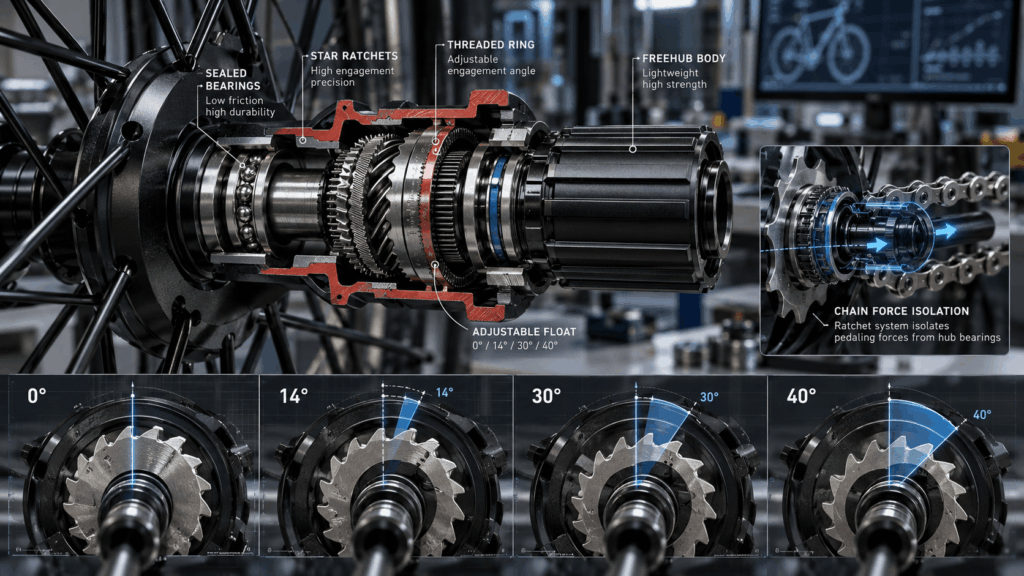
DT Swiss describes its DF technology as allowing a defined amount of freehub movement before drivetrain force is transferred. During suspension compression, that movement can absorb some chain growth before it pulls against the cranks.
In other words, the freehub temporarily creates mechanical space between suspension motion and the rider’s feet.
DT Swiss Expands Degrees of Freedom in 2026
DT Swiss originally introduced its Degrees of Freedom concept for Ratchet DEG hubs. The system allowed riders to select different amounts of rotational movement inside the freehub.
The important 2026 development is broader compatibility.
Pinkbike reported in September 2026 that DT Swiss expanded DF technology to Ratchet and Ratchet LN hubs, including common 350 and 370-series designs.
The newer Ratchet DF option offers a normal setting and a setting with additional free movement before engagement. Updated DEG configurations can provide still larger amounts of float for riders who want stronger drivetrain isolation.
This matters because the technology is no longer limited to riders purchasing an entirely new premium hub. Existing compatible hubs may be converted using internal components.
Why Would Anyone Want Slower Engagement?
For years, fast engagement has been marketed as a premium feature. Cross-country riders in particular may appreciate immediate response during technical climbs where rapid bursts of power are needed.
However, downhill and enduro riders spend much more time coasting through rough terrain.
When the pedals are not being used to accelerate the bicycle, ultra-fast engagement may offer less benefit. Giving the freehub additional rotational freedom can instead allow the suspension and drivetrain to interact less aggressively.
DT Swiss says the DF concept enables riders to tune this balance depending on terrain and bicycle characteristics.
The trade-off becomes clear:
- Less freehub float can provide quicker pickup when pedaling.
- More freehub float can potentially isolate suspension movement from the cranks more effectively.
Pedal Kickback Is More Complicated Than It Sounds
The subject is not completely settled.
SRAM has published instrumented testing of pedal feedback suggesting that traditional pedal kickback may be much less significant at normal trail speeds than simplified static calculations imply. When the rear wheel is rotating and the freehub can disengage, drivetrain behavior becomes more complicated.
A 2026 Sports Engineering study examining crank torque in downhill mountain biking likewise explored several mechanisms that can create forces at the pedals rather than assuming all rider feedback comes from one form of kickback.
That means riders should be cautious about treating any anti-kickback device as a guaranteed universal suspension upgrade.
The technology may change drivetrain feedback, but how noticeable or beneficial it feels can depend heavily on the bike and rider.
How Anti-Squat Fits Into the Equation
Anti-squat is designed to counteract suspension compression caused by acceleration and weight transfer while pedaling.
Many high-performance bikes use chain forces as part of this system. Increasing chain influence can improve pedaling support, but it may also increase interaction between suspension movement and the drivetrain.
This creates an engineering balancing act between:
- Pedaling efficiency
- Suspension freedom
- Traction
- Chain growth
- Pedal feedback
An anti-kickback hub does not redesign the frame’s suspension geometry. Instead, it modifies how drivetrain forces reach the rider during certain conditions.
Why Downhill Bikes Are an Ideal Test Platform
Downhill bikes are a natural application because racers spend long periods coasting across repeated impacts while trying to maintain stable foot pressure.
A freer-moving suspension may theoretically improve the bike’s ability to track rough terrain without transferring as much drivetrain disturbance to the rider.
The concept fits with the broader race-focused developments discussed in our Electronic Downhill Drivetrains 2026 article, where drivetrain architecture is increasingly optimized specifically for gravity racing.
More Freehub Float Is Not Automatically Better
Adding free movement introduces an obvious compromise: the rider must rotate the cranks farther before the hub engages.
This may be barely noticeable while descending, but it can become much more apparent when:
- Restarting after a technical obstacle
- Pedaling through tight terrain
- Climbing steep sections
- Accelerating out of slow corners
BikeRadar’s analysis of pedal-kickback technologies highlights this basic compromise: systems that isolate the drivetrain can also introduce additional movement before power delivery.
Hub Tuning Becomes Part of Suspension Setup
This is perhaps the most interesting part of the trend. Riders already tune air pressure, rebound, compression, tire pressure, and spring progression. Freehub movement is now becoming another adjustable variable.
Our Next-Generation Air Shocks 2026 article explores how rear suspension itself is becoming more adjustable through multi-chamber springs and digital setup tools.
Freehub float extends that philosophy beyond the shock.
A rider could theoretically choose a low-float setting for pedaling-intensive terrain and increase isolation for steep, rough downhill tracks.
Retrofitting Makes the Technology More Interesting
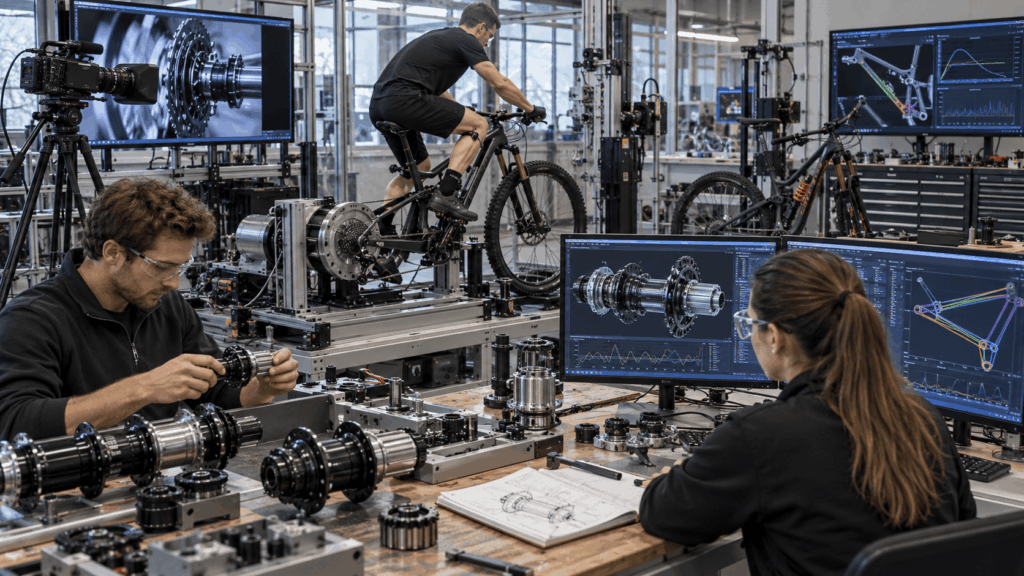
One of the advantages of DT Swiss’s approach is that the system can be installed inside compatible hubs instead of requiring a completely different frame or suspension layout.
Velomotion’s September 2026 test of the updated Ratchet DF system examined how the retrofit changes engagement and trail feel on existing hubs.
This makes anti-kickback experimentation much more accessible than technologies requiring specialized cranksets, frames, or complete wheel replacements.
The Future of Hub-Based Suspension Tuning
Hub technology is increasingly moving beyond bearings and engagement speed.
Future systems could potentially combine adjustable freehub behavior with drivetrain telemetry, suspension sensors, or electronic controls. Whether that level of complexity becomes necessary remains to be seen, but the principle is important: rear hubs can influence how a full-suspension bicycle feels, not simply how efficiently it rolls.
Our Bike Wheel Technology and Aerodynamic Rim Design 2026 guide looks at how wheel components are already becoming increasingly specialized around discipline and performance goals.
Conclusion
Anti-pedal-kickback hubs in 2026 are turning freehub engagement into a suspension-tuning variable. DT Swiss’s expanding DF ecosystem makes the concept particularly relevant because compatible riders can now experiment with additional freehub movement without redesigning their entire bicycle.
The technology also demonstrates why mountain bike engineering rarely has a simple answer. Fast engagement is useful, but instantaneous engagement is not necessarily ideal in every situation. Drivetrain isolation may help suspension behavior, but additional float can make pedal pickup feel slower.
The most useful approach is therefore not to assume that maximum or minimum float is universally best. It is to treat hub behavior like suspension damping or tire pressure — another parameter that can be tuned around the bike, terrain, and rider.