Gravel racing has spent the last several years borrowing aerodynamic ideas from road cycling. Frames have become narrower and more sculpted, cables have disappeared inside cockpits, wheel rims have become deeper, and riders are adopting faster positions. In 2026, aerodynamics is moving into a component that once seemed almost impossible to make slippery: the wide, knobby gravel tire.
Aero gravel tires in 2026 are introducing sidewall features more commonly associated with aircraft surfaces and aerodynamic clothing. Vortex generators, trip strips, wider rim profiles, CFD modeling, and real-world testing are now being used to control airflow around tires that may exceed 50mm in width.
WTB and Stromm brought the concept into sharp focus in September 2026 with three updated gravel tires featuring aerodynamic sidewalls. WTB’s technical explanation of the project describes hundreds of aerodynamic design iterations and extensive CFD development focused on reducing drag without removing the tread required for real off-road riding.
Why Gravel Tires Have Become an Aero Problem
Gravel tires have become dramatically wider as racers pursue more grip, comfort, and puncture resistance.
Modern race bikes increasingly accommodate 50mm or larger tires, and some current designs provide clearance approaching mountain-bike dimensions.
That additional volume brings significant off-road advantages, but a wide tire also presents a larger shape to the airflow at the front of the bicycle.
Our 2026 Gravel Bike Trends and Technology Innovations article explores how growing tire clearance has become one of the category’s defining developments.
The aerodynamic challenge is especially difficult because a tire is not a stationary frame tube. It rotates, changes shape under load, contains tread, collects dust and mud, and interacts with the rim.
What Are Vortex Generators?
Vortex generators are small surface features designed to manipulate airflow.
They intentionally disturb the thin layer of air traveling along a surface. That may sound counterproductive, but energizing the boundary layer can sometimes help airflow remain attached to a difficult shape for longer.
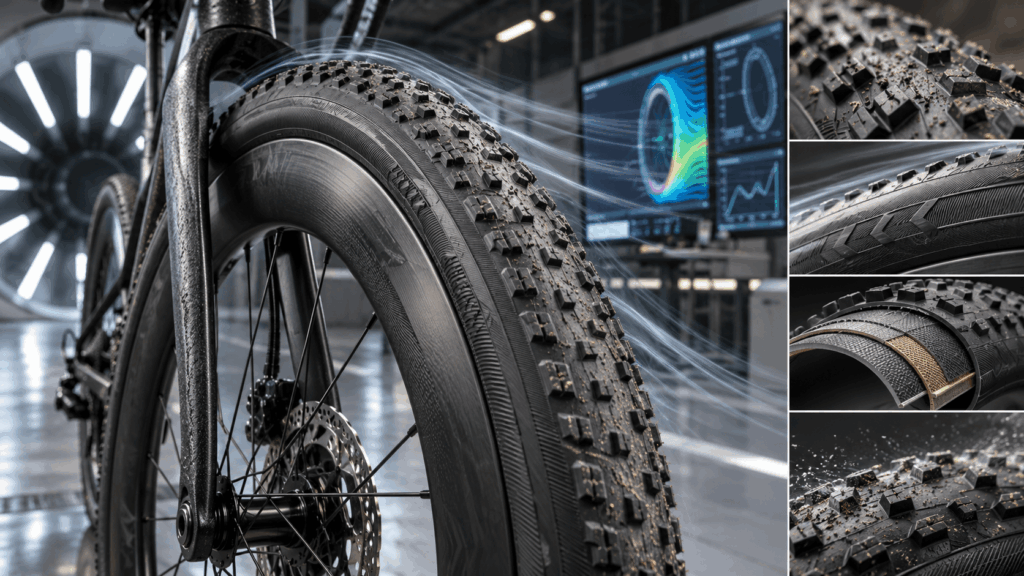
WTB’s new tires were developed with aerodynamic specialist Stromm and incorporate both vortex generators and trip strips along their sidewalls.
WTB says the system is intended to manage the airflow around the tire-and-wheel combination and reduce the low-pressure wake that contributes to aerodynamic drag.
This idea is familiar elsewhere in performance engineering. Similar concepts appear on aircraft surfaces, racing vehicles, aerodynamic clothing, and other objects where controlling airflow separation matters.
Why Put Aero Features on the Sidewall?
The obvious place to reshape a tire might seem to be the tread, but tread is critical to traction and rolling performance.
A gravel tire needs to accelerate, brake, corner, and maintain grip across loose surfaces. Making the center tread significantly more aerodynamic could compromise those functions.
WTB and Stromm therefore concentrated much of their aero development on the sidewall.
Road.cc’s coverage of the September launch explains how the three tires retain distinct tread patterns while sharing the new aerodynamic sidewall treatment.
Three Tires Cover Different Gravel Conditions
The new range includes three increasingly aggressive options.
- Byway RS 50 for faster and smoother gravel
- Course 52 for mixed terrain
- Macro 54 for rougher and more technical riding
The numbers reflect their approximate width in millimeters.
The Byway RS uses a comparatively smooth centerline to prioritize speed, while the Course and Macro add more pronounced tread for traction.
All three demonstrate an important shift in gravel design: wide tires and aerodynamic development are no longer considered mutually exclusive.
Manufacturer Testing Shows Meaningful Claimed Savings
WTB and Stromm report substantial aerodynamic savings compared with otherwise similar control tires without the aero sidewall treatment.
Escape Collective reports manufacturer testing claiming approximately 5.8 watts of savings at 30 km/h, 9.3 watts at 35 km/h, and 13.8 watts at 40 km/h.
Those figures should be interpreted carefully. They come from manufacturer-associated testing rather than a broad independent comparison, and aerodynamic results depend on speed, rim shape, yaw angle, tire size, and bicycle configuration.
The largest claimed savings also occur at relatively high gravel-racing speeds.
Still, the numbers demonstrate why brands are beginning to consider tires part of the aerodynamic system.
CFD Has Become Essential for Tire Development
Computational Fluid Dynamics allows engineers to simulate airflow through enormous virtual models before manufacturing physical prototypes.
WTB says the project used extremely large CFD simulations to examine airflow around rotating tires and wheels.
This is more complicated than modeling a stationary frame because the rotating surface changes the local airflow and boundary-layer behavior.
The engineers also used real-world testing to calibrate their models rather than relying on computer simulations alone.
This mirrors developments discussed in our Bike Wheel Technology and Aerodynamic Rim Design 2026 guide, where CFD and wind-tunnel testing increasingly determine rim profiles.
The Rim and Tire Must Work Together
A tire cannot be considered aerodynamic in isolation.
The installed width and shape depend heavily on the rim’s internal and external dimensions. A 50mm tire mounted to one rim can create a noticeably different profile than the same tire mounted to another.
This is why modern gravel wheels are becoming wider at the same time as tires.
Recent independent wind-tunnel work also demonstrates how seriously the industry is treating the wheel-and-tire combination. Cyclingnews recently tested deep gravel wheelsets using the same 55mm tire to compare aerodynamic performance across multiple brands.
The test shows that large-volume gravel tires do not automatically make aerodynamic optimization irrelevant.
Wide Tires Can Still Be Fast
For years, riders often assumed narrow tires were inherently faster. Modern testing has made the picture much more complicated.
Wider tires can operate at lower pressure and conform more effectively to rough surfaces, potentially reducing energy lost through vibration and vertical movement.
This means total performance depends on multiple forms of resistance:
- Aerodynamic drag
- Rolling resistance
- Surface losses
- Weight
- Traction
- Puncture risk
Our Bike Tire Technology and Tread Pattern Innovations 2026 article explains how casing construction, tread design, pressure, and tubeless technology contribute to this balance.
Why Aero Gains Matter More at High Speed
Aerodynamic resistance rises dramatically as speed increases. That means aero tire features are unlikely to deliver the same benefit to every cyclist.
A rider averaging modest speeds on rough bikepacking routes may care much more about durability and comfort than sidewall airflow.
A gravel racer traveling above 35 or 40 km/h across exposed roads can face a very different equation.
That is why the trend is primarily relevant to competitive gravel racing rather than every form of off-road cycling.
Will Dirt Make Vortex Generators Stop Working?
A gravel-specific aero feature must continue functioning outside a clean wind tunnel.
WTB and Stromm say their development process considered dirt and mud contamination during design testing. The small surface features were intended to retain useful aerodynamic behavior under realistic riding conditions rather than only when perfectly clean.
Independent long-term testing will still be valuable because gravel conditions vary enormously.
Sticky mud could interact with small surface structures very differently than fine dust or dry hardpack.
Tubeless and Puncture Protection Still Matter
Aerodynamics cannot come at the expense of basic gravel reliability.
The new tires retain tubeless-ready construction and puncture-protection technology. WTB says the range uses a high-thread-count casing and SG2 protection intended to provide coverage from bead to bead.
Bikepacking.com’s launch coverage notes that the new 50mm, 52mm, and 54mm tires combine their aero features with puncture protection and terrain-specific tread patterns.
For most riders, those characteristics will remain more important than small aerodynamic gains if the terrain is particularly rough.

Aero Gravel Is Becoming a Complete System
The tire development is part of a much larger trend.
Modern race gravel bikes increasingly feature:
- Aero-shaped frames
- Integrated cockpits
- Deep wheel rims
- Hidden brake hoses
- Race-oriented rider positions
- Wide aerodynamic tires
The goal is no longer to copy a road bike and install off-road tires. Gravel aerodynamics is becoming a discipline of its own because engineers must balance drag reduction against stability, comfort, traction, and tire volume.
Could Aero Sidewalls Spread Beyond Gravel?
If the concept proves effective through independent testing, similar approaches could spread to other cycling categories.
Road tires already interact closely with aerodynamic rim shapes, while cross-country mountain bike racers increasingly travel at speeds where airflow can matter.
However, sidewall textures must survive abrasion, deformation, mud, installation, and long-term use. Manufacturing complexity and cost will also determine whether such features become commonplace.
Conclusion
Aero gravel tires in 2026 represent an unusual but logical next step in gravel racing. As frames and wheels become increasingly optimized, the large rotating tire at the front of the bicycle has become an obvious remaining source of aerodynamic drag.
Vortex generators and trip strips demonstrate that future tire development may involve much more than rubber compounds and tread patterns. Engineers are now considering airflow, rotating-wheel CFD, rim compatibility, casing shape, and real-world contamination as part of the same performance problem.
The manufacturer’s claimed savings are promising, but independent testing will ultimately determine how large the advantage is across different wheels, speeds, yaw angles, and riding conditions.
What is already clear is that wide tires and aerodynamics are no longer opposites. The newest gravel technology is trying to deliver both — more volume for rough terrain and less drag when the race reaches full speed.