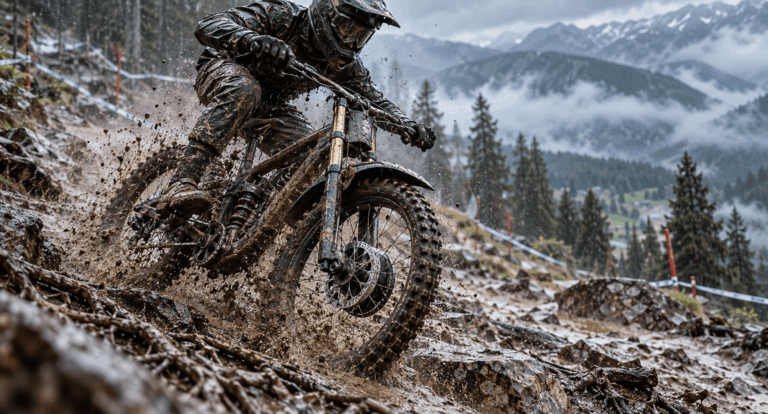
Downhill racing becomes an entirely different sport when rain turns a course into mud, wet roots, slick rocks, and deep ruts. Riders who normally focus on suspension balance and line choice suddenly need to think about mud clearance, tire penetration, braking consistency, visibility, and keeping critical components functioning through a run. In 2026, wet-weather downhill technology is becoming increasingly specialized.
The trend was especially visible during practice for the 2026 Whistler Downhill World Cup, where teams fitted oversized fenders, brake-rotor covers, and full mud-spike tires as persistent rain transformed the course. Pinkbike’s paddock coverage showed how quickly elite teams adapt equipment when conditions change.
Pinkbike’s wet-weather Whistler tech coverage documented full mud tires, large fenders, rotor protection, and other improvised solutions being used during the rain-soaked practice sessions.
Why Wet Downhill Racing Demands Different Equipment
Dry downhill setup is already highly specialized, but rain introduces several additional problems at once. Mud fills tire tread, collects around forks and frames, contaminates drivetrains, reduces visibility, and changes how tires interact with rocks and roots.
The main challenges include:
- Maintaining traction in soft soil
- Clearing mud from tires and frame openings
- Keeping braking predictable
- Preventing spray from blocking vision
- Protecting components during repeated washing
- Adjusting suspension and tire pressure for reduced grip
This makes wet-weather preparation a complete bike-system problem rather than simply a tire swap.
Our Electronic Downhill Drivetrains 2026 guide explains how downhill equipment is already becoming increasingly discipline-specific.
Mud-Spike Tires Become the First Major Decision
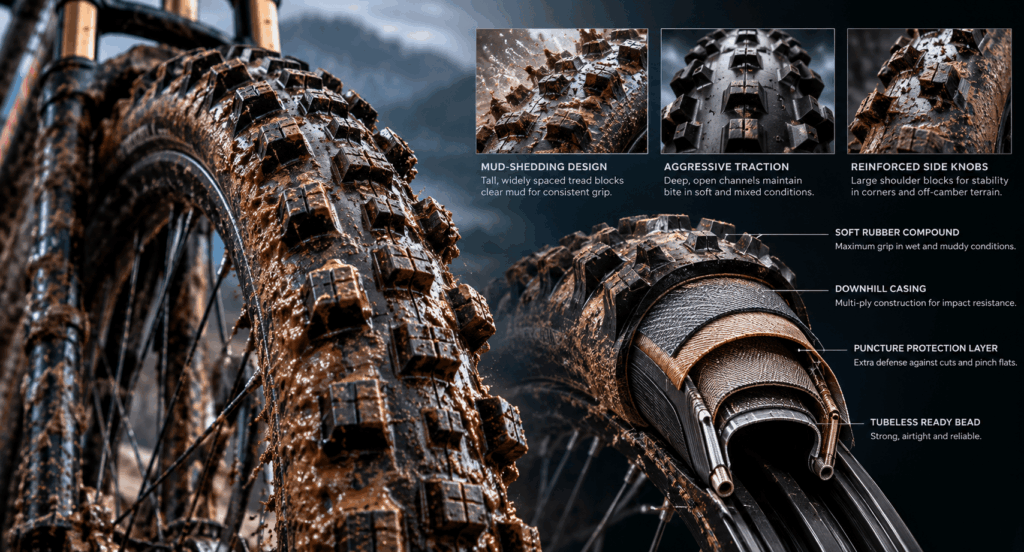
Tires are usually the most visible wet-weather change. A typical dry or intermediate downhill tire uses substantial tread, but a dedicated mud tire takes the design much further.
Mud spikes use tall knobs that can penetrate soft ground and wider gaps that help release mud as the wheel rotates.
Pirelli’s Scorpion Race DH MUD, for example, uses a relatively narrow 2.4-inch profile with deeply carved tread designed for severe mud and rapid self-cleaning.
Schwalbe’s Dirty Dan follows the same basic philosophy with an open tread pattern, large blocks, and wide spaces between knobs to improve mud clearance.
Why Tall Knobs Work in Soft Ground
A normal tire gains grip partly through rubber friction and partly by allowing tread blocks to engage the terrain. In deep mud, the upper surface may be too soft to provide meaningful support.
Tall spikes attempt to reach firmer material below the surface.
The trade-off appears when the course contains hard rock slabs or exposed roots. Tall knobs can deform more than shorter tread blocks, producing a vague or unstable feeling on hard surfaces.
That is exactly why Whistler riders faced a difficult choice. Full spikes offered obvious advantages in soft sections, but the course also contained wet rock and roots where tall tread could feel less predictable.
Mid-Spike Tires Offer a Compromise
Not every wet course requires the most aggressive mud tire available.
The Maxxis Shorty is designed as a more versatile wet and loose-condition tire. Maxxis says its narrower casing and revised knob layout improve mud shedding, wet traction, and cornering while remaining useful beyond pure mud racing.
This creates a practical three-way decision:
- Dry or intermediate tire for mixed hard terrain
- Mid-spike tire for variable wet conditions
- Full mud spike for deep, consistently soft ground
Our Bike Tire Technology and Tread Pattern Innovations 2026 article explains how tread spacing, casing construction, rubber compounds, and tire pressure affect grip.
Race Mechanics May Cut Tire Knobs
World Cup mechanics sometimes modify mud tires rather than accepting the factory tread exactly as supplied.
Schwalbe has documented dedicated MTB tread-cutting tools that allow mechanics to shorten individual knobs. The company notes that riders may retain full-height tread in deep mud but reduce center knobs when a course mixes mud with faster, firmer surfaces.
This is a useful example of how race setup becomes highly condition-specific. Two riders using the same tire model may still run different tread heights.
Large Fenders Are About Vision, Not Just Cleanliness
Fenders on downhill bikes can look oversized compared with normal trail accessories, but their function is critical.
A front wheel rotating through deep mud can throw water and soil directly toward the rider’s face. Goggles help, but heavy spray can quickly cover lenses.
A larger fender attempts to intercept that material before it reaches the rider.
In a race where riders need to identify roots, braking points, ruts, and rock edges at high speed, clearer vision can matter far more than keeping clothing clean.
Brake Rotor Covers Appear in Wet Paddocks
Rotor covers were another noticeable feature during wet Whistler practice. Teams may use protective covers while bikes are being transported, washed, or worked on around the pits.
The goal is to limit accidental contamination from lubricants, cleaners, mud, and other substances before the bike returns to the course.
Rotor protection does not change the brake’s fundamental performance, and covers must not interfere with normal operation while riding. Their value is primarily in paddock preparation and component protection.
Reliable brakes remain especially important on wet courses. Our Bike Brakes Technology and Stopping Power 2026 guide examines modern hydraulic systems, pad compounds, heat management, and downhill braking demands.
Wet Conditions Change Brake Feel
Disc brakes are much more consistent in rain than traditional rim brakes, but water, grit, and mud can still influence performance.
Wet downhill racing may produce:
- Temporary changes in initial bite
- More pad and rotor noise
- Accelerated pad wear
- Contamination risk during washing
- Greater demand for controlled braking on slippery surfaces
Metallic pads are often favored in severe gravity conditions because they can tolerate high temperatures and abrasive environments, although exact pad choice depends on the brake manufacturer and rider preference.
Tire Pressure Becomes Even More Critical
Lowering tire pressure can enlarge the contact patch and help a tire conform to roots and rocks. However, going too low increases the risk of rim strikes, tire instability, and burping in tubeless systems.
Wet race setup therefore involves finding a compromise between grip and support.
A rider may adjust pressure based on:
- Body weight
- Tire casing stiffness
- Wheel size
- Course speed
- Rock exposure
- Insert use
There is no single rain pressure that works for every racer.
Suspension Setup May Change With Grip Levels
When traction decreases, suspension can play a major role in helping the wheels remain connected to uneven ground.
Some riders may look for greater sensitivity and compliance, while others need enough support to prevent excessive chassis movement in deep ruts and compressions.
The latest tunable systems discussed in our Next-Generation Air Shocks 2026 article provide increasingly precise ways to control sensitivity, mid-stroke support, and bottom-out resistance.
Mud Clearance Can Decide Whether a Setup Works
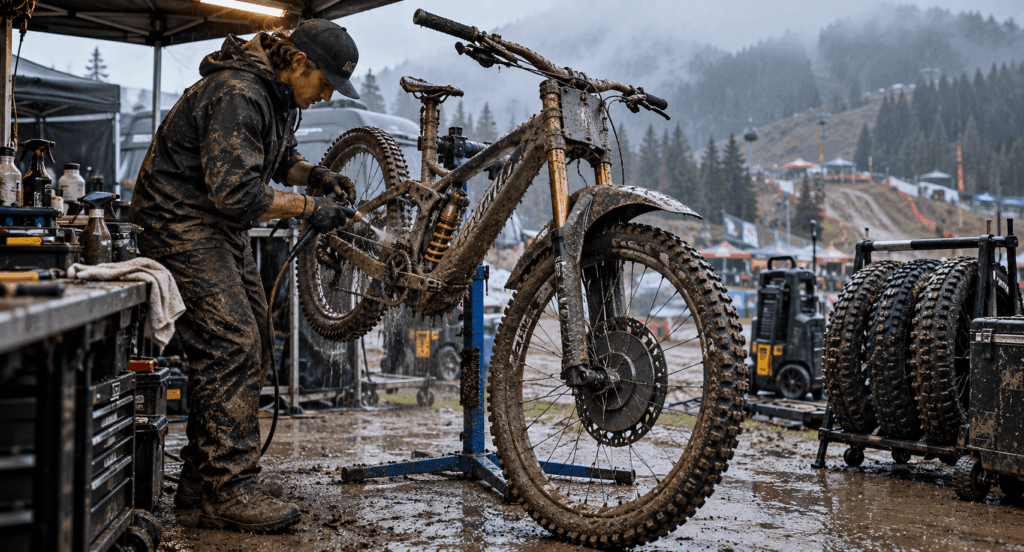
A tire that grips extremely well is not useful if the frame fills with mud and the wheel stops rotating freely.
This explains why dedicated mud tires are often narrower than comparable dry-condition downhill tires. Additional clearance around the fork, stays, and tire can allow mud to escape.
Teams may also examine:
- Fork-arch clearance
- Seatstay and chainstay space
- Fender placement
- Cable routing
- Chain-guide mud accumulation
Wet-weather design therefore extends beyond tread pattern.
Pressure Washing Requires Care
Downhill race bikes may be washed repeatedly during a muddy weekend. That creates another maintenance challenge.
High-pressure water directed at bearing seals, suspension seals, electronics, or pivots can potentially force water and contaminants into places they do not belong.
Teams need to remove mud quickly without treating every sealed component as if it were completely immune to pressure.
The Future of Wet-Weather Downhill Tech
Rain racing will probably remain a combination of sophisticated products and simple mechanical solutions.
Some of the most effective technologies are surprisingly basic: taller tire knobs, larger fenders, rotor protection, careful tire pressure, and meticulous cleaning.
At the same time, modern telemetry may help teams understand how wet conditions change wheel slip, suspension movement, braking, and rider speed through individual track sectors.
Conclusion
Wet-weather downhill tech in 2026 shows how quickly race equipment can change when a course becomes saturated. Mud-spike tires, oversized fenders, rotor covers, modified tread, pressure changes, and suspension adjustments all attempt to solve different parts of the same problem: maintaining control when grip becomes unpredictable.
The setup that works in deep loam may not work on polished rock, which is why rain racing remains as much about judgment as technology.
For riders watching the World Cup pits, the lesson is clear. Wet-weather performance does not come from one magical component. It comes from matching tires, brakes, suspension, protection, and maintenance to the exact conditions on the mountain.