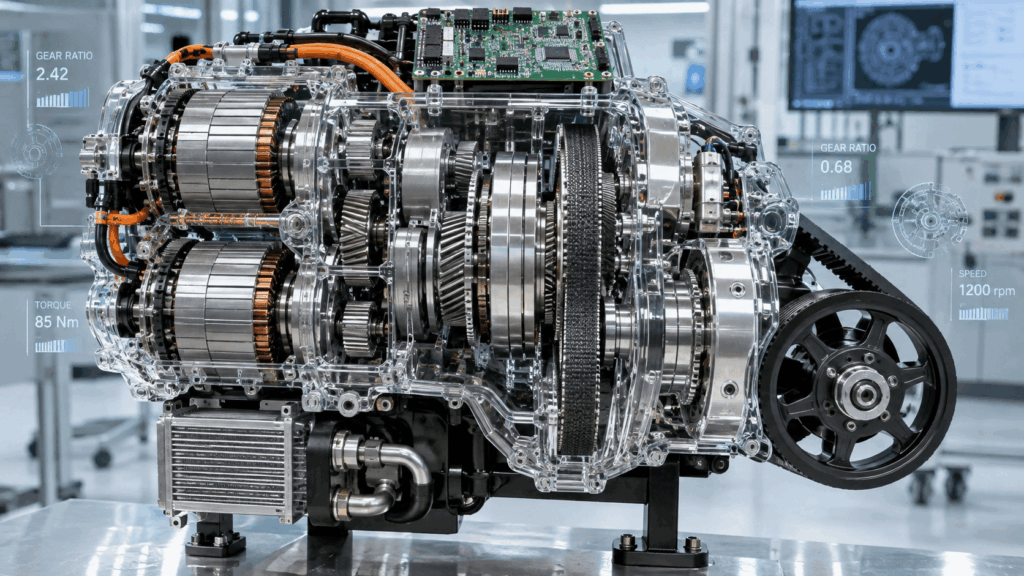
The rear derailleur has defined bicycle shifting for generations, but electric bicycles are creating an opportunity to redesign the drivetrain from the ground up. In 2026, eCVT e-bike drivetrains are emerging as one of the most interesting alternatives by combining electric motors and continuously variable transmissions inside compact central drive units.
Instead of selecting between a fixed number of sprockets, an electronic continuously variable transmission can theoretically move smoothly across a range of gear ratios. When combined with an e-bike motor, software, torque sensing, and automatic cadence control, the system can change gearing continuously while the rider focuses on pedaling and steering.
The trend became particularly visible at Eurobike 2026. BikeRadar highlighted new eCVT systems from Avinox and Gobao as evidence that motor-integrated transmissions could become an important direction for future e-bikes.
What Is an eCVT E-Bike Drivetrain?
CVT stands for continuously variable transmission. Unlike a traditional cassette with clearly separated gears, a CVT can adjust between ratios without requiring conventional stepped shifts.
An eCVT adds electronic control to the process. Sensors and software determine which ratio is appropriate based on conditions such as:
- Pedaling cadence
- Rider torque
- Bike speed
- Gradient
- Motor assistance
- Selected riding mode
The objective is to keep the cyclist in an efficient pedaling range while eliminating many of the mechanical compromises of a conventional derailleur drivetrain.
This represents a logical extension of the electronic shifting evolution discussed in our Electronic Shifting Revolution article.
Why Eurobike 2026 Put eCVT in the Spotlight
Eurobike 2026 brought two particularly notable systems into the discussion.
Avinox showed its MG motor-gearbox concept, which is being developed around a continuously variable drivetrain architecture. Industry reporting describes a gear range comparable with wide-range mountain bike cassettes while eliminating conventional external shifting components.
Gobao also displayed X-series motor-gearbox systems using electronically controlled continuously variable transmission technology.
Both point toward the same idea: instead of attaching a separate motor to a conventional bicycle drivetrain, manufacturers can design the motor and gearing as one integrated system.
How Stepless Gearing Changes the Ride
A conventional drivetrain gives riders discrete choices. Moving from one sprocket to another changes the ratio by a defined amount.
An eCVT can theoretically make much smaller, continuous adjustments.
Imagine climbing a road that gradually becomes steeper. Instead of waiting until cadence drops enough to trigger a conventional shift, the transmission can continuously adjust the ratio to help maintain a target cadence.
The rider may barely notice the gearing changing.
This could make e-bikes especially intuitive for commuters and recreational cyclists who do not want to think constantly about gear selection.
Automatic Cadence Control Could Be the Killer Feature
Cadence describes how quickly a cyclist turns the cranks. Most riders have a range in which pedaling feels efficient and comfortable.
An eCVT can potentially use cadence as a primary control target.
A rider might select 80 revolutions per minute, for example. The transmission could then continuously modify its ratio as gradient, speed, and assistance change.
On a climb, the gearing becomes easier. When the road flattens, the system moves toward a higher ratio. The cyclist continues pedaling at approximately the same rhythm.
This type of automation complements the smart motor technology discussed in our E-Bike Motor Technology and Power Systems 2026 guide.
Why Removing the Rear Derailleur Matters
Rear derailleurs work remarkably well, but they remain exposed to impacts, mud, vegetation, and debris.
This vulnerability becomes particularly noticeable on mountain bikes.
Moving the transmission into a protected central housing can remove or reduce:
- Rear derailleur damage
- Large rear cassettes
- External electronic shifting components
- Complex drivetrain adjustment
- Unsprung drivetrain weight at the rear wheel
Depending on the system, the rear wheel can then be driven using a conventional chain or a low-maintenance belt.
Pinion’s current Motor.Gearbox.Unit demonstrates the broader advantages of centralizing a motor and transmission. Pinion uses a conventional multi-speed gearbox rather than the latest eCVT architecture, but it illustrates why manufacturers are interested in eliminating exposed derailleurs.
eCVT Is Different From Other Motor Gearboxes
Not every integrated motor-and-gearbox system uses continuously variable gearing.
The distinction is important.
Pinion’s MGU integrates a motor with a gearbox offering fixed gear ratios. Its current versions provide electronic shifting with multiple conventional ratios inside the housing.
Valeo’s Cyclee system also combines a central electric motor with an integrated automatic transmission.
eCVT systems take the concept further by attempting to remove the perceptible steps between gears.
Rather than selecting gear 4, 5, or 6, software can select virtually any appropriate ratio within the available range.
Could eCVT Improve Technical E-MTB Riding?
Electric mountain biking may be one of the most interesting applications.
On technical climbs, riders frequently need to manage motor assistance, cadence, traction, and shifting simultaneously. Conventional drivetrains can also be placed under enormous chain tension when a high-power motor and rider apply torque together.
An intelligent eCVT could potentially coordinate gearing with motor output.
The system may gradually reduce the transmission ratio during a steep climb while controlling torque so the rear tire maintains grip.
This is closely connected with the automation trends covered in our E-Mountain Bike Technology and Motor Innovations in 2026 article.
Motor and Transmission Software Can Work Together
Integration is one of eCVT’s strongest theoretical advantages.
A conventional e-bike may use one control system for its motor and another for its electronic derailleur. An integrated motor gearbox allows both functions to be managed by one software architecture.
The controller can potentially consider:
- Motor torque
- Pedaling cadence
- Transmission ratio
- Battery condition
- Rider input
- Terrain data
and adjust the complete drivetrain as one system.
This fits directly into the trend described in our Software-Defined Bicycles 2026 article, where firmware increasingly controls the character of bicycle hardware.
Could eCVT Reduce Maintenance?
One of the biggest selling points for integrated transmissions is protection from dirt and physical damage.
Traditional chains, cassettes, and derailleurs can require frequent cleaning and adjustment, particularly on e-MTBs ridden through mud and dust.
A sealed central transmission can isolate critical gears from the environment.
Pinion emphasizes this protected drivetrain approach in its current e-bike systems, pairing central gearing with belt-drive options that can reduce routine external drivetrain maintenance.
Whether future eCVT units achieve similar durability will depend on design quality, sealing, software reliability, service procedures, and replacement-part availability.
There Are Trade-Offs
Integrating a motor, transmission, electronics, sensors, and cooling system into one unit introduces complexity.
Possible disadvantages include:
- Higher drive-unit weight
- Greater manufacturing complexity
- More expensive repairs
- Dependence on proprietary electronics
- Specialized servicing requirements
A derailleur can often be replaced independently. With an integrated system, a problem inside the drive unit may require specialist diagnostics.
Weight also matters. High-performance mountain bikes benefit from centralized mass, but riders still care about total bike weight.
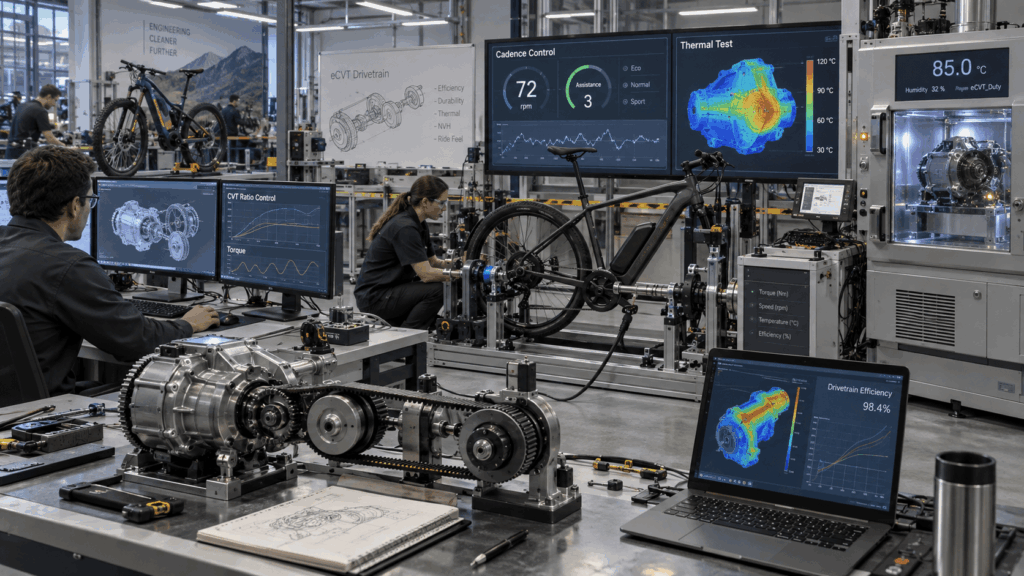
Efficiency Will Be Closely Watched
A conventional chain drivetrain can be extremely efficient when clean and correctly aligned.
An eCVT introduces additional conversion stages, electric motors, gears, and electronic control. Engineers therefore need to ensure that the advantages of automatic gearing are not undermined by excessive energy losses.
For an e-bike, even small drivetrain efficiency differences can influence battery range.
Future systems will likely need to balance:
- Transmission efficiency
- Motor efficiency
- Cooling
- Gear range
- Weight
- Battery consumption
eCVT Could Change Bicycle Design
Removing the rear derailleur and large cassette gives bicycle engineers more freedom.
The rear suspension no longer needs to be designed around a conventional derailleur’s movement and chain path in the same way. Rear-wheel mass can change, chain growth may become easier to manage, and frame designers can create cleaner layouts.
Pinkbike identified integrated eCVT systems as one of the major technical themes from Eurobike 2026, highlighting how motor and drivetrain integration could influence future e-MTB architecture.
Who Could Benefit Most?
E-Mountain Bikers
Protected gearing, automatic cadence control, and fewer vulnerable rear-wheel components could be valuable on technical trails.
Urban Commuters
Automatic stepless gearing could make e-bikes easier to operate in stop-and-go traffic.
Cargo Bike Riders
Heavy loads create high drivetrain forces. An integrated automatic transmission could simplify starts and climbing.
Touring Riders
Reduced external maintenance and automatic gear selection could appeal to long-distance riders.
Will eCVT Replace the Derailleur?
Not immediately.
Modern derailleur systems are light, efficient, relatively affordable, widely serviceable, and supported by an enormous global parts ecosystem.
eCVT systems must prove that their convenience, protection, automatic operation, and integration justify additional complexity and cost.
The most likely near-term adoption may come from premium e-MTBs, commuter bikes, cargo bikes, and high-end trekking machines where electric assistance already reduces sensitivity to small weight penalties.
Conclusion
eCVT e-bike drivetrains in 2026 represent a potentially important shift in how electric bicycles manage both propulsion and gearing.
Instead of treating the motor and transmission as separate systems, manufacturers are beginning to combine them into intelligent central drive units capable of continuously adapting the gear ratio.
For riders, that could mean fewer manual shifts, more consistent cadence, a cleaner rear wheel, less exposed hardware, and drivetrain behavior that automatically adapts to terrain.
The derailleur is unlikely to disappear anytime soon. But Eurobike 2026 showed that manufacturers are seriously investigating another future — one where an electric bicycle quietly selects exactly the ratio it needs without the rider ever feeling a conventional gear change.