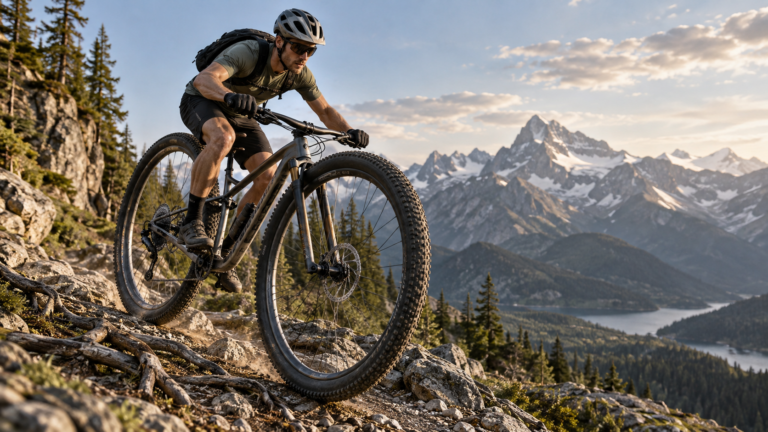
Bicycle wheel standards rarely change without debate. The transition from 26-inch mountain bike wheels to 27.5-inch and 29-inch formats reshaped off-road cycling, and in 2026 another size is attracting serious attention. 32-inch bike wheels are appearing on cross-country race concepts, gravel bikes, custom builds, prototype suspension forks, production-ready wheelsets, and an expanding selection of tires.
The idea is straightforward: increasing wheel diameter changes how a bicycle interacts with obstacles. A larger wheel approaches rocks, roots, potholes, and washboard at a shallower angle, potentially allowing it to maintain momentum more effectively. But bigger wheels also create challenges involving weight, acceleration, frame geometry, rider fit, component compatibility, and handling.
The result is one of the most interesting cycling technology debates of 2026: could 32-inch wheels become the next major off-road standard, or will they remain a specialized option for certain riders and terrain?
Why 32-Inch Bike Wheels Are Trending in 2026
The 32-inch discussion has accelerated significantly this year. Eurobike highlighted 32-inch wheels as an emerging gravel and mountain bike trend, noting prototypes, competitive testing, and development activity from wheel and tire manufacturers.
The trend is also becoming more visible through major bicycle brands. Canyon introduced the Lux Era cross-country concept with 32-inch wheels, an inverted fork, aerodynamic frame development, and a multi-position cockpit.
Meanwhile, builders and component manufacturers are increasingly treating 32 inches as more than an experimental exercise. That growing ecosystem is important because a wheel standard cannot succeed without compatible rims, tires, forks, frames, and replacement components.
What Makes a 32-Inch Wheel Different?
The main difference is diameter. Compared with a 29-inch wheel, a 32-inch wheel presents a larger circle to the terrain.
That changes several characteristics:
- The angle at which the wheel meets an obstacle
- The length and shape of the tire contact patch
- Rotational mass and inertia
- Bike geometry requirements
- Overall wheelbase and front-end dimensions
Many of these principles are already familiar from the move toward 29-inch mountain bike wheels. A larger diameter can make irregular terrain feel smoother because the wheel does not drop as deeply into small depressions or strike obstacles at as abrupt an angle.
This development fits closely with the broader changes discussed in our Bike Suspension Technology and Geometry 2026 guide, where wheel size, suspension, and frame geometry increasingly work as one integrated system.
The Rollover Advantage
Rollover is one of the strongest arguments for increasing wheel diameter.
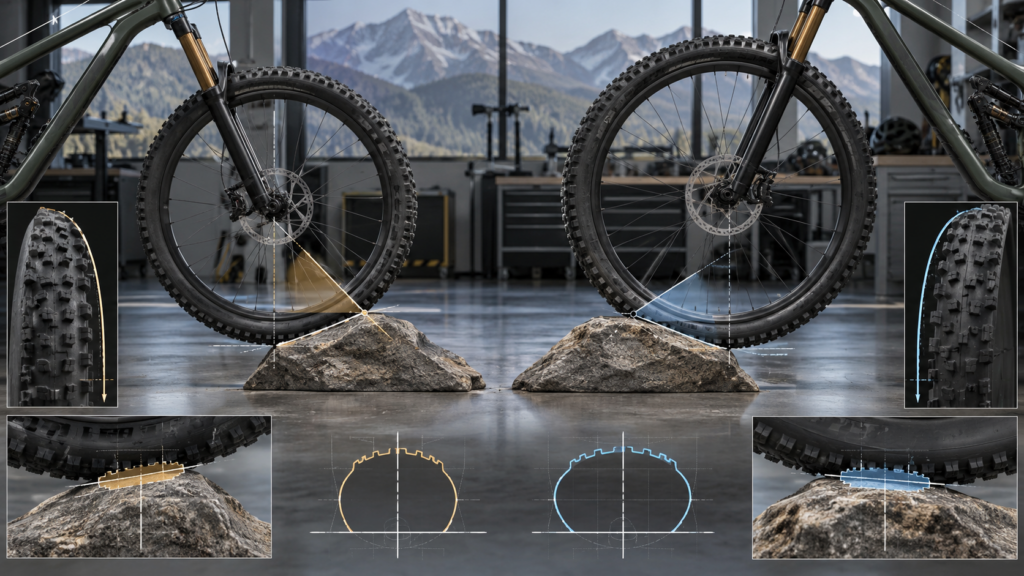
When a wheel reaches a rock or root, the axle needs to move upward and forward to pass over it. A larger wheel generally meets the same obstacle at a shallower approach angle. In practical terms, the obstacle represents a smaller interruption relative to the wheel’s diameter.
Eurobike specifically identified a flatter rollover angle as one of the physical factors driving interest in 32-inch wheels.
Potential advantages can include:
- Smoother passage over rocks and roots
- Better momentum through rough surfaces
- Reduced tendency to hang up on square-edged obstacles
- Greater comfort over repeated trail irregularities
These characteristics may be especially attractive in modern cross-country racing, where courses increasingly combine high average speeds with technical terrain.
Traction and the Larger Contact Patch
Larger wheels may also change how the tire interacts with the ground. Supporters of the format point to a longer contact patch that may improve traction under certain conditions.
That could matter when climbing loose gravel, accelerating across rough ground, or maintaining control through uneven sections.
However, wheel diameter is only one part of traction. Tire width, casing construction, rubber compound, tread pattern, rim width, inflation pressure, rider weight, and terrain can all influence grip.
That is why 32-inch wheels should not automatically be treated as more capable in every situation. Their potential advantages depend on the complete wheel-and-tire system.
32-Inch Wheels Enter Cross-Country Racing
Cross-country mountain biking may be one of the strongest applications for larger wheels because modern XC racing increasingly rewards momentum and efficiency.
Canyon says its Lux Era concept uses 32-inch wheels because the larger diameter can roll over obstacles more easily, maintain speed, increase traction, and improve comfort.
The design is notable because Canyon did not simply install larger wheels into a conventional XC frame. The company reconsidered the bicycle’s cockpit, fork, aerodynamics, and overall layout around the demands of faster racing.
That illustrates an important point: if 32-inch wheels become successful, bikes will likely need to be designed around them rather than simply modified to accommodate them.
Why Gravel Bikes Could Be an Ideal Application
Gravel cycling may prove equally important. Fast gravel racing often includes washboard, potholes, loose stones, ruts, and long stretches where maintaining momentum is valuable.
At Sea Otter 2026, industry coverage showed growing interest in 32-inch gravel platforms. Bikerumor documented several 32-inch gravel developments and noted that the format may suit gravel particularly well because designers do not necessarily need to package long-travel suspension around the larger wheel.
This trend complements the changes already explored in our 2026 Gravel Bike Trends and Technology Innovations article, where wider tires, progressive geometry, suspension, and increasingly specialized race designs are already reshaping the category.
The Geometry Challenge
Simply increasing wheel diameter creates packaging problems.
The larger radius raises the axle relative to the bicycle’s surrounding structure. Designers need to consider fork length, head tube height, bottom bracket position, toe clearance, wheelbase, chainstay dimensions, and handlebar height.
If the front end becomes too tall, riders may struggle to achieve the position they want. This could be particularly noticeable for shorter riders.
Some experimental bikes have used unusually negative-rise stems or redesigned front ends to compensate. As Singletracks reported while examining the developing 32-inch component market, fit and front-end packaging are among the challenges manufacturers are currently working through.
Our Bike Fit and Geometry Optimization for Performance 2026 guide provides additional context on why stack, reach, wheelbase, and rider proportions matter when changing bicycle dimensions.
Are 32-Inch Wheels Better for Tall Riders?
Taller riders are an interesting use case because their frames already require larger dimensions.
In September 2026, Canyon revealed a custom 32-inch-wheel Grizl CF built for LeBron James, who is 6 feet 9 inches tall. Canyon engineered the 3XL gravel bike around his dimensions rather than simply enlarging an existing production frame.
That does not mean 32-inch wheels are only appropriate for unusually tall riders. However, larger riders may face fewer geometry compromises because their frames naturally provide more room for the bigger wheels.
For shorter cyclists, designers may need more creative solutions to maintain appropriate stand-over height, cockpit position, and handling.
Weight and Acceleration Remain Important Trade-Offs
A larger wheel normally requires more material in the rim, tire, and spokes. That can increase weight, particularly at the outside of the rotating assembly.
Additional rotational mass can influence acceleration. Riders repeatedly sprinting out of corners may notice that a heavier wheel requires more energy to accelerate than a lighter equivalent.
This creates a classic engineering trade-off:
- Smaller wheels may accelerate and change direction more readily.
- Larger wheels may preserve momentum better and roll through irregular terrain more smoothly.
The best choice therefore depends on the course, rider, wheel construction, tire selection, and riding style.
Component Availability Is Improving
One of the biggest barriers to any new wheel standard is ecosystem support.
Earlier 32-inch builders faced limited choices for tires, rims, and forks. That situation is changing quickly. Singletracks reported numerous 32-inch tire developments at Sea Otter 2026, including products or prototypes associated with several established tire brands.
Wheel availability is also becoming more concrete. In August, Industry Nine officially introduced its Hush 32-inch carbon XC and trail wheels, moving at least part of the market from prototypes toward purchasable equipment.
That is significant because riders are much more likely to adopt a new wheel size when replacement tires, rims, wheels, and service parts are readily available.
Could 32 Inches Replace 29 Inches?
There is not enough evidence yet to declare 32 inches the next universal standard.
Pinkbike’s 2026 survey of industry insiders showed substantial interest but also uncertainty among manufacturers. The bicycle industry remembers how long it took 29-inch wheels to develop broad component support, geometry refinement, and rider acceptance.
Thirty-two-inch wheels may eventually follow several possible paths. They could become common in XC racing, remain concentrated in gravel and tall-rider applications, develop into a specialist niche, or eventually become mainstream across several off-road categories.
Who Might Benefit Most From 32-Inch Wheels?
Cross-Country Racers
Riders competing on fast, rough courses may value momentum retention and smoother obstacle rollover.
Gravel Racers
Long races featuring washboard, rocks, and sustained high speeds could reward the ability of larger wheels to carry momentum through irregular terrain.
Tall Riders
Larger frames may integrate 32-inch wheels more naturally while providing proportions that better match taller cyclists.
Adventure Riders
Riders prioritizing comfort and stability over rapid acceleration could also find the format interesting as component availability improves.
The Future of 32-Inch Bike Wheels
The next year or two will likely determine whether 32-inch wheels transition from an industry experiment into a meaningful market category.
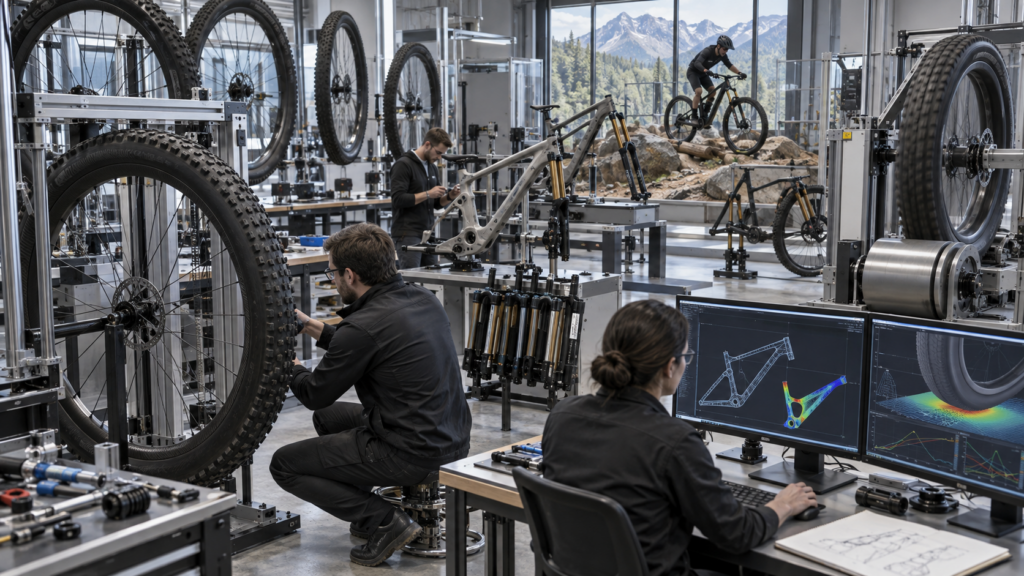
Manufacturers still need to solve questions around weight, geometry, suspension compatibility, tire selection, frame sizing, and handling. At the same time, the ecosystem is advancing quickly enough that the technology can now be tested on purpose-built bicycles rather than theoretical prototypes alone.
The emergence of commercial wheels, more tire options, new forks, gravel race bikes, XC concepts, and custom production-quality builds suggests the industry is taking the idea seriously.
Conclusion
32-inch bike wheels in 2026 represent one of cycling’s most interesting equipment experiments. Their larger diameter offers credible advantages in rollover characteristics, momentum, traction, and comfort, particularly across rough gravel and cross-country terrain.
Those benefits come with real compromises. Larger wheels can add weight, complicate frame geometry, reduce fit options for some riders, and require an entirely new component ecosystem.
For now, 29-inch and 700c wheels remain firmly established. But 32-inch wheels have moved far enough beyond prototypes that they can no longer be dismissed as a novelty. Whether they become the next dominant standard or a specialized performance option will depend on what riders, racers, engineers, and manufacturers discover as more bikes reach real trails and gravel roads.