Electric bicycles have transformed commuting, recreation, and urban mobility, but one challenge continues to shape the riding experience: keeping the battery charged. In 2026, solar e-bikes are pushing that conversation in a new direction by combining photovoltaic technology, intelligent energy management, and increasingly creative ways to integrate solar panels directly into the bicycle.
Instead of treating solar power as a separate charging accessory, some new designs aim to make energy harvesting part of the bike itself. Wheel-integrated photovoltaic panels, maximum power point tracking controllers, smart batteries, and connected range prediction systems are creating a glimpse of what self-charging electric cycling could eventually look like.
The idea is still developing, and solar energy will not eliminate conventional charging for most riders. However, recent prototypes, commercial projects, and academic research suggest that sunlight could become a useful supplementary energy source for future e-bikes.
Why Solar E-Bikes Are Gaining Attention in 2026
Traditional e-bikes depend almost entirely on electricity supplied through wall chargers. Riders typically charge the battery at home, work, or dedicated charging stations.
Solar-assisted systems introduce another source of energy. Depending on the design, photovoltaic cells can generate electricity while the bicycle is parked, moving, or both.
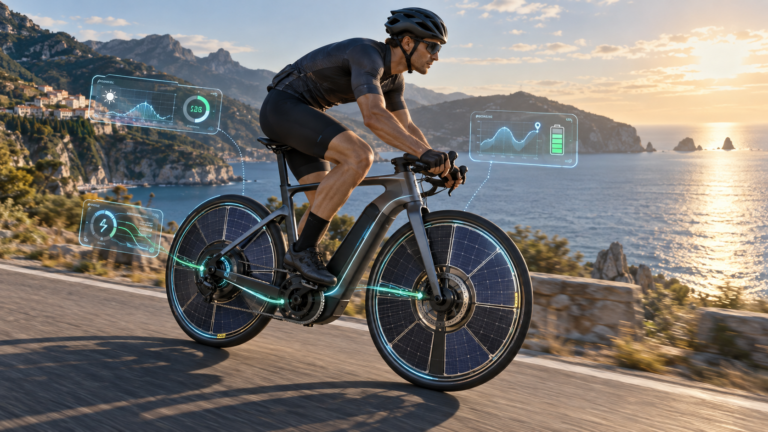
A particularly interesting 2026 development comes from Phosgo’s solar e-bike technology. The company says it has developed photovoltaic panels specifically for integration into bicycle wheels rather than using conventional rectangular solar panels mounted on external frames.
The concept differs from earlier solar bicycles that often relied on large panels mounted above or behind the rider.
This technology connects naturally with our guide to Smart E-Bike Energy Ecosystems 2026, where intelligent batteries, predictive range calculations, and connected power management are already changing how riders think about energy.
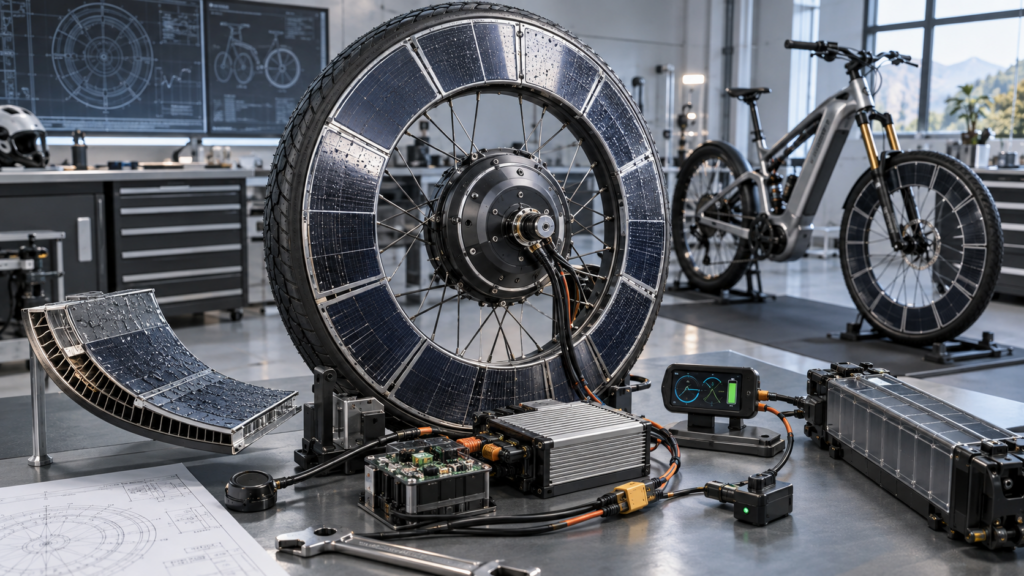
How Wheel-Integrated Solar Charging Works
Solar panels traditionally need a relatively large flat surface. Bicycle wheels present an engineering challenge because they are circular, lightweight, exposed to vibration, and constantly rotating.
Phosgo says its approach places specially shaped photovoltaic cells within the wheel structure. According to the company’s technical overview, the system uses waterproof encapsulation, wear-resistant materials, and a specialized mounting design intended to secure the panels inside the wheel.
The design also requires a way to move electricity from a rotating wheel into the stationary electrical system of the bicycle.
Phosgo describes a conductive hub architecture designed to transfer electrical energy without conventional wires twisting around the wheel. Because this information comes from the manufacturer, real-world durability and long-term performance should ultimately be evaluated through independent testing.
Charging While Riding and While Parked
One of the most interesting possibilities is dual-mode solar energy management.
According to the manufacturer, its system can route solar energy toward supporting the motor while the bicycle is moving and redirect available solar power toward battery charging while the bike is parked.
This means solar power does not necessarily need to replace the battery charger. Instead, it can reduce how quickly stored battery energy is consumed or gradually restore some charge during periods of sunlight.
The current Phosgo crowdfunding FAQ also cautions that actual solar generation varies with sunlight, weather, panel angle, and other conditions.
That limitation is important. Solar e-bikes should be viewed as energy-assisted electric bicycles rather than machines offering unlimited free range.
Why MPPT Technology Matters
Sunlight is constantly changing. Clouds, buildings, trees, riding direction, and panel orientation can all affect photovoltaic output.
Maximum power point tracking, commonly called MPPT, helps a solar charging system extract useful power as conditions change.
A 2025 Journal of Power Sources study on solar-powered electric vehicles found that MPPT strategy can significantly influence the amount of solar electrical energy captured and the resulting range benefit.
For bicycles, compact and efficient MPPT control is especially important because available panel area is limited compared with automobiles or stationary solar installations.
What Research Says About Solar E-Bike Range
Real-world solar contribution depends heavily on system design and environmental conditions, so there is no universal number for additional range.
However, experimental research suggests that useful gains are possible.
A Transportation Research Part D study of solar electric bicycles reported that its experimental solar e-bike gained 20.5 kilometers of endurance during a sunny-day test. The researchers also modeled how environmental factors, vehicle design, and daily electricity consumption influence annual performance.
A separate 2026 Energy Science & Engineering study evaluated a photovoltaic-fed electric bicycle for campus transportation. Its prototype used solar panels, an MPPT controller, and a lithium-ion battery as part of a broader assessment of practical electric mobility.
These studies do not mean every solar bicycle will achieve the same results. Panel size, battery capacity, route, weather, rider weight, motor efficiency, and sunlight exposure can produce very different outcomes.
Smart Range Prediction Becomes Even More Important
Adding solar generation makes traditional battery range calculations more complicated.
A normal e-bike range estimate might consider:
- Battery charge
- Motor assistance level
- Elevation
- Rider effort
- Speed
A solar e-bike may eventually add:
- Current sunlight intensity
- Solar generation rate
- Weather forecast
- Expected parking duration
- Panel orientation
- Predicted route exposure
An intelligent energy platform could then calculate whether the rider is likely to gain meaningful charge during a stop or conserve enough energy to extend a planned journey.
This is where the predictive systems discussed in Smart E-Bike Energy Ecosystems 2026 could become especially useful.
Solar Power and E-Bike Motor Efficiency
Energy harvesting is only one side of the equation. Using electricity efficiently is equally important.
Modern motors, torque sensors, and battery controllers can reduce unnecessary power consumption by providing assistance only when the rider needs it.
Our article on E-Bike Motor Technology and Power Systems 2026 explores how torque sensing, integrated batteries, smart connectivity, and advanced motor management are improving electric bicycle efficiency.
A future solar e-bike could combine efficient motor assistance with solar harvesting. Even modest photovoltaic output becomes more valuable when the bike minimizes unnecessary energy use.
Could Solar Charging Help Bikepacking?
Long-distance touring and bikepacking are obvious applications for solar-assisted cycling.
Travelers may spend hours away from electrical outlets, particularly on rural routes. A bicycle capable of collecting energy during riding and rest periods could reduce dependence on conventional charging infrastructure.
Solar charging could also be useful during:
- Extended lunch stops
- Camping
- Remote touring
- Outdoor work shifts
- Daily parking in sunny locations
The actual benefit would depend heavily on climate and solar exposure. Riders traveling through cloudy regions or shaded forests should expect much less generation than those riding through consistently sunny environments.
The Challenge of Weight and Aerodynamics
Solar integration is not free from engineering compromises.
Photovoltaic cells, mounting structures, wiring, controllers, and specialized hubs can add weight. Wheel-mounted panels can also influence rotating mass and potentially affect crosswind behavior or aerodynamic drag.
Manufacturers therefore need to balance:
- Solar panel area
- Energy output
- Wheel weight
- Durability
- Aerodynamics
- Handling
These trade-offs may determine whether integrated solar wheels become common or remain a specialist solution.
Sustainability Is More Than Solar Charging
Solar electricity can reduce reliance on grid charging, but a sustainable e-bike also depends on manufacturing, battery lifespan, repairability, and component recycling.
This broader lifecycle perspective is covered in our Sustainable Smart Bicycles 2026 guide.
A genuinely sustainable solar e-bike would ideally combine renewable charging with long-lasting batteries, repairable electronics, recyclable materials, and efficient manufacturing.
Software Will Help Manage Solar Energy
Modern e-bikes increasingly rely on software to coordinate batteries, motors, sensors, and displays.
Solar-assisted bikes could use software to decide when harvested energy should:
- Support the motor
- Recharge the battery
- Protect battery health
- Reserve energy for later
- Update the rider’s range estimate
This reinforces the trend explored in Software-Defined Bicycles 2026, where firmware and connected services increasingly determine how bicycle hardware behaves.
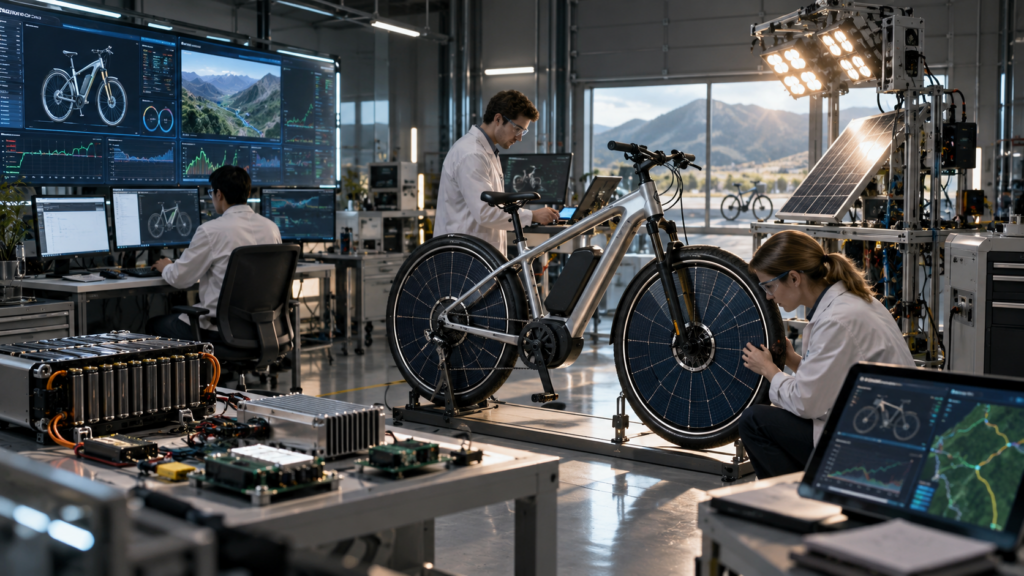
What Comes Next for Solar E-Bikes?
Future solar bicycles could benefit from lighter photovoltaic materials, improved solar-cell efficiency, better battery chemistry, smarter power electronics, and more accurate energy forecasting.
Research into lightweight solar-assisted mobility is also expanding beyond bicycles. A 2026 Scientific Reports study examined integrated solar PV energy management for a lightweight electric trike, demonstrating how renewable generation, batteries, energy storage, and adaptive motor control can work together.
Future bicycles may follow the same broader direction: not simply adding solar panels, but creating intelligent energy systems that constantly balance generation, storage, and motor demand.
Conclusion
Solar e-bikes in 2026 are moving beyond experimental rooftop panels toward more integrated concepts such as photovoltaic wheels, conductive hubs, MPPT energy management, smart batteries, and connected range prediction.
Solar charging is unlikely to eliminate conventional e-bike charging in the near future. Available sunlight, limited bicycle surface area, added hardware, weather, and energy demand all place practical limits on how much electricity a bike can generate.
But that does not make the technology insignificant. Even supplementary energy can extend range, reduce charging frequency, or improve independence during long rides.
The most interesting future may therefore be neither a conventional e-bike nor a completely self-powered solar bicycle. It may be an intelligent electric bicycle that continuously combines rider effort, battery power, efficient motor assistance, and whatever renewable energy is available along the way.