Electric bicycle motors are becoming much better at understanding what is happening around the rider. For years, most pedal-assist systems primarily responded to relatively straightforward signals such as cadence, speed, and pedal torque. In 2026, a new generation of rider-intent e-bike motors is expanding that model by incorporating inertial sensing, bike-position data, terrain recognition, and increasingly sophisticated control software.
The goal is not simply to make motors more powerful. It is to make assistance feel more appropriate to the situation. A smart drive system can potentially recognize that the bike is climbing, leaning into a corner, starting on a steep hill, crossing rough terrain, or suddenly decelerating and then adjust motor behavior accordingly.
One of the most recent examples arrived at Taichung Bike Week in September 2026, where VINKA introduced its X150 mid-drive system with a 9-axis MEMS sensing architecture designed to monitor bike posture, riding dynamics, environmental conditions, and what the manufacturer describes as rider intent.
Why E-Bike Motors Need More Than Pedal Sensors
Traditional pedal-assist technology usually depends heavily on several familiar inputs. A speed sensor determines how fast the bicycle is moving, a cadence sensor measures how quickly the rider is pedaling, and a torque sensor estimates how much force is being applied to the pedals.
These measurements remain extremely important. Bosch’s current Performance Line CX, for example, combines torque and cadence sensing with inertial measurement units that monitor bicycle acceleration and movement.
However, pedal input alone does not describe everything happening during a ride.
A cyclist may apply similar pedal pressure while:
- Starting on a steep incline
- Riding across loose gravel
- Leaning through a technical corner
- Climbing over rocks and roots
- Accelerating on smooth pavement
The rider’s effort may appear similar to a conventional sensor, but the bicycle’s physical situation is very different. That is where additional motion sensing becomes useful.
This development builds on concepts already covered in our E-Bike Motor Technology and Power Systems 2026 guide, where torque sensing and smarter motor management are already reshaping pedal assistance.
What Is a 9-Axis MEMS Sensor?
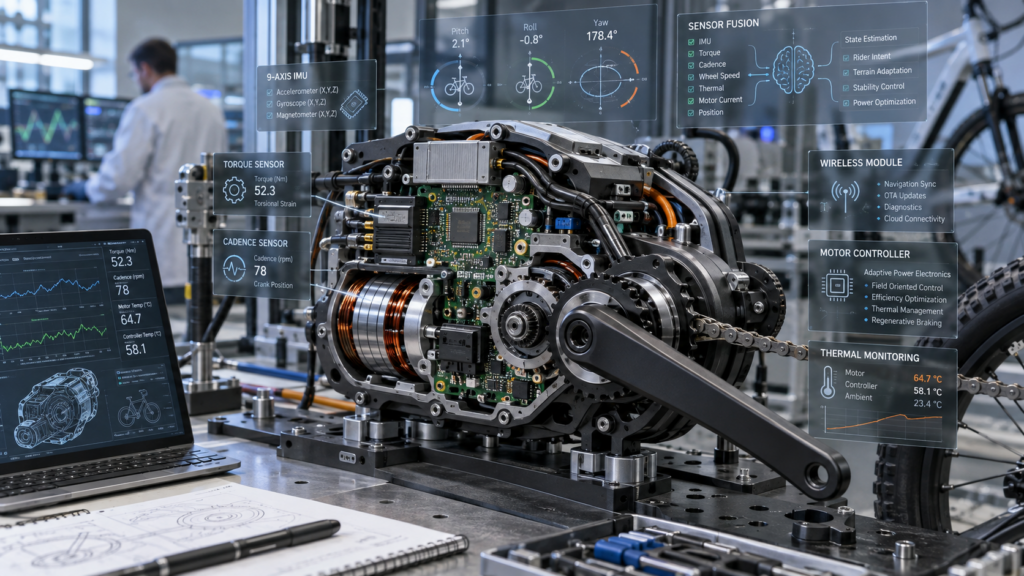
A 9-axis sensing system typically combines multiple motion-sensing elements to create a detailed picture of movement and orientation.
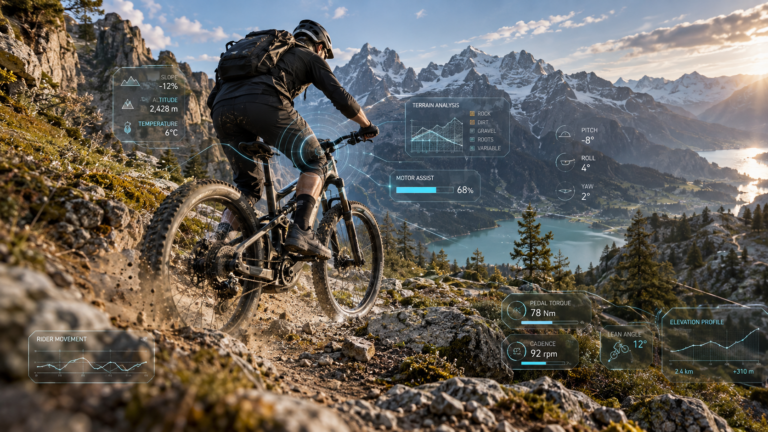
In an e-bike application, an inertial measurement system can help interpret:
- Pitch — whether the bike is pointing upward or downward
- Roll — how far the bicycle is leaning from side to side
- Yaw — directional rotation around the vertical axis
- Acceleration and sudden movement changes
- Bike posture during technical riding
VINKA says its X150 system uses a high-precision MEMS inertial measurement unit and a Madgwick-based control algorithm to determine the bike’s three-dimensional posture and combine that information with other riding data.
The significance is not the number of sensors by itself. The larger change is sensor fusion — combining several measurements so the motor understands the riding situation rather than reacting to one input in isolation.
From Rider Input to Rider Intent
Rider-intent technology attempts to answer a more complicated question than traditional pedal assistance: what is the cyclist trying to do?
Imagine a rider approaching a steep climb. The system may detect increasing pedal torque, declining speed, an upward pitch angle, and a change in cadence. Taken together, those signals strongly suggest climbing effort.
The motor controller can then respond differently than it would on flat ground.
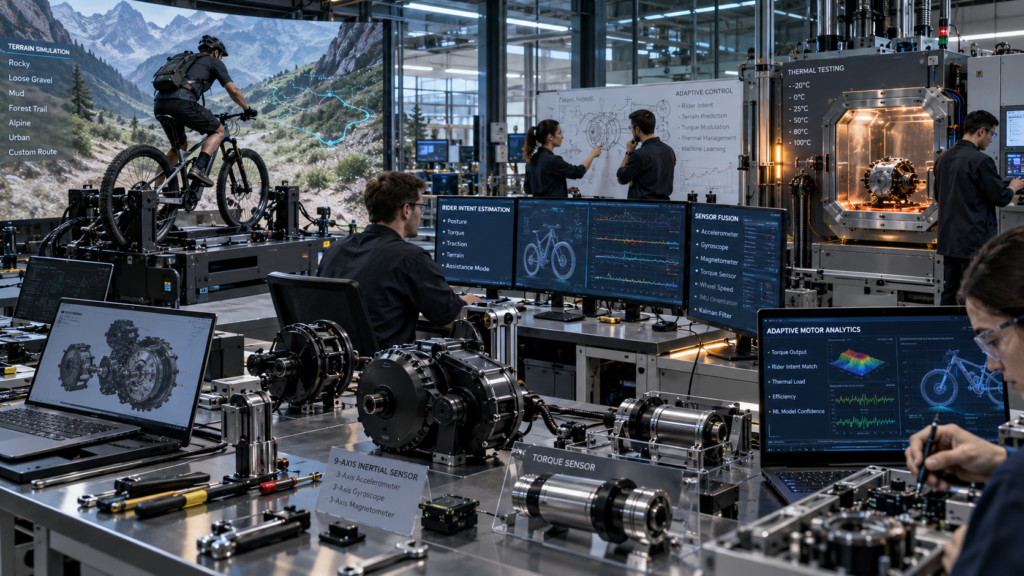
According to the Taichung Bike Week presentation, VINKA’s system is designed to recognize scenarios including climbs, descents, rough terrain, hill starts, and changing lean angles. Manufacturer-described functions include slope-adaptive assistance, hill-start anti-roll behavior, tip-over power cut-off, and filtering intended to reduce unwanted assistance over rough surfaces.
These are manufacturer claims rather than independent performance test results, but they illustrate the direction in which intelligent drive systems are moving.
Adaptive Power Delivery on Climbs
Climbing is one of the clearest situations where rider-intent sensing may improve the experience.
A conventional motor can already respond strongly when a cyclist pushes harder on the pedals. A more context-aware system may additionally recognize the slope and bicycle posture.
That could allow assistance to become smoother during:
- Steep hill starts
- Long technical climbs
- Sudden changes in gradient
- Low-speed high-torque riding
The objective is not necessarily maximum assistance. In many situations, controlled torque delivery may be more useful than simply adding power.
Too much rear-wheel torque on loose terrain can reduce traction, while an abrupt surge on a steep technical climb can affect bike handling. Intelligent control systems therefore need to balance responsiveness with stability.
Terrain Awareness Could Improve Traction
Sensor-rich motors can also interpret how the bicycle is moving across uneven surfaces.
VINKA describes its system as capable of identifying rough terrain and dynamically changing torque thresholds to help limit situations such as rear-wheel slip or unwanted front-wheel lift.
This concept has obvious applications in e-mountain biking, where motor behavior needs to work with constantly changing traction.
A future system could combine:
- Pedal torque
- Wheel speed
- Bike pitch
- Lean angle
- Suspension movement
- Surface vibration
The result could be assistance that changes continuously instead of operating as a fixed percentage determined solely by the selected mode.
That direction also connects with our article on AI Bicycle Personalization 2026, which explores how connected bikes can adapt motor assistance and other settings around individual riders.
Automatic Shifting Shows Where Integration Is Heading
Smarter motor control becomes even more interesting when it connects with the drivetrain.
Shimano’s AUTO SHIFT system already analyzes cadence, torque, and speed to select gears automatically on compatible e-bikes. The system demonstrates how sensors, motor electronics, and electronic shifting can operate together rather than as independent components.
Shimano’s EP801 platform can also work with FREE SHIFT and AUTO SHIFT, allowing compatible drivetrains to change gears while pedaling or, in some configurations, while coasting.
The logical next step is deeper integration between motion sensing and drivetrain decisions.
A future bike might detect that a steep climb is approaching, recognize the rider’s cadence is falling, select an appropriate gear, and modify motor torque before the cyclist manually requests either change.
Smart Motors Could Communicate With Other Components
Rider-intent sensing becomes more powerful when the motor is part of a larger connected bicycle.
A future control system could potentially share information with:
- Electronic drivetrains
- Adaptive suspension
- Smart displays
- Battery management systems
- Navigation platforms
- Safety sensors
This is closely related to the ideas in our Software-Defined Bicycles 2026 article. As bicycles become software-controlled platforms, manufacturers can coordinate multiple components through firmware instead of treating each electronic part as an isolated device.
Rider Intent Could Improve Battery Efficiency
More intelligent assistance may also help manage energy.
A motor that understands terrain and rider behavior may be able to avoid unnecessarily aggressive power delivery when conditions do not require it.
For example, assistance could potentially be reduced on easy rolling terrain and increased more precisely during difficult climbs rather than using a relatively static support level throughout the ride.
This matters because battery range depends on far more than battery capacity. Motor efficiency, terrain, rider effort, speed, temperature, and assistance strategy all affect energy use.
Our Smart E-Bike Energy Ecosystems 2026 guide explores how predictive range calculations and connected battery management can work with adaptive motor control to improve overall efficiency.
Smarter Does Not Mean Fully Autonomous
The phrase “rider intent” can make these systems sound more autonomous than they currently are.
Modern e-bike motors are still fundamentally rider-assistance systems. Sensors interpret movement and pedal input so software can make better decisions about assistance, but the cyclist remains responsible for controlling the bicycle.
This distinction is important because road regulations also vary by jurisdiction. Motor power, assistance speed limits, throttle functionality, and vehicle classifications differ between markets.
The VINKA X150 announcement describes a system designed around 36V/48V and 250W standards while also publishing significantly higher peak-performance figures. How a finished bicycle is configured and legally classified will depend on the market, software limits, manufacturer specification, and applicable regulations.
Firmware Could Change Motor Behavior After Purchase
Another major change is that motor performance is increasingly influenced by software.
Shimano has already demonstrated this with updates to its EP801 platform. Its race-focused EP801 firmware update modified assistance behavior and AUTO SHIFT responses based on development work in e-enduro racing.
That means the physical motor does not necessarily define the bicycle’s behavior permanently.
Manufacturers can potentially refine:
- Torque response
- Sensor interpretation
- Assist curves
- Automatic shifting logic
- Thermal management
- Terrain-specific behavior
through future software releases.
What Rider-Intent Motors Could Mean for Different Cyclists
E-Mountain Bike Riders
Trail riders may gain the most obvious benefits from terrain-aware assistance because grip, slope, bike angle, and technical obstacles change constantly.
Commuters
Urban cyclists could benefit from smoother starts, more intuitive assistance, and systems that adapt automatically between hills, traffic, and cruising.
Cargo Bike Riders
Load-carrying bicycles may benefit from contextual torque control during hill starts and low-speed maneuvering, where predictable power delivery is particularly important.
Touring Riders
Long-distance cyclists could benefit if adaptive assistance improves energy efficiency and reduces the need to manually switch modes throughout the day.
The Future of Rider-Intent E-Bike Motors
The latest motor systems suggest that e-bike development is moving from simple pedal detection toward broader situational awareness.
Future systems may combine torque sensing, cadence, speed, inertial data, navigation, suspension movement, battery condition, wheel traction, and rider profiles into a single control model.
The motor could then make thousands of small adjustments throughout a ride without requiring the cyclist to constantly change assistance modes.
VINKA’s broader smart e-bike platform, Bosch’s use of IMUs, and Shimano’s increasingly integrated motor-and-drivetrain ecosystem all point toward this larger trend: the drive unit is becoming the computational center of the electric bicycle rather than simply a motor bolted onto the frame.
Conclusion
Rider-intent e-bike motors in 2026 represent an important evolution in electric bicycle design. Traditional torque, cadence, and speed sensors remain essential, but newer systems are adding inertial measurement, bike posture, terrain recognition, and more sophisticated software to understand the riding situation in greater detail.
The recent emergence of 9-axis sensing shows how quickly the technology is progressing. Instead of waiting for a rider to select the perfect assistance mode for every climb, descent, corner, or rough section, future motors may continuously interpret the bicycle’s movement and adapt automatically.
The result could be an e-bike that feels less like a machine delivering predetermined assistance and more like a system that understands how the rider, bicycle, terrain, drivetrain, and battery are interacting at every moment.