Bicycle drivetrains have spent the last decade moving toward simplicity. Triple chainsets largely disappeared, double chainrings became less common off-road, and wide-range 1x systems took over mountain biking and much of gravel riding. In 2026, however, an unusual new concept is asking whether eliminating multiple front chainlines created a problem worth solving.
Battery-free self-shifting drivetrains are now attracting attention after Marginal Gain and Blackwater Bicycles revealed the Orient concept. Instead of using a front derailleur, electronic motor, battery, or conventional double-chainring shift, the system uses two parallel front chainlines and a mechanical transition section that allows the chain to move automatically between them as the rear derailleur travels across the cassette.
The goal is straightforward: keep the chain straighter across a wide cassette while retaining the simple rider experience of a 1x drivetrain.
The concept appeared publicly on a Blackwater Splitfire at the 2026 CRAFTED Bike Show and quickly generated discussion across the cycling industry. CyclingNews described the Orient drivetrain as a battery-free system designed to combine multiple chainlines with automatic mechanical shifting.
Why Modern 1x Drivetrains Have a Chainline Problem
Modern 1x drivetrains are remarkably capable. A single chainring can now work with cassettes providing enormous gear ranges, eliminating the front derailleur and simplifying controls.
The compromise is chain angle.
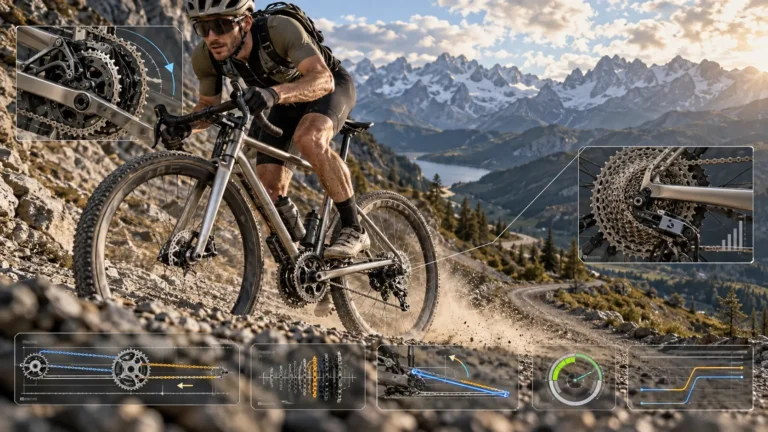
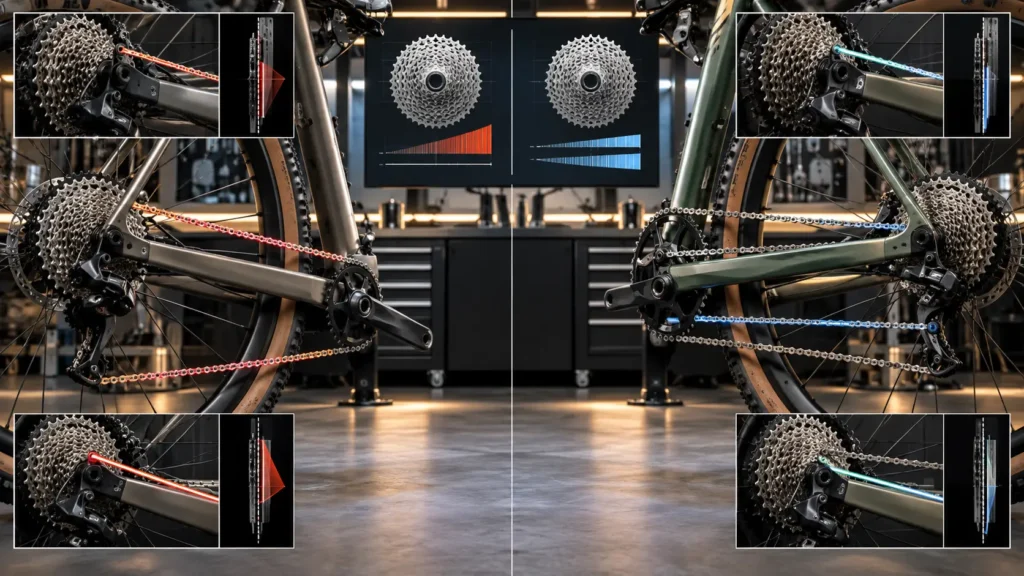
When the chain sits near the center of the cassette, it can run relatively straight between the chainring and rear sprocket. Shift toward the largest or smallest sprockets, however, and the chain increasingly travels sideways.
This lateral misalignment is usually called cross-chaining.
CeramicSpeed’s drivetrain testing found that lateral chain misalignment produces measurable frictional losses and that those losses increase as chain angle becomes more severe.
The issue is particularly relevant as manufacturers continue adding cassette range and sprockets.
Our 13-Speed Road Drivetrains 2026 article examines how modern drivetrains are packing more ratios into increasingly sophisticated systems.
How the Orient Dual-Chainline System Works
The Orient concept approaches chainline from the front of the bicycle rather than simply redesigning the cassette or rear derailleur.
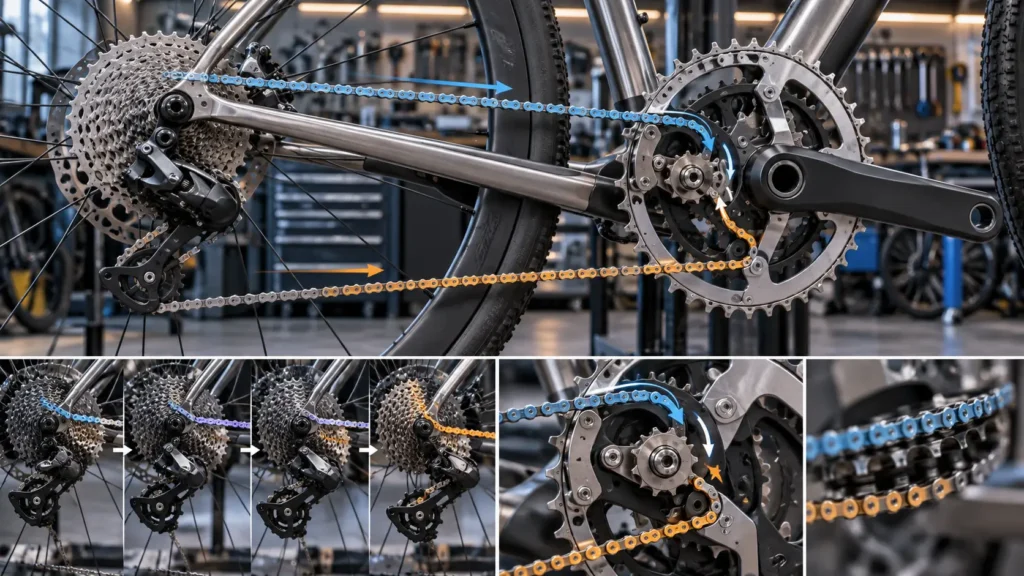
Pinkbike’s first look at the system explains that Orient uses two parallel front chainrings connected by a diagonal transition element.
One chainline is positioned to work more naturally with the outer portion of the cassette. The other aligns more closely with the inner portion.
As the rider shifts the rear derailleur across the cassette, the increasing lateral chain angle eventually guides the chain across the transition section and onto the other front chainline.
The rider does not press another button or move a front derailleur.
In that sense, the front shift happens automatically because of the chain’s position at the rear.
No Battery, Motor or Electronic Controller Is Required
This is what makes Orient particularly unusual in 2026.
Most automatic bicycle shifting development currently relies on electronics. E-bikes can combine motor data with electronic derailleurs, while road and mountain groupsets increasingly use wireless shifting.
The Orient concept does the opposite.
It attempts to make the front chainline respond mechanically without:
- A battery
- Shift buttons
- An electronic actuator
- A conventional front derailleur
- Wireless communication
That gives it more in common philosophically with the mechanically focused approach covered in our Two-Chain Utility Bikes 2026 article than with the latest electronic racing groupsets.
Why Use Two Chainlines Instead of One?
Imagine dividing a 12-speed cassette into two groups.
The outer chainline could serve approximately half of the cassette while the inner chainline handles the remaining ratios. Each front ring can then sit closer to the sprockets it serves.
The exact transition depends on the design, but Pinkbike reports that on a conventional 12-speed setup it would occur around the middle of the cassette.
This does not create twice as many gears. Both front rings effectively perform the same gearing function. Their purpose is primarily to improve alignment.
The result could potentially reduce:
- Extreme cross-chaining
- Side loading on chain links
- Friction at severe chain angles
- Wear associated with highly angled chain operation
Those potential benefits still require independent testing on the finished system.
Chain Efficiency Is More Than a Marginal Gain
A modern bicycle chain is extremely efficient when clean, lubricated and running in favorable alignment.
But small losses become relevant in racing and long-distance cycling.
Our Bike Chain Technology and Drivetrain Efficiency 2026 guide explains how lubrication, coatings, chain articulation and drivetrain geometry influence power transfer.
Cross-chaining adds another variable because every chain link must articulate while also accommodating lateral misalignment.
That is why the Orient concept is interesting even before its claimed benefits are independently quantified. Instead of trying to make the chain tolerate extreme angles more efficiently, the design attempts to prevent those extreme angles from occurring in the first place.
The System Was Shown on a Blackwater Splitfire
The prototype drivetrain has been displayed on a titanium Blackwater Splitfire gravel bike.
Blackwater Bicycles describes the Splitfire platform as a big-tire gravel and adventure bike using elevated-chainstay architecture and clearance for tires up to approximately 700 x 57mm or 29 x 2.25 inches.
The elevated chainstay is particularly useful for an unconventional drivetrain because it creates additional room around the chainrings and chain path.
Bikerumor’s report from the CRAFTED reveal notes that the current prototype uses this unusual frame layout while developers continue exploring a narrower version for more conventional bicycles.
Could It Work With 15- or 16-Speed Cassettes?
This is where the concept becomes especially interesting.
CyclingNews reports that Marginal Gain is exploring a narrower version intended to work with conventional frame layouts and potentially support cassettes extending to 15 or even 16 sprockets.
That does not mean a production 16-speed Orient drivetrain exists today.
It demonstrates the design philosophy: as cassettes become wider and contain more sprockets, dividing the cassette between multiple optimized front chainlines could become increasingly useful.
The industry has historically responded to additional sprockets by making chains narrower and shifting more precise. Orient proposes another possibility — allow the front chainline to move too.
The Concept Is Not a Conventional 2x Drivetrain
It is easy to look at two front rings and call the system a double chainset, but that description misses the point.
A normal 2x drivetrain uses two differently sized chainrings to provide different gear ratios. The rider intentionally shifts between them using a front derailleur.
Orient’s two chainlines are intended primarily to manage alignment. The chain changes automatically based on its lateral position rather than a separate rider command.
The experience is therefore intended to resemble a 1x system from the rider’s perspective.
There Are Still Major Questions About Durability
A chain automatically moving between two front paths creates new wear surfaces and transition points.
The system therefore needs to prove that repeated transitions remain reliable after exposure to:
- Mud
- Dust
- Water
- High pedal torque
- Chain wear
- Contaminated lubrication
Reporting around the prototype indicates that wear at the transition area is still being evaluated.
This is an important reminder that Orient is currently an experimental drivetrain concept, not a commercially established replacement for existing 1x groupsets.
Frame Compatibility May Be the Biggest Barrier
The current prototype benefits from an elevated chainstay and generous space around the drivetrain.
A conventional gravel or mountain bike may have chainstays, tire clearance or suspension hardware occupying the same area required by the mechanism.
Developers are reportedly working toward a narrower design, but production compatibility remains unresolved.
Any future system would need to answer practical questions involving:
- Bottom bracket standards
- Chainring clearance
- Q-factor
- Crank compatibility
- Chainstay geometry
- Existing rear derailleurs and cassettes
Independent Bike Shows Are Becoming Innovation Laboratories
The drivetrain emerged publicly at the inaugural CRAFTED Bike Show rather than one of cycling’s largest international trade fairs.
Cane Creek describes CRAFTED as a showcase for independent frame builders, component designers and makers, held September 26–27, 2026 in North Carolina.
That setting matters because small companies can experiment with ideas that may be too unconventional for a major production brand to pursue immediately.
Could Mechanical Automatic Shifting Become a Real Category?
Electronic automatic shifting is already becoming more common, particularly on e-bikes. Our Electronic Shifting Revolution article explores how servo motors, batteries and programmable controls have changed modern drivetrain design.
Orient presents a different possibility: automatic mechanical behavior built directly into the drivetrain’s geometry.
If the system can prove reliable, efficient, lightweight and compatible with practical frames, the concept could appeal to riders who want automatic chainline management without adding another battery to the bicycle.
Conclusion
Battery-free self-shifting drivetrains in 2026 show that drivetrain innovation does not have to mean adding another electronic component.
The Marginal Gain Orient concept uses two front chainlines and a mechanical transition system to let the chain reposition itself automatically as the rear derailleur crosses the cassette. Its purpose is not to create more front gears, but to reduce the severe chain angles created by increasingly wide 1x systems.
The design remains experimental. Efficiency gains, long-term wear, production weight, compatibility, pricing and commercial availability have not yet been established through independent testing.
Still, the concept asks an important question. As bicycles move toward 13, 14, 15 and potentially 16 rear sprockets, perhaps the solution is not simply making the chain bend farther. Perhaps the front chainline itself should move with it.