Two of cycling’s most convenient equipment trends are beginning to interact in an unexpected way. Thermoplastic polyurethane inner tubes are lighter and dramatically more compact than traditional butyl tubes, while miniature electric pumps can replace a bulky hand pump with a device small enough to fit in a jersey pocket. In 2026, however, cyclists are learning that combining electric mini pumps and TPU tubes requires more attention to heat, valve design, and inflation technique.
A recent investigation into reported TPU valve failures found that the problem is not necessarily the TPU film itself melting. Instead, heat produced by high-speed micro-compressors can travel through the valve assembly and stress the small joint where the valve and TPU material meet. That distinction matters because the newest tube designs are already addressing the issue through metal valve stems, stronger mechanical connections, hose extenders, and updated manufacturer compatibility guidance.
Cycling Weekly’s October 2026 investigation brought renewed attention to the subject after speaking with TPU specialists about failures associated with electric-pump heat.
Why TPU Tubes Have Become So Popular
TPU tubes occupy an interesting space between conventional butyl tubes and tubeless systems. They are manufactured from thermoplastic polyurethane rather than the thick rubber traditionally used for bicycle inner tubes.
The material allows manufacturers to produce tubes that can be much lighter and smaller when folded. That makes TPU particularly appealing as an emergency spare for riders using tubeless tires.
For example, Pirelli’s P ZERO SmarTUBE weighs around 35 grams in several road sizes and is substantially more compact than an equivalent butyl tube.
TPU also appears across road, gravel, touring, and mountain-bike applications, with manufacturers changing wall thickness and construction depending on intended use.
Our Road Bike Tubeless vs Tubed Tires in 2026 guide explains why modern TPU tubes have helped keep traditional clincher setups competitive even as tubeless adoption grows.
Why Electric Mini Pumps Generate So Much Heat
A pocket-sized electric pump has to compress a large amount of air using an extremely small motor and compressor.
Compression generates heat. The motor itself also produces heat, and a compact pump has relatively little surface area through which that energy can dissipate.
During a long continuous inflation, the pump body and outlet can become noticeably hot.
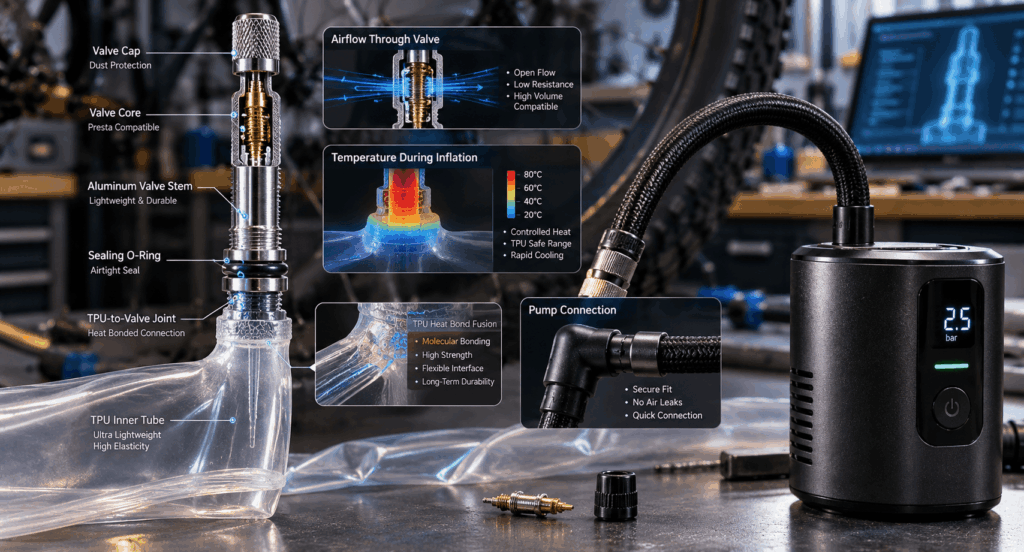
With a conventional metal valve and thick butyl tube, that heat may not create an obvious problem. Some earlier TPU designs, however, use plastic valve stems or bonded interfaces where different materials meet.
The TPU Film May Not Be What Is Failing
The recent discussion often uses the word “melting,” but that description can be misleading.
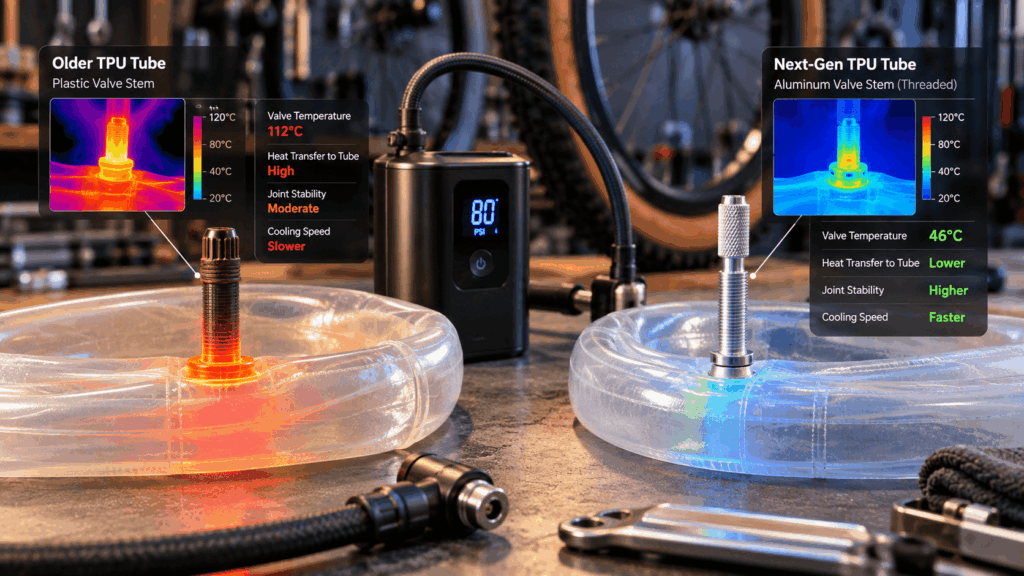
According to the experts interviewed by Cycling Weekly, failures may occur because different materials in the valve assembly expand differently as they heat. The small bond between the valve and TPU material can deform or separate even if the main tube film remains below its melting temperature.
This makes valve construction a major part of electric-pump compatibility.
The practical question for riders is therefore not simply, “Can TPU handle heat?” It is, “How is this particular tube’s valve built, and what does its manufacturer recommend?”
2026 Is Bringing More Aluminum TPU Valve Stems
One of the clearest responses to these concerns is the movement toward metal valves.
Schwalbe’s 2026 Aerothan guidance says its previous TPU-valve version was not compatible with handheld electric pumps because of overheating concerns. The latest version uses an aluminum valve stem, and Schwalbe now lists it as compatible with handheld electric pumps.
That is an important example of how quickly TPU technology is evolving.
A tube that looks nearly identical from the outside may have a completely different valve architecture depending on generation.
SILCA Is Also Designing Around Electric-Pump Heat
Another example comes from SILCA’s current TPU tubes.
SILCA says it uses a threaded aluminum valve partly to help the tube resist heat from electric pumps. The company also uses a mechanical valve attachment and welded tube joint intended to address failure points associated with earlier TPU designs.
This illustrates an important change in product design. Manufacturers are no longer treating the valve as a simple attachment. It is becoming a carefully engineered part of the complete TPU system.
All-Metal Valves Can Solve Other Problems Too
Heat is not the only reason manufacturers are moving toward metal stems.
Rene Herse’s current TPU tube range uses all-metal valves and offers several stem lengths and threaded or smooth designs. The company says metal valves also address some leakage and deformation concerns associated with plastic stems.
Different valve options can improve compatibility with deep rims, screw-on hoses, push-on pump heads, and valve nuts.
For riders with deep aerodynamic wheels, choosing the correct stem length remains essential. Our Bike Wheel Technology and Aerodynamic Rim Design 2026 article explains why increasingly deep rims have made valve compatibility more important.
A Flexible Hose Can Isolate the Tube From Pump Heat
One of the simplest precautions is to avoid attaching a hot pump body directly to the tube’s valve.
A short flexible hose or extension places physical distance between the compressor and valve stem. That reduces direct heat conduction into the valve assembly and can also reduce mechanical stress while the pump is running.
This can be particularly useful with delicate or lightweight valves.
However, riders should use an extension that is compatible with both the pump and the tube’s valve design. Screw-on heads can sometimes loosen removable valve cores if they are overtightened or removed carelessly.
Inflating in Short Bursts Can Reduce Heat Buildup
Another useful technique is staged inflation.
Instead of running a miniature compressor continuously from zero pressure to full road pressure, riders can stop periodically and allow the pump to cool.
This is especially useful when inflating narrow road tires to higher pressures because the compressor works harder as pressure increases.
A practical roadside routine may look like this:
- Install the tube carefully and add a small amount of air first.
- Check that the tube is not trapped under the tire bead.
- Inflate gradually rather than running the pump continuously for an extended period.
- Allow the pump and hose to cool if they become very hot.
- Stop at the tire and rim manufacturer’s recommended pressure.
The exact procedure should always follow the pump and tube manufacturers’ instructions.
Pressure Accuracy Still Matters
Miniature electric pumps increasingly include digital pressure displays or automatic shutoff, but riders should not assume every device is equally accurate.
Road and gravel tire performance can change significantly with only a few PSI of pressure difference.
Our AI Tire Intelligence 2026 guide examines why tire pressure is becoming a measurable performance variable rather than a number riders choose once and forget.
If an electric pump does not include a reliable gauge, a small separate pressure gauge can still be useful after inflation.
TPU Tubes Remain Excellent Tubeless Emergency Spares
One reason this compatibility issue matters so much is that many cyclists do not use TPU tubes as their normal setup.
Instead, they carry one as a compact emergency backup for tubeless tires.
A TPU tube may take up less space than a butyl spare, leaving more room for tire plugs, tools, food, or a second tube. That is particularly useful in gravel and endurance events where a tubeless puncture may be too large for sealant or plugs to repair.
Our Bike Tire Technology and Tread Pattern Innovations 2026 article discusses how modern tire systems increasingly combine tubeless sealant, puncture protection, casing design, and emergency repair strategies.
Rim-Brake Compatibility Must Be Checked Separately
Electric-pump compatibility is only one specification riders need to verify.
Some TPU tubes are approved for both rim and disc brakes, while others are disc-brake-only. Rim braking can generate heat in the wheel, which may expose the tube to additional thermal stress.
Pirelli, for example, lists compatibility individually across its SmarTUBE products rather than applying one rule to every TPU tube.
Riders should therefore check:
- Correct tire-width range
- Wheel diameter
- Valve length
- Rim- or disc-brake compatibility
- Maximum pressure
- Electric-pump guidance
Electric Pumps Still Offer Real Roadside Advantages
The compatibility discussion does not mean cyclists should abandon electric mini pumps.
They remain extremely convenient. A good micro pump can save considerable effort after a puncture, especially when a high-pressure road tire or large gravel tire would require hundreds of strokes with a tiny manual pump.
They can also be useful for gradually adjusting tire pressure during a ride.
The lesson from 2026 is simply that the pump, valve and tube should be treated as one inflation system.
Should You Still Carry a Manual Backup?
For remote rides, redundancy remains valuable.
An electric pump has its own battery, electronics and thermal limits. If its battery is depleted or the device fails, a tiny manual backup can still save a ride.
Riders who want the smallest possible repair kit may accept the risk of carrying only an electric pump, while endurance and adventure cyclists may prefer both.
The Future of TPU and Micro Inflation
The current compatibility issue is likely to improve as manufacturers design tubes specifically around modern electric inflators.
Likely developments include:
- More aluminum valve stems
- Stronger mechanical valve attachments
- Improved hose insulation
- Smarter pump temperature management
- Automatic cooling pauses
- More accurate pressure control
The result could make the combination of TPU tubes and electric pumps more reliable than either early product generation.
Conclusion
Electric mini pumps and TPU tubes in 2026 are both excellent examples of cycling equipment becoming smaller and more efficient. But convenience depends on compatibility.
The latest evidence suggests that reported failures are often connected to heat at the valve-to-tube interface rather than the TPU film simply melting. New aluminum and all-metal valve designs are already addressing that weakness, while hose extenders and staged inflation can reduce heat transfer further.
For riders, the best approach is straightforward: check the tube manufacturer’s guidance, use the correct valve connection, avoid unnecessary heat buildup, and make sure the entire inflation system works together before depending on it during a roadside repair.