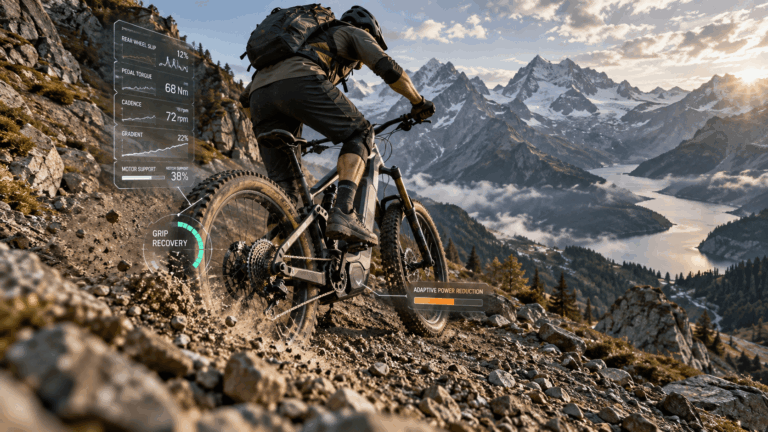
Electric mountain bikes are becoming powerful enough that simply producing more torque is no longer the only engineering goal. Modern motors can deliver enormous assistance on steep climbs, but all that power becomes useless when the rear tire loses grip. In 2026, e-MTB traction control is emerging as a practical answer by allowing the bike to detect wheel slip and temporarily adjust motor assistance.
Giant’s latest Trance Advanced E+ platform brings that concept into a much broader connected system. Introduced for the 2027 model year in October 2026, the bike combines traction control, six-sensor motor management, electronic shifting integration, a main-battery-powered electronic dropper post, real-time tire-pressure monitoring, connected security and a centralized digital gateway.
BikeRadar’s first look at the new Giant Trance Advanced E+ highlights how these features work together rather than operating as independent accessories.
Why Full-Power E-MTBs Need Traction Control
Electric mountain bikes can produce far more torque at the rear wheel than a rider could comfortably deliver alone, particularly at low speed on steep climbs.
Giant’s new SyncDrive Pro 4 motor is specified at 120Nm of torque and 850W of peak output. Those numbers give riders considerable climbing support, but loose dirt, wet roots, gravel and rocks place a strict limit on how much force a tire can transfer into the trail.
When motor torque exceeds available traction, the rear wheel begins to spin.
Once that happens, the rider can lose:
- Forward momentum
- Steering control
- Climbing balance
- Energy efficiency
- Confidence on technical terrain
Our Rider-Intent E-Bike Motors 2026 article explores the wider trend toward motors that understand more than simple pedal pressure.
How E-MTB Traction Control Detects Wheel Slip
Traction control needs to recognize the difference between normal acceleration and a rear tire spinning faster than conditions should allow.
On the new system, multiple sensor inputs are used to understand what the rider and bicycle are doing.
Giant describes its traction-control system as detecting rear-wheel slip during loose climbs and refining motor assistance to help the tire recover grip.
BikeRadar reports that cadence, rider torque and other parameters are monitored. When the onboard system identifies a loss of traction, motor assistance is temporarily reduced before returning toward the rider’s selected support level.
The idea is similar to traction management in other powered vehicles, but the implementation must remain subtle enough that the bicycle still feels natural under human control.
Traction Control Is About Modulation, Not Less Power
A traction-control system does not need to make the motor permanently weaker.
The objective is to deliver the maximum useful assistance that the tire can actually transfer into the trail.
On a dry surface with excellent grip, the rider may be able to use the full available assistance. On wet roots or loose gravel, slightly reducing torque for a fraction of a second may allow the tire to reconnect with the surface.
This can be more effective than simply continuing to add power while the wheel spins.
Six-Sensor Motor Management Adds Context
Giant’s current Trance Advanced E+ specification describes a Synchronized Power Matrix that uses six real-time sensors, including torque, cadence and slope information.
The system can use those inputs to decide how much assistance is appropriate.
This is important because motor control increasingly depends on context. The same rider torque can mean something very different when:
- Climbing a steep rock step
- Accelerating on smooth trail
- Crossing loose gravel
- Restarting on an incline
- Spinning at high cadence on flatter terrain
The more accurately the bicycle understands the situation, the more naturally assistance can be delivered.
The Motor Is Becoming Only One Part of the E-Bike System
One of the most important trends in the new platform is that motor control no longer operates alone.
Giant uses a central electronic architecture called Smart Gateway 2.0 to connect the motor, battery, rider controls, display and safety systems.
Giant describes Smart Gateway 2.0 as the digital brain of its latest E+ ecosystem, coordinating hardware, software and connected services.
This is exactly the type of architecture discussed in our Software-Defined Bicycles 2026 guide.
The Electronic Dropper Draws Power From the Bike
Electronic mountain-bike droppers are not new, but many use their own removable or rechargeable batteries.
The new Contact Switch E+ takes a different approach by connecting directly to the e-bike’s electrical system.
This means the motor battery can also supply the energy required to raise or lower the saddle.
BikeRadar reports that Giant says the dropper retains enough reserved energy for roughly 20,000 activations even after the main drive battery reaches its nominal empty state.
That arrangement removes another small battery that riders would otherwise need to monitor independently.
One Handlebar Controller Can Manage Multiple Systems
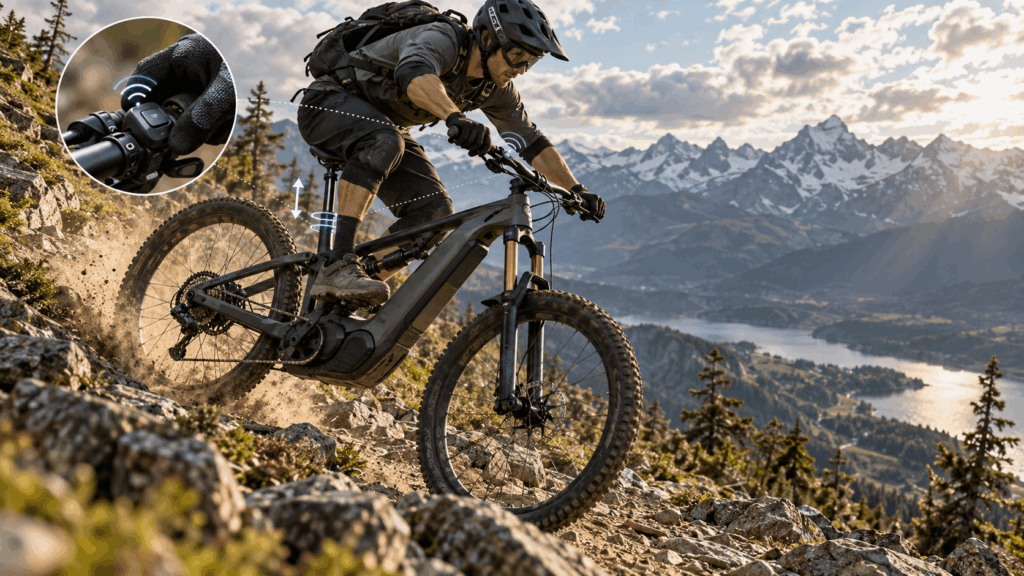
The RideControl Ergo 5 controller can operate assistance settings and the electronic dropper, while compatible configurations can also use electronic drivetrain controls.
This represents another important change in cockpit design.
Instead of installing a separate remote for:
- Motor modes
- Dropper control
- Electronic shifting
manufacturers can increasingly combine commands into customizable electronic buttons.
The benefit is a cleaner cockpit and potentially easier operation. The downside is increased dependence on one proprietary electronic ecosystem.
Live Tire Pressure Becomes Part of the Ride Data
Tire pressure has an enormous influence on mountain-bike traction.
A difference of only a few PSI can change:
- Grip
- Rolling resistance
- Ride comfort
- Rim protection
- Cornering support
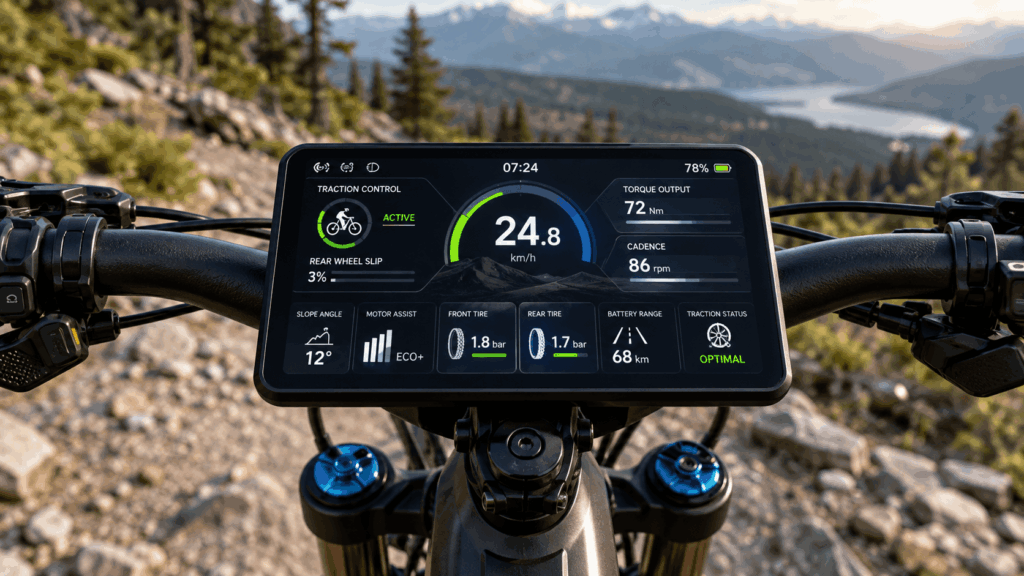
The new system can display front and rear pressure using Aegis Tire Checker sensors.
Giant says its Aegis Tire Checker provides real-time pressure readings, configurable limits and rapid-pressure-drop warnings. The sensors are rated for up to 600 active hours and are compatible with both tubes and tubeless setups.
Why Tire Alerts Complement Traction Control
Traction control can respond to wheel slip after it begins, but correct tire pressure helps determine how much grip is available in the first place.
This creates a useful relationship between two systems.
If the rider begins the ride with excessive pressure, the tire may have a smaller effective contact patch and less ability to conform to loose terrain. If pressure becomes too low, the rider risks rim strikes or instability.
Real-time monitoring therefore helps riders manage the mechanical side of traction while motor software manages power delivery.
A Connected Display Reduces Phone Dependence
The integrated display can show battery status, range, speed, cadence and front and rear tire pressure directly on the bicycle.
That matters because connected bikes become less useful if riders must constantly remove a phone to check every system.
A central display allows information from multiple sensors to become part of the normal riding interface.
Security Is Becoming Part of the Same Ecosystem
Connectivity is also expanding beyond ride performance.
Giant’s latest E+ platform includes digital locking and location functions. The broader Giant E+ ecosystem includes Apple Find My integration and connected bike-security features.
The RideControl app can also manage system settings and firmware.
This reinforces the idea that the modern e-bike is becoming a connected platform rather than simply a frame with a motor attached.
High Torque Requires Stronger Mechanical Parts
Smarter software cannot eliminate mechanical loads.
A motor producing 120Nm places substantial stress on the drivetrain, freehub and chain.
Giant says the new platform uses strengthened hub internals and an e-bike-specific chain designed for high torque. The company’s current specification cites a stronger titanium ratchet system and increased chain-pin strength compared with its chosen benchmarks.
These manufacturer claims will benefit from long-term independent testing, but they highlight an important engineering reality: increasing motor intelligence must be accompanied by durable hardware.
The 840Wh Battery Powers More Than Propulsion
The main EnergyPak battery stores 840Wh and operates at 48V.
That energy primarily powers the motor, but the integrated architecture also supports connected components such as displays and the electronic seatpost.
This is an evolution of the energy-management concepts discussed in our Smart E-Bike Energy Ecosystems 2026 article.
As more components share the main energy source, riders may have fewer independent batteries to charge.
Integration Creates New Service Challenges
The advantages of a connected system come with trade-offs.
A conventional mechanical dropper, pressure gauge and motor can often be serviced relatively independently. An integrated electronics platform may require:
- Firmware compatibility
- Diagnostic software
- Specific replacement components
- Dealer support
- Compatible controllers
Smart Gateway 2.0, for example, is not designed as a universal retrofit for older e-bikes.
That means riders gain integration while becoming more dependent on the ecosystem surrounding the bicycle.
Traction Control Will Not Replace Rider Technique
No electronic system can create grip where none exists.
Riders still need to manage:
- Body position
- Pedal pressure
- Line choice
- Tire selection
- Tire pressure
- Momentum
Traction control is best understood as another tool that supports those skills.
A good rider can still improve climbing grip by staying balanced and applying power smoothly. Software simply gives the motor another way to avoid overwhelming the rear tire.
The Future Is a Coordinated E-MTB
The most important aspect of the new technology may not be any individual feature.
Traction control, tire-pressure monitoring, electronic shifting, a powered dropper, battery management and security all become more useful when they communicate through the same architecture.
Future systems could go even further by coordinating motor torque with suspension behavior, tire pressure, drivetrain gear selection and route gradient.
The bicycle would not ride itself. Instead, each electronic component could provide information that helps the others respond more intelligently.
Conclusion
E-MTB traction control in 2026 demonstrates that electric mountain-bike development is moving beyond the pursuit of ever-higher torque figures.
The new generation of systems aims to make power more usable. Detecting wheel slip and briefly adjusting motor assistance can help riders maintain momentum on loose climbs, while live tire-pressure monitoring helps preserve the mechanical grip that traction control depends on.
The addition of main-battery-powered electronic droppers, customizable wireless controls, connected security and centralized software makes the trend even more significant.
The future full-power e-MTB may not be defined by one extraordinary component. It may be defined by how effectively the motor, battery, tires, controls, drivetrain and software work together as one coordinated machine.