Power meters have become one of cycling’s most useful training tools, but nearly every system still has one small limitation: it needs a battery. Some pedals use disposable cells, while others need to be plugged into a charger every few weeks or months. In 2026, a different approach is attracting fresh attention — self-charging power meter pedals that generate their own electricity while the rider pedals.
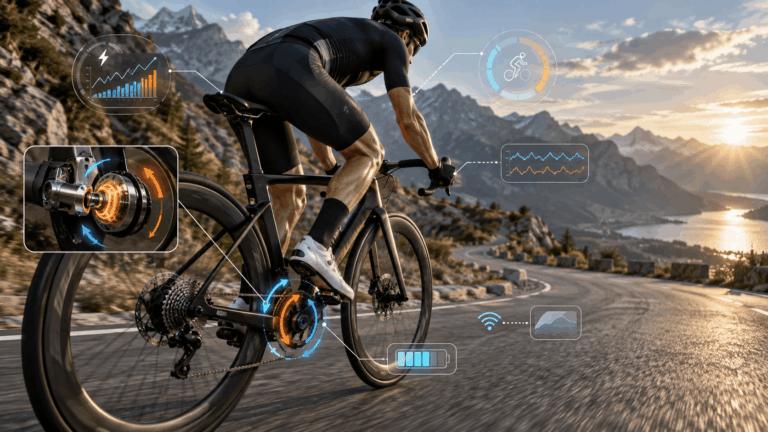
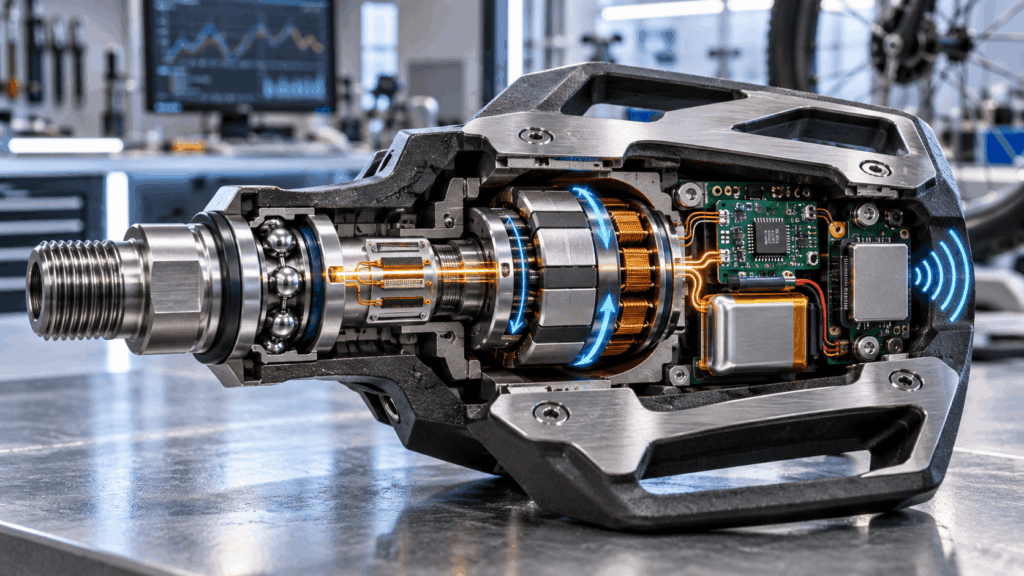
A patented design from Giant Manufacturing describes a pedal containing a compact generator and an internal energy-storage element. As the pedal body rotates around the spindle, the generator can produce electricity that is stored and used to power sensors and electronics.
The concept does not mean a commercial Giant self-charging power meter is available today. It is a patented engineering approach rather than a confirmed production launch. However, it offers an interesting look at how future power meters could reduce or potentially eliminate routine charging.
Cycling Weekly recently highlighted Giant’s self-powered pedal technology, bringing renewed attention to an idea that could change how cyclists manage electronic pedals.
How a Self-Charging Power Meter Pedal Works
The basic concept is energy harvesting. Instead of depending entirely on electricity that was placed into a battery before the ride, the pedal attempts to collect a small amount of energy from its own movement.
According to Giant’s U.S. patent for a self-powered cycling apparatus, the design includes several key parts:
- A rotating pedal body
- A pedal spindle
- A generator containing a stator and rotor
- An internal energy-storage element
- Power-measurement sensors
- Electronic circuitry
The stator remains fixed relative to the spindle while the rotor moves with the pedal body. Their relative movement allows the generator to produce electrical energy as the rider pedals.
This is closely related to the technology already discussed in our Cycling Power Meters and Training Metrics Guide 2026, but it changes one fundamental part of the system: how the electronics receive power.
Why Power Meter Batteries Still Matter
Modern power meters have excellent battery life, so energy harvesting is solving an inconvenience rather than an emergency.
For example, Garmin’s Rally RS200 power-meter pedals use replaceable batteries and are rated for up to approximately 120 hours of riding.
Rechargeable designs can last even longer. Favero’s Assioma PRO RS pedals use rechargeable lithium-ion batteries and list up to 160 hours of operating time per charge.
Crank and spider systems also achieve long operating periods. SRAM’s Quarq AXS Power Meter Spider uses a replaceable CR2032 cell rated for roughly 200 riding hours.
Those figures make today’s power meters practical, but riders still need to remember another battery among an increasingly large collection of electronic cycling components.
The Goal Is Not Necessarily a Completely Battery-Free Pedal
The phrase “self-charging” can create the impression that the pedal would operate without any form of stored electrical energy.
That is not what Giant’s patent describes.
The system still includes an energy-storage element. The difference is that the storage device can receive power from a generator inside the pedal rather than relying exclusively on an external charger or replacement battery.
The European version of the patent documentation similarly describes a generator electrically connected to an energy-storage component.
This could allow the pedal to maintain its own charge during normal riding.
Pedaling Creates an Ideal Repeating Motion
A bicycle pedal rotates thousands of times during a typical ride. That repetitive movement provides engineers with a potentially useful source of mechanical energy.
Consider a cyclist maintaining 90 revolutions per minute. Over a two-hour ride, the crank completes more than 10,000 revolutions.
A micro-generator does not need to capture much energy from each rotation if the pedal electronics consume very little power.
Power-meter electronics are well suited to this approach because modern sensors, Bluetooth transmitters, ANT+ radios, processors, and strain-gauge circuits can operate using relatively small amounts of electricity.
How Power Measurement Fits Into the System
The electricity-generating hardware would still need to coexist with the equipment responsible for measuring rider output.
A typical power meter calculates power using measurements related to torque and angular velocity. Strain gauges detect extremely small physical deformation in the pedal spindle or another structural component as the rider applies force.
The electronics then combine that information with cadence to calculate watts.
Our Pedal Technology and Innovations for 2026 guide explains how modern pedals are increasingly combining mechanical contact-point design with sensors and wireless connectivity.
Adding a generator means engineers need to package another electronic and electromagnetic system into the same restricted space without compromising measurement accuracy.
Sealing Could Be One of the Biggest Advantages
Battery access can create a difficult engineering trade-off.
A replaceable battery requires some type of opening in the pedal or sensor housing. Manufacturers use seals and O-rings to protect those openings, but every removable cover introduces another interface exposed to rain, washing, sweat, dust, and mud.
A self-powered pedal could potentially be designed with fewer reasons for the rider to open the electronics enclosure.
Rechargeable systems already demonstrate the value of reducing battery compartments. Favero, for example, places its electronics, strain gauges and rechargeable battery inside the spindle and uses external magnetic charging connections.
An energy-harvesting design could potentially take this idea one step further by reducing how often external electrical access is needed.
Long-Distance Riders Could Benefit Most
For most cyclists, charging a power meter every few weeks is not particularly difficult.
The technology becomes more interesting for riders spending long periods away from electricity.
Potential applications include:
- Ultra-distance racing
- Bikepacking
- Multi-day touring
- Remote training camps
- Adventure racing
A cyclist already managing GPS batteries, lights, electronic shifting, a smartphone, and other devices may appreciate having one component that maintains its own energy supply.
Energy Harvesting Could Reduce Battery Waste
Disposable coin cells are small, but millions of electronic cycling accessories collectively use a substantial number of them.
A pedal capable of extending the lifespan of its internal power source could reduce battery replacement frequency.
This does not make the product automatically sustainable. Magnets, circuit boards, batteries, aluminum, steel, composites, and manufacturing energy still contribute to its environmental footprint.
However, longer service intervals align with the broader design philosophy discussed in our Sustainable Smart Bicycles 2026 article.
Generating Power Must Not Create Noticeable Resistance
One important engineering question is how much mechanical resistance the generator introduces.
Energy cannot be created without taking energy from somewhere. If a generator produces electrical power from pedal rotation, it is ultimately collecting a very small portion of the rider’s mechanical work.
The crucial issue is scale.
Power-meter electronics require tiny amounts of electricity compared with the hundreds of watts a cyclist may produce. A carefully designed generator could theoretically collect sufficient electrical power while creating resistance too small for the rider to notice.
Engineers would still need to quantify that effect before any commercial product could make meaningful efficiency claims.
Weight and Stack Height Are Major Constraints
Pedals are already difficult components to package because riders care about both weight and biomechanics.
Additional generator hardware could increase:
- Pedal mass
- Spindle diameter
- Stack height
- Q-factor
- Manufacturing complexity
Road racers in particular may resist a system that eliminates charging but adds significant weight or changes foot position.
This means a successful self-powered pedal would need to make its generator exceptionally compact.
Durability Could Be More Difficult Than the Electronics
A pedal experiences substantial mechanical stress. It supports rider weight, transmits sprint forces, rotates continuously, encounters water and debris, and is vulnerable during crashes.
Placing a generator around the spindle means the internal components must survive this environment without interfering with bearings or strain-gauge measurements.
Engineers would need to manage:
- Shock loads
- Vibration
- Water ingress
- Temperature changes
- Bearing wear
- Magnetic and electrical stability
Self-Charging Pedals Fit the Software-Defined Bike
Modern cycling electronics increasingly receive firmware updates and communicate with multiple devices.
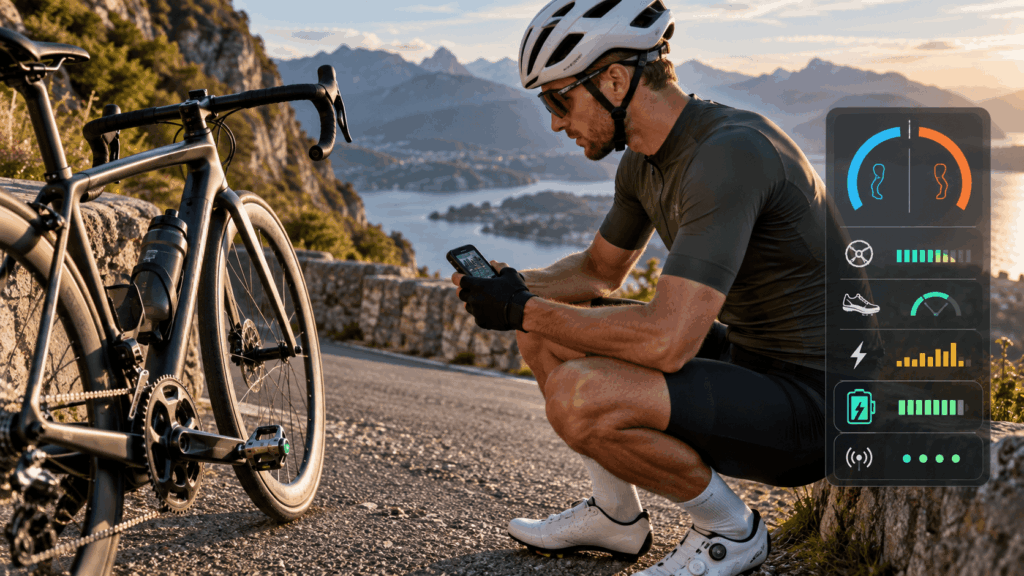
A self-powered pedal could potentially send power, cadence, left-right balance, battery condition, diagnostic information, and generated-energy data to a cycling computer or smartphone.
This fits naturally with the connected component ecosystem explored in our Software-Defined Bicycles 2026 article.
Energy harvesting could allow smart components to become increasingly capable without giving riders another device that must constantly be charged.
A Patent Does Not Guarantee a Product
This is the most important limitation to understand.
Companies patent technologies for many reasons. Some concepts become products quickly, others change substantially during development, and some never reach consumers.
Giant’s patent demonstrates that a technically detailed self-powered pedal architecture has been developed and legally protected. It does not confirm a release date, price, final weight, accuracy specification, or commercial model.
Until a manufacturer announces production hardware, the technology should be viewed as a possible direction for future power meters rather than something riders can currently purchase.
Conclusion
Self-charging power meter pedals in 2026 offer an intriguing answer to one of cycling electronics’ most persistent inconveniences: battery management.
By placing a micro-generator inside the pedal and harvesting energy from normal rotation, future systems could potentially keep their own sensors and wireless electronics powered for extremely long periods.
The concept still faces important challenges involving weight, resistance, sealing, durability, accuracy, packaging, and manufacturing cost. Current replaceable and rechargeable power meters already offer excellent battery life, so any self-powered alternative will need to provide clear practical advantages.
But the larger idea is compelling. As bicycles accumulate more electronic components, the next generation of smart cycling equipment may not simply consume energy more efficiently. Some components may begin producing the small amount of electricity they need for themselves.