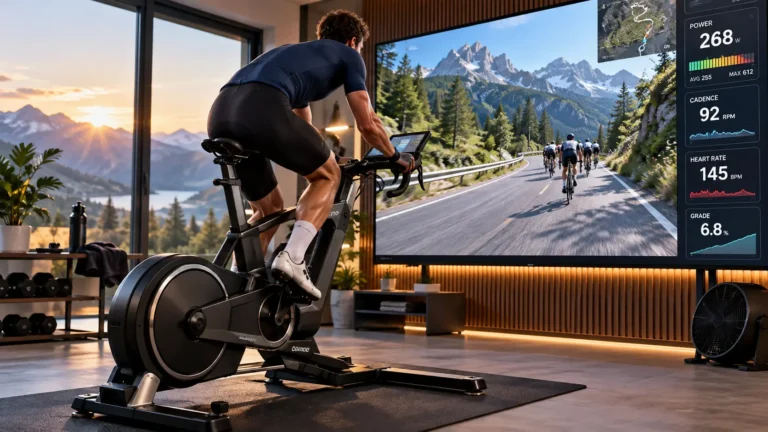
Indoor cycling used to involve a simple compromise: riders accepted that a stationary bike would never feel quite like riding outdoors. Smart resistance, virtual roads and accurate power measurement made training more engaging, but the physical machine underneath the rider often remained heavy, rigid and disconnected from the movements of a real bicycle.
In 2026, smart indoor bikes are beginning to address that problem from several directions at once. New systems are combining chassis movement, high-inertia drivetrains, realistic braking, customizable virtual gearing, integrated displays and increasingly open communication standards that allow hardware and training software to work together more naturally.
The newest example is the Stages SB200, launched October 5 as the successor to the SB20. It is the first new Stages smart bike in seven years and the first hardware product to ship with the open OpenBikeControl protocol built directly into its firmware.
Stages Cycling describes the SB200 as a smart bike built around realistic chassis movement, a high-inertia two-stage drivetrain and extensive virtual-world controls.
Indoor Cycling Is Moving Beyond Resistance Control
The first generation of smart trainers transformed indoor training by allowing apps to automatically control resistance based on terrain or structured workouts.
That remains essential, but riders now expect much more.
A modern smart bike may need to reproduce:
- Realistic pedaling inertia
- Virtual gear changes
- Braking
- Steering or game controls
- Power measurement
- Bike-fit adjustments
- Movement beneath the rider
- Multiple software platforms
Our Indoor Cycling Revolution article explains how virtual worlds and structured training turned indoor riding into a year-round discipline. The newest hardware is now trying to make the physical riding experience catch up with the software.
The SB200 Uses a Two-Stage High-Inertia Drive
One of the most important changes is inside the drivetrain.
According to BikeRadar’s launch coverage, the SB200 uses a high-inertia, freewheeling two-stage drive instead of relying entirely on a very heavy flywheel.
Stages lists the system as a dual-stage belt drive using a synchronous belt for one stage and a Poly-V belt for the other.
High inertia matters because a real bicycle continues moving between pedal strokes. The mass of the rider and bicycle carries momentum forward even as crank torque fluctuates through each revolution.
An indoor bike with insufficient inertia can feel unnatural because the pedals slow too rapidly through the weaker portions of the pedal stroke.
Realistic Ride Feel Does Not Require a 60kg Bike
The previous SB20 earned a reputation for being exceptionally heavy.
The new platform reduces mass substantially. Stages’ current technical specification lists the SB200 at approximately 32.3kg, while launch reports emphasize a reduction of roughly 25kg compared with the previous generation.
That difference matters for home users who may need to reposition the bike between sessions.
It also demonstrates that perceived road feel does not come only from adding more physical flywheel mass. Engineers can use drivetrain ratios and resistance-system design to generate effective inertia more efficiently.
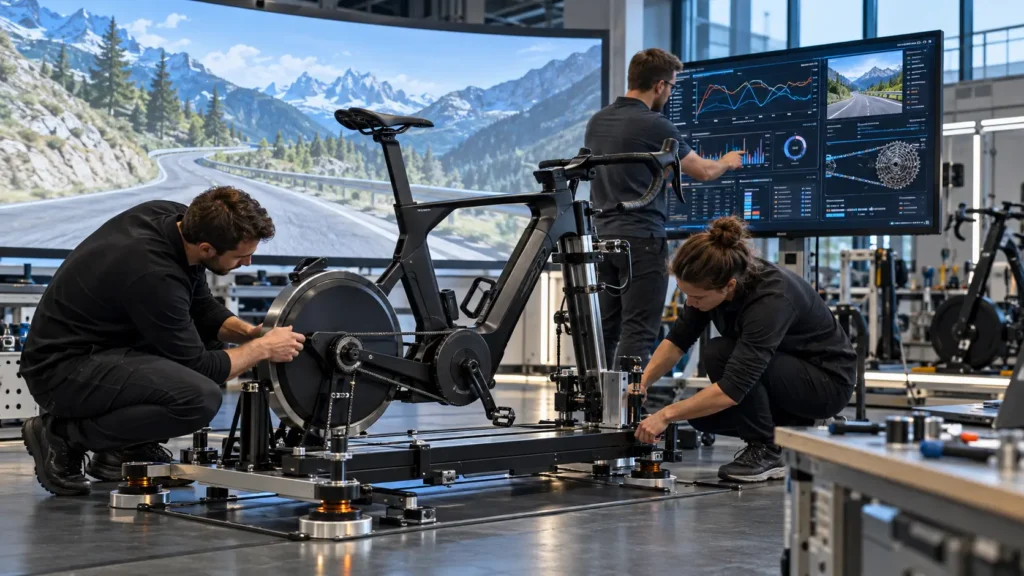
The Bike Is Designed to Move Under the Rider
Another major change is the chassis.
A bicycle outdoors moves slightly beneath the rider with every pedal stroke, sprint and standing effort. A perfectly rigid indoor frame forces more of that movement into the rider’s hips, knees and upper body.
Stages uses flexible contact points beneath the SB200 to allow controlled lateral movement.
Stages’ setup documentation says the standard soft rubber feet permit the bike to rock slightly from side to side. Firmer replacement pads can be fitted when a rider wants less movement.
This makes chassis feel another adjustable part of indoor-bike setup.
Virtual Gearing Can Mimic More Than One Bicycle
A dedicated indoor smart bike does not need a physical cassette containing every ratio the rider might want.
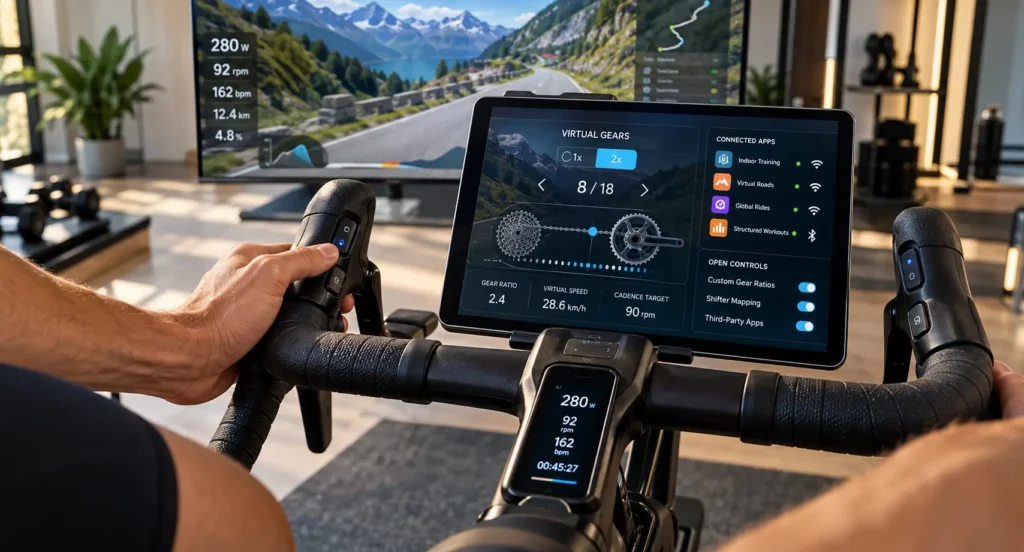
Instead, software can create virtual gears.
The SB200 includes presets designed to mimic familiar drivetrain styles and allows riders to create custom configurations.
Stages says riders can configure 1x or 2x layouts and use its Dream Drive system to create customized gear steps across an extremely broad virtual ratio range.
This is useful because the same indoor bike might be shared by:
- A road cyclist
- A gravel rider
- A triathlete
- A mountain biker
- Another family member with different gearing preferences
Each rider can make the virtual drivetrain behave more like the bicycle they use outdoors.
Virtual Gears Remove Mechanical Limitations
Physical bicycle drivetrains are restricted by chainrings, cassettes, chain length and derailleur capacity.
Virtual gearing has no such limitation.
Stages says Dream Drive can operate across a ratio range equivalent to extremely large theoretical mechanical gearing, while allowing the rider to choose how many steps are available.
The benefit is not that riders need a fictional 140-tooth cassette. It is that software can create whatever progression best suits the workout or virtual route without replacing hardware.
This is another example of the principles covered in our Software-Defined Bicycles 2026 guide.
Ten Programmable Buttons Bring the Virtual World to the Bars
Virtual cycling apps increasingly require more than shifting.
Riders may need controls for steering, menus, workout targets, route selections, power-ups and other software functions.
The SB200 places 10 independently programmable buttons around its outdoor-style shift controls.
This allows the rider to interact with software while keeping hands near a normal riding position.
Stages’ official specifications also list functional brake levers and audible feedback during shifting.
OpenBikeControl Could Be the Bigger Story
The most significant development may not be mechanical at all.
The SB200 is the first hardware device to ship with OpenBikeControl built into its firmware.
OpenBikeControl is a publicly documented protocol designed to let cycling controllers communicate standardized commands to indoor-training applications over Bluetooth or a local network.
Instead of every hardware company creating a proprietary control language and requiring each app developer to build a custom integration, an open protocol can provide one common set of commands.
These can include:
- Shift up and down
- Report front and rear virtual gears
- Steer
- Send brake-lever input
- Control menus
- Trigger application functions
Why Open Protocols Matter for Indoor Cycling
Indoor cycling has become increasingly fragmented.
Some trainers, controllers and virtual-shifting systems work best only within particular software ecosystems. That can limit riders who want to change apps without replacing hardware.
BikeControl’s October launch explanation says the SB200 communicates OpenBikeControl commands through both Bluetooth and Wi-Fi, with TrainingPeaks Virtual supporting the system from launch.
The broader promise is hardware portability: a button should mean the same thing to any app that supports the standard.
That is a particularly relevant development as the industry moves deeper into connected software ecosystems, a trend also covered in our Cycling Apps and Training Software Trends 2026 guide.
Wi-Fi Is Becoming More Important Alongside Bluetooth
Bluetooth remains the most common connection method for many indoor trainers, but Wi-Fi offers advantages for fixed home equipment.
A smart bike connected to the home network can potentially communicate with computers, tablets and other devices without relying solely on direct Bluetooth pairing.
The SB200 supports both Bluetooth and Wi-Fi, allowing software developers to choose the transport method that best fits their application.
Integrated Displays Reduce Setup Friction
The SB200 includes a small OLED display directly on the bike.
It is not intended to replace a tablet or large virtual-cycling screen. Instead, it can provide basic ride and system information without forcing the rider to launch another device for every simple task.
Stages also includes phone and tablet mounting options, an integrated cycling-computer mount and two USB-C charging ports.
The trend reflects a broader desire to make smart bikes feel ready to ride rather than like a collection of accessories that must be assembled before every workout.
Power Accuracy Remains Critical
A smart bike can have excellent virtual controls and realistic movement, but serious training still depends on reliable power measurement.
Stages rates the SB200’s power measurement at ±1 percent and recommends an initial spindown procedure for accurate operation.
The manufacturer’s technical specification lists a maximum resistance capacity of 2,500 watts, with defined resistance performance at lower cadences as well.
Power accuracy matters because structured workouts depend on repeatability. A rider training at 300 watts needs that number to represent approximately the same workload from one session to the next.
Our Fast Fitness With Power guide explains why consistent wattage data is central to modern cycling training.
Fit Has to Work for Multiple Riders
One advantage of a dedicated smart bike is rapid fit adjustment without changing stems, seatposts or cranksets.
Stages lists an approximate rider-height range from 4 feet 10 inches to 6 feet 10 inches and provides four crank-length positions: 165, 170, 172.5 and 175mm.
The SB200 specification guide also details handlebar stack and reach adjustment ranges, allowing one bike to serve riders with substantially different body dimensions.
There Are Still Trade-Offs
A dedicated smart bike occupies permanent floor space and costs significantly more than many direct-drive trainers.
It also means riders cannot simply take the indoor machine outside when the weather improves.
Some riders will prefer placing their own bicycle on a smart trainer because it preserves identical saddle position, handlebars and contact points.
A dedicated smart bike instead prioritizes convenience, low maintenance and multi-user adjustability.
The Future May Be Less About One Virtual Platform
The most important direction in 2026 may be the movement toward hardware that is designed to work across multiple virtual environments.
A rider might use one platform for racing, another for structured workouts and another for realistic route simulation.
Hardware that supports standardized controls, virtual drivetrains and broad connectivity can make those transitions easier.
That could push indoor cycling away from tightly locked ecosystems and toward a model where riders choose hardware and software independently.
Conclusion
Smart indoor bikes in 2026 are becoming more realistic, more configurable and potentially more open.
The Stages SB200 illustrates that shift through its two-stage high-inertia drivetrain, controlled chassis movement, customizable virtual gearing, integrated controls, Wi-Fi connectivity and precise power measurement.
But its most significant contribution may be OpenBikeControl. By supporting a public control standard directly in production hardware, the bike offers a glimpse of an indoor-cycling ecosystem where trainers, bikes and apps can communicate without every feature being locked to one platform.
For riders, the ideal indoor bike may therefore be defined by more than maximum resistance or power accuracy. The next generation will also be judged by how naturally it moves, how closely it can reproduce an outdoor drivetrain and how freely it can connect to whatever virtual world the rider chooses next.