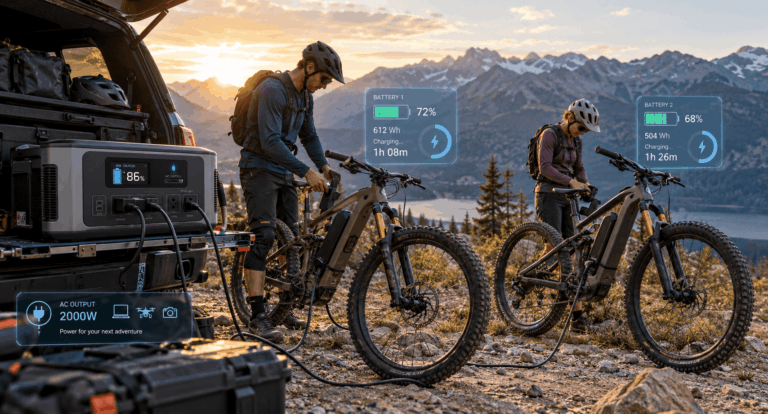
Long-range e-bikes have made it possible to explore farther into the mountains, but every electric ride eventually reaches the same limitation: the battery needs another source of energy. In 2026, off-grid e-bike charging is becoming more practical as high-capacity portable power stations and faster manufacturer-approved chargers allow riders to add meaningful range without finding a wall outlet.
The idea gained renewed attention in September when Pinkbike tested a 2,048Wh portable power station with an 800Wh e-bike battery. The test showed that portable stored energy can provide substantial trailhead charging, but it also highlighted an important issue: conversion losses mean the simple watt-hour numbers printed on the batteries do not tell the whole story.
Pinkbike’s September off-grid charging test used a DJI Power 2000 to recharge an 800Wh Avinox battery and found the power station consumed more energy than the nominal battery capacity alone would suggest.
Why Off-Grid E-Bike Charging Is Becoming More Relevant
E-bike batteries are getting larger while chargers are getting faster. That combination changes what riders can accomplish from a car park, campsite, race paddock, or remote base camp.
A few years ago, bringing enough stored power to recharge an e-MTB battery could require a very large generator or battery system. Modern lithium power stations can store one or several kilowatt-hours while supplying normal AC outlets.
Current use cases include:
- Trailhead charging between rides
- Multi-day e-MTB trips
- Camping and bikepacking support
- Race paddocks
- Remote filming trips
- Emergency backup during outages
This trend complements our Solar E-Bikes 2026 article, but portable stations solve a different problem: they store substantial energy in advance and can deliver it regardless of whether the sun is currently shining.
Start With Watt-Hours
The most useful number when planning off-grid charging is watt-hours, abbreviated Wh.
An 800Wh e-bike battery theoretically stores approximately 800 watt-hours when full. A portable station rated at 2,048Wh appears at first glance to contain enough energy for more than two complete 800Wh charges.
Real systems are not perfectly efficient.
Energy may be lost through:
- The portable station’s inverter
- The e-bike charger
- Battery charging electronics
- Heat
- Cables and conversion circuitry
That is why capacity planning should include a reasonable reserve instead of assuming every advertised watt-hour reaches the bicycle battery.
Real-World Testing Shows the Importance of Losses
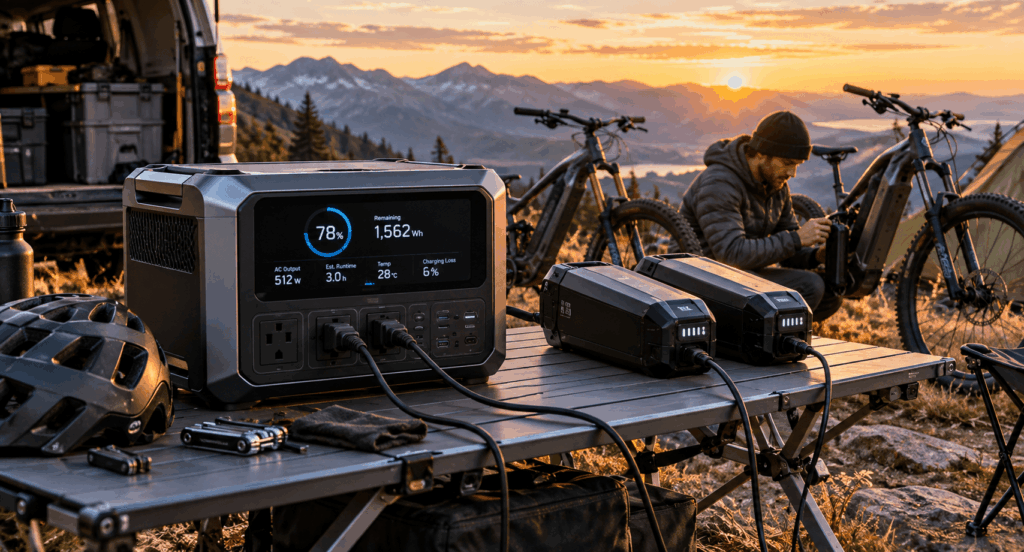
Pinkbike reported that charging an 800Wh Avinox battery from empty with a 2,048Wh DJI Power 2000 consumed about 52 percent of the power station’s capacity during its test.
A purely mathematical 800Wh transfer would equal about 39 percent of 2,048Wh, so the observed test illustrates the effect of conversion losses.
The exact result will vary according to charger efficiency, battery temperature, charge level, power-station architecture, and other factors. It should not be treated as a universal percentage for every setup.
Portable Power Stations Are Getting Large Enough to Matter
The DJI Power 2000 provides a useful example of current portable energy storage. DJI lists 2,048Wh capacity, 3,000W continuous AC output, lithium iron phosphate chemistry, and support for mains, vehicle, and solar recharging.
That level of AC output is far beyond what a normal e-bike charger requires, meaning capacity is usually the limiting factor rather than inverter power.
A smaller 500Wh station may provide a useful partial top-up, while a 2,000Wh-class unit can support much larger riding plans.
Fast Chargers Change the Calculation
Stored energy is only useful during a riding day if the charger can transfer it quickly enough.
Modern high-output chargers are reducing downtime. Specialized’s current 12-amp Smart Charger, for example, is specified to charge compatible high-capacity Levo batteries from zero to 80 percent in under an hour.
That makes lunch-stop charging far more practical than systems requiring several hours.
However, riders should only use charging equipment approved for their specific battery and e-bike system.
Never Treat a Power Station as a Universal Battery Charger
A portable power station should normally be viewed as a replacement for the wall outlet, not as a replacement for the e-bike’s approved charger.
The safe architecture is typically:
Portable power station → manufacturer-approved e-bike charger → e-bike battery.
The U.S. Consumer Product Safety Commission advises riders to use only chargers supplied or recommended by the micromobility manufacturer and to follow manufacturer charging instructions.
Directly connecting an arbitrary DC source to an e-bike battery can bypass protections or provide incorrect voltage or current. Riders should not improvise direct battery charging unless the bicycle manufacturer explicitly supports the method.
Battery Certification Still Matters Off Grid
Moving charging from a garage to a campsite does not remove lithium battery safety considerations.
UL 2849 evaluates complete e-bike electrical systems, including interactions among the battery, charger, drive system, and other electronics.
CPSC also recommends remaining present during charging and avoiding modified or unapproved battery packs.
These precautions matter anywhere, including a remote campsite.
How Many Charges Can a Power Station Provide?
A simple planning formula is:
Usable station energy ÷ energy required per recharge = approximate number of charges.
Suppose a rider has a 1,024Wh station and a 600Wh bicycle battery. The theoretical result is about 1.7 complete charges, but after inverter and charger losses, the realistic figure will be lower.
For this reason, partial charging can be more useful than trying to refill every battery to 100 percent.
A rider may only need enough energy to complete the second half of a route.
Partial Charging Can Extend a Big Riding Day
A one-hour lunch stop does not need to deliver a complete recharge to transform the day.
Adding 30 to 50 percent battery capacity may allow riders to complete another major climb or an additional trail loop.
This works particularly well when paired with the predictive range concepts covered in our Smart E-Bike Energy Ecosystems 2026 guide.
The more accurately a rider understands remaining range, the easier it becomes to decide how much off-grid charging is actually necessary.
Solar Panels Can Recharge the Power Station
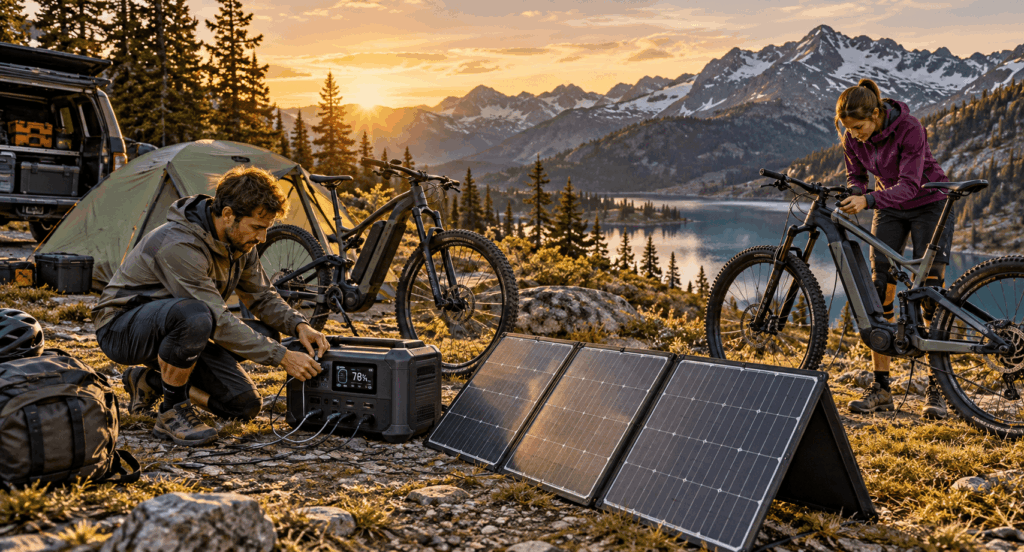
Portable stations can also act as buffers between solar panels and e-bike chargers.
EcoFlow’s current off-grid e-bike charging guide explains how portable stations can be paired with solar panels during multi-day trips.
This arrangement is generally more flexible than attempting to connect a raw solar panel directly to an e-bike battery.
The power station’s solar electronics manage panel input, store energy, and later provide a normal AC source for the approved bicycle charger.
Solar Input Is Best for Multi-Day Base Camps
Solar charging works best when riders have time.
A large folding panel may collect meaningful energy while the group is riding, eating, or resting, but output changes with:
- Cloud cover
- Panel angle
- Temperature
- Shade
- Time of day
- Rated panel capacity
For a single afternoon, carrying more stored battery capacity may be simpler. For several days away from mains power, solar input becomes much more valuable.
Vehicle Charging Adds Another Option
Many modern portable power stations can recharge from a vehicle electrical system.
This creates a useful cycle for shuttle-based e-MTB trips: bikes consume energy on the trail, the portable station charges bikes at the trailhead, and the station itself recovers energy while the vehicle is moving.
Actual charging speeds depend heavily on the vehicle, power station, and compatible charging hardware.
LFP Chemistry Is Well Suited to Base-Camp Use
Many current portable stations use lithium iron phosphate, commonly abbreviated LFP or LiFePO4.
DJI lists LFP chemistry for its Power 2000 and claims more than 80 percent capacity after 4,000 controlled charge cycles under specified laboratory conditions.
LFP is popular for stationary and portable energy storage because manufacturers can prioritize cycle life and thermal stability even though the units may be heavier than high-energy-density bicycle batteries.
Weight Is the Main Limitation
The term “portable” needs context.
A 2,048Wh station may weigh more than 20 kilograms. DJI lists the Power 2000 at about 22kg.
That makes it reasonable for:
- Car camping
- Trailhead use
- Race vans
- Shuttle trips
but unrealistic for most bicycle-mounted bikepacking trips.
Riders carrying everything on the bicycle still need much smaller energy systems or strategically planned charging stops.
Better E-Bike Batteries Make Off-Grid Charging More Useful
Battery improvements can reduce how often riders need the portable station.
Our Semi-Solid-State E-Bike Batteries 2026 article examines newer cell technologies targeting higher energy density, faster charging, and longer cycle life.
If e-bike packs become lighter and accept higher charging rates safely, portable base-camp charging could become even more practical.
How to Plan an Off-Grid Charging Setup
Before leaving, riders should identify:
- Battery capacity in watt-hours
- Approved charger power
- Portable-station usable capacity
- Expected conversion losses
- Number of bikes being charged
- Available charging time
- Solar or vehicle recharging options
Then add a reserve rather than planning around ideal laboratory numbers.
The Future of Off-Grid E-Bike Charging
The most interesting change is that range is becoming less dependent on permanent charging infrastructure.
Portable LFP stations, fast chargers, vehicle charging, solar panels, removable batteries, and smarter range prediction can work together as a mobile energy ecosystem.
That does not make electricity unlimited, but it can turn a remote trailhead into a temporary charging hub.
Conclusion
Off-grid e-bike charging in 2026 is becoming genuinely useful for riders who travel by vehicle to remote trails, spend multiple days camping, or want to extend long e-MTB sessions without depending on a café or mains outlet.
The important numbers are not simply the advertised battery capacities. Conversion losses, charger speed, portable-station weight, solar conditions, and battery compatibility all affect what the system can actually deliver.
Most importantly, riders should continue using manufacturer-approved e-bike chargers rather than treating portable energy systems as universal direct battery chargers.
With careful energy planning, portable power stations can transform the traditional e-bike range problem from “Where is the nearest outlet?” into a much more flexible question: “How much energy do we need for tomorrow’s ride?”