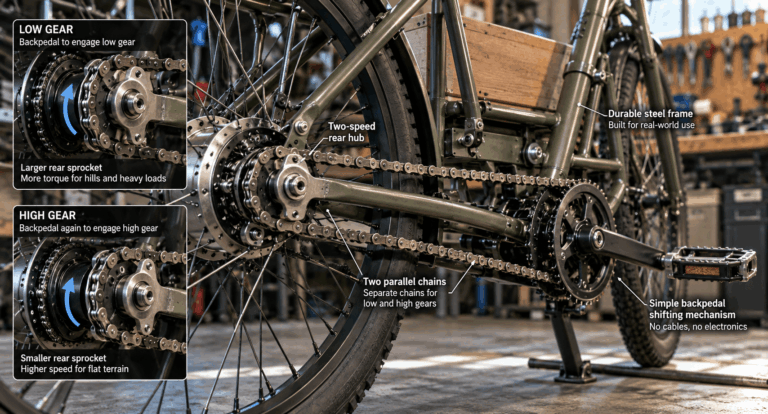
Some of the most interesting bicycle technology in 2026 is not electronic, aerodynamic, or artificial intelligence driven. It is deliberately simple. World Bicycle Relief’s latest Buffalo Pro uses a patented two-chain utility-bike drivetrain that gives riders two useful gears without relying on a conventional derailleur, complex shifter, or exposed multi-sprocket cassette.
The updated Buffalo Pro was introduced in September 2026 alongside the simpler Buffalo One. The new bikes focus on durability, load carrying, braking, repairability, and rider fit for communities where a bicycle may be used every day for school, healthcare, farming, business, and transporting goods.
The design provides a useful reminder that bicycle innovation is not always about adding features. Sometimes the engineering challenge is achieving more capability with fewer vulnerable parts.
Why the Buffalo Pro Is Trending in 2026
World Bicycle Relief introduced the Buffalo One and Buffalo Pro as the latest evolution of its long-running utility bicycle program.
The Pro keeps the organization’s unusual two-speed, two-chain drivetrain while adding practical updates such as redesigned frame options, stronger cargo hardware, and mechanical disc braking.
BikeRadar’s September coverage emphasizes that the design process incorporated feedback from riders and field teams in countries including Kenya, Zambia, and Zimbabwe.
This rider-centered approach makes the project particularly interesting from an engineering perspective.
Why Two Chains Instead of a Derailleur?
Most multi-speed bicycles use a derailleur to move one chain across several rear sprockets. The system can provide a wide range of ratios, but it includes exposed components that need reasonably accurate alignment.
For high-performance cycling, that trade-off makes sense.
For a utility bicycle carrying heavy loads over rough rural roads, designers may prioritize different qualities:
- Simple maintenance
- Low replacement cost
- Impact resistance
- Reliable operation in dirt and mud
- Easy field repair
World Bicycle Relief’s history of the Buffalo drivetrain explains that an earlier geared design introduced more exposed parts and maintenance requirements. The later Utility S2 introduced a patented two-chain solution intended to provide multiple ratios with less drivetrain complexity.
How Backpedal Shifting Works
The Buffalo Pro provides two gear ratios rather than a large cassette of options.
The rider changes between the two by using a backpedaling action. The drivetrain moves between separate chain paths, allowing the bicycle to offer one ratio better suited to climbing or carrying heavy loads and another suited to flatter, faster riding.
This is unusual because modern cyclists normally associate backpedaling with a freewheel or coaster brake rather than selecting a gear.
The system’s strength is not the number of ratios. It is the attempt to provide the most useful two ratios with a mechanism designed around simplicity.
Two Gears Can Be Enough for the Job
A performance road or mountain bike may use twelve or thirteen rear sprockets because riders constantly encounter changing speeds and gradients.
A rural utility bicycle has a different mission.
For many riders, the most important distinction is simply:
- A lower gear when the bicycle is heavily loaded or climbing
- A higher gear for normal travel on flatter terrain
That limited selection can still significantly improve usability compared with a single-speed bicycle.
World Bicycle Relief’s design discussion explains that the Pro’s extra gear range is particularly useful on varied terrain and when riders depend on the bicycle for carrying heavy loads or earning income.
Why Heavy Loads Change Bicycle Design
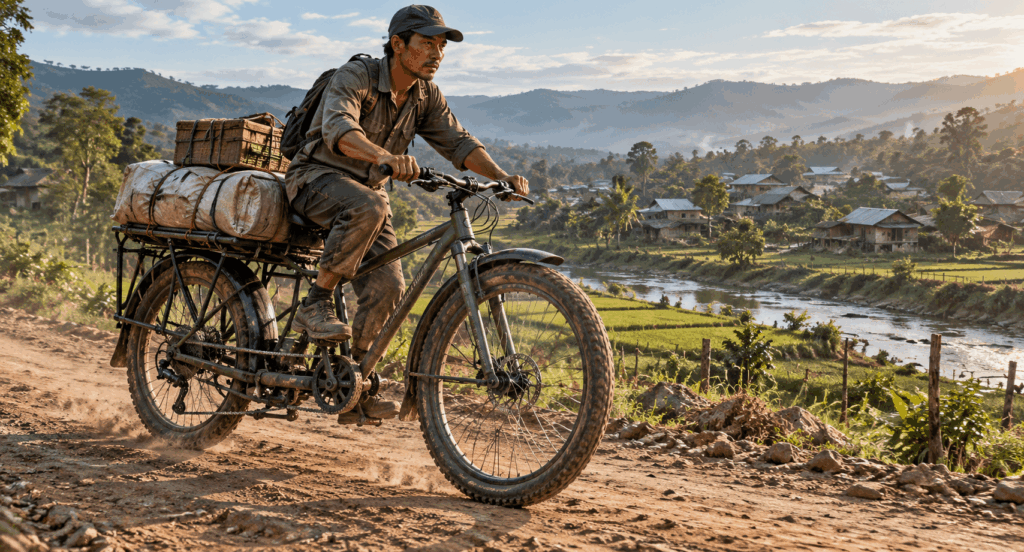
A bicycle carrying groceries is one thing. A working utility bicycle may carry agricultural products, water, supplies, tools, or commercial goods weighing tens of kilograms.
The Buffalo platform uses a reinforced rear carrier designed for substantial loads. World Bicycle Relief states that the current carrier is designed to support up to 100 kilograms.
That kind of payload changes the demands placed on:
- The frame
- Wheels
- Brakes
- Kickstand
- Carrier structure
- Drivetrain
This is why utility-bike engineering cannot simply copy lightweight sport-bike design.
Disc Brakes Are a Major 2026 Upgrade
Stopping a heavily loaded bicycle requires reliable braking.
The new Buffalo Pro uses mechanical disc brakes at both ends, while the Buffalo One combines a front mechanical disc brake with a rear coaster brake.
Mechanical discs offer useful advantages in this application. They provide braking at the hub rather than the rim and avoid hydraulic fluid systems that may require specialized service.
World Bicycle Relief’s current Buffalo specifications describe the two models as sharing a common core architecture while using different drivetrain and braking solutions according to intended use.
For more context on braking technology, see our Bike Brakes Technology and Stopping Power 2026 guide.
Repairability Is Part of Performance
High-end bicycles often define performance through low weight, aerodynamic efficiency, or electronic integration.
For a rural utility bicycle, being repairable may be equally important.
A broken component can prevent a rider from reaching work, school, healthcare, or market. Parts therefore need to be understandable, replaceable, and supported through a practical supply network.
The Buffalo One and Pro intentionally share many components. World Bicycle Relief says both models use common frame architecture, carriers, stands, wheels, mudguards, and headset systems.
That commonality can simplify:
- Spare-parts inventory
- Mechanic training
- Service procedures
- Program logistics
Field Feedback Shapes the Bike
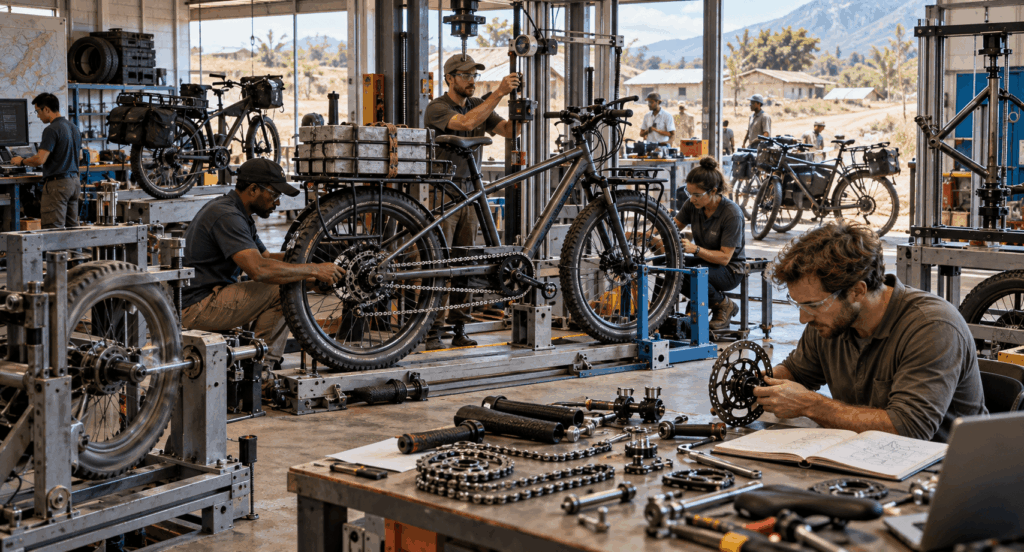
One of the strongest aspects of the 2026 update is the role of riders and local mechanics in development.
BikeRadar reports that World Bicycle Relief incorporated team members from Kenya, Zambia, and Zimbabwe directly into the product-development process.
This matters because engineers working far from the actual riding environment can easily optimize the wrong thing.
A component that looks elegant in a laboratory may become difficult to service in a rural workshop. A lightweight carrier may fail under daily commercial loads. A braking system may require parts that are not readily available.
Two Frame Sizes Improve Accessibility
The new platform also introduces multiple frame sizes.
Cycling Weekly’s launch coverage notes that the updated bicycles include two size options, improving fit for shorter and taller riders.
Fit is often discussed in racing terms, but it is equally important on a working bicycle. Better fit can improve:
- Control
- Comfort
- Braking confidence
- Pedaling efficiency
- Mounting and dismounting
The Buffalo One Shows Why Simplicity Still Matters
The Buffalo One is a single-speed alternative intended for flatter terrain and riders who do not need the Pro’s two-speed drivetrain.
This is an important design decision. Adding technology where it is unnecessary can increase cost and maintenance without providing meaningful benefit.
Offering two models allows the bicycle to match actual use rather than forcing every rider into the same specification.
Utility Innovation Is Different From Performance Innovation
The two-chain drivetrain looks almost opposite to the direction of modern racing technology.
Our Electronic Shifting Revolution article examines systems using wireless communication, servo motors, batteries, and programmable controls.
The Buffalo Pro solves a similar basic problem — selecting an appropriate gear — through a dramatically different engineering philosophy.
Neither approach is inherently superior. They are optimized for different environments.
Durability Can Be a Sustainability Strategy
A product that lasts longer and can be repaired locally may reduce material consumption over its service life.
This connects with ideas explored in our Sustainable Smart Bicycles 2026 article, where repairability and longer component lifecycles are important parts of circular design.
The Buffalo approach demonstrates that sustainability does not always require advanced materials or digital tracking. It can also come from robust construction, shared parts, straightforward maintenance, and keeping bicycles useful for many years.
Chain Design Still Matters
Using two chains increases the importance of basic drivetrain durability.
Chains operate under contamination, load, and repeated articulation. Utility bicycles may encounter dust, mud, rain, and inconsistent maintenance schedules.
Strong, widely serviceable components are therefore more useful than highly specialized parts that cannot be replaced locally.
Our Bike Chain Technology and Drivetrain Efficiency 2026 guide explores how chain design, lubrication, wear, and drivetrain alignment influence reliability.
Could Two-Chain Shifting Spread Beyond Rural Utility Bikes?
The patented Buffalo drivetrain is designed for a specific mission, so it is unlikely to replace conventional multi-speed systems on sport bicycles.
However, the engineering principle is broadly relevant: simplify the system around the user’s real needs.
Other mobility products could borrow similar thinking by emphasizing:
- Fewer service-sensitive parts
- Simple control methods
- Shared components
- Local repairability
- Load-specific gearing
The Future of Durable Utility Cycling
World Bicycle Relief says more than one million Buffalo bicycles have been distributed. That scale creates a significant real-world test environment for bicycle design.
The latest generation shows how mature products can improve without becoming unnecessarily complicated.
Disc brakes, multiple frame sizes, a stronger carrier, and a two-speed drivetrain are meaningful changes, but the design remains centered on durability and field service.
Conclusion
Two-chain utility bikes in 2026 demonstrate a very different kind of cycling innovation. Instead of chasing more gears, wireless controls, or lower weight, the Buffalo Pro focuses on providing two practical ratios through a durable system that can survive heavy loads and difficult riding conditions.
The new model adds mechanical disc brakes, improved fit options, stronger cargo hardware, and continued compatibility across a shared service ecosystem.
Its biggest lesson may be broader than the drivetrain itself. Good bicycle technology is not necessarily the most complex technology. It is the technology that solves the rider’s actual problem with the least unnecessary complication.