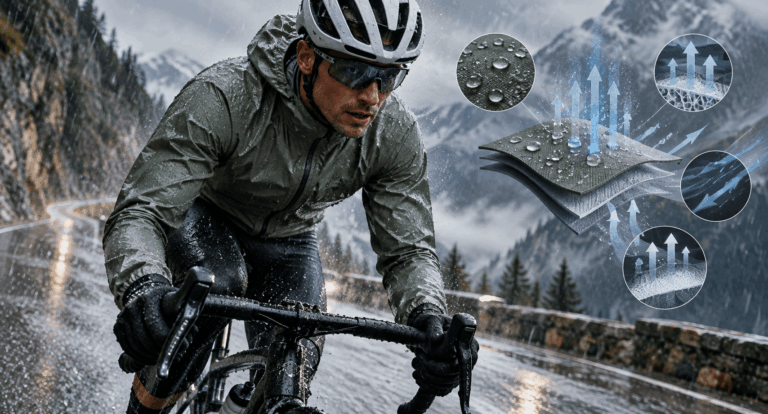
For decades, high-performance cycling rainwear relied heavily on fluorinated chemistry to deliver the combination riders wanted: water beading, wind protection, low weight, and enough breathability to avoid becoming soaked from sweat. In 2026, that formula is changing rapidly. PFAS-free cycling rainwear is moving from an environmental ambition into mainstream premium equipment as brands adopt new membranes, non-fluorinated durable water-repellent treatments, recycled fabrics, and entirely different approaches to moisture management.
One of the clearest examples arrived in September 2026 when Castelli expanded Polartec AirCore into its new Gabba Pro and updated Perfetto weather-protection range. At the same time, next-generation GORE-TEX products using expanded polyethylene membranes are appearing across cycling shells from brands such as Rapha.
The result is a major materials transition that affects much more than sustainability. Removing long-established fluorinated chemistry forces textile engineers to rethink breathability, surface water repellency, durability, garment care, packability, and what cyclists should realistically expect from a weather jacket.
BikeRadar’s September 2026 coverage of the Castelli Gabba Pro and Perfetto updates shows how quickly PFAS-free fabric technology is moving into high-performance cycling apparel.
What Are PFAS and Why Were They Used in Outdoor Clothing?
PFAS is a broad term covering per- and polyfluoroalkyl substances. Various members of this chemical family have historically been used because they can provide exceptional resistance to water, oil and stains.
Those characteristics made fluorinated chemistry attractive for outdoor garments exposed to rain, road spray and repeated washing.
The environmental concern is persistence. Many PFAS compounds break down extremely slowly, which has led to increasing regulatory pressure and a major materials transition across outdoor clothing.
California law, for example, already restricts regulated PFAS in many textile products while providing a later deadline for certain outdoor apparel intended for severe wet conditions. The law also requires disclosure for qualifying severe-wet-weather apparel containing regulated PFAS during the transition period.
California Health and Safety Code Section 108971 illustrates how legislation is accelerating the move toward alternative textile chemistry.
Polartec AirCore Takes a Different Approach
Polartec AirCore is one of the most interesting new cycling-specific technologies because it is designed around controlled air permeability rather than creating the most completely sealed barrier possible.
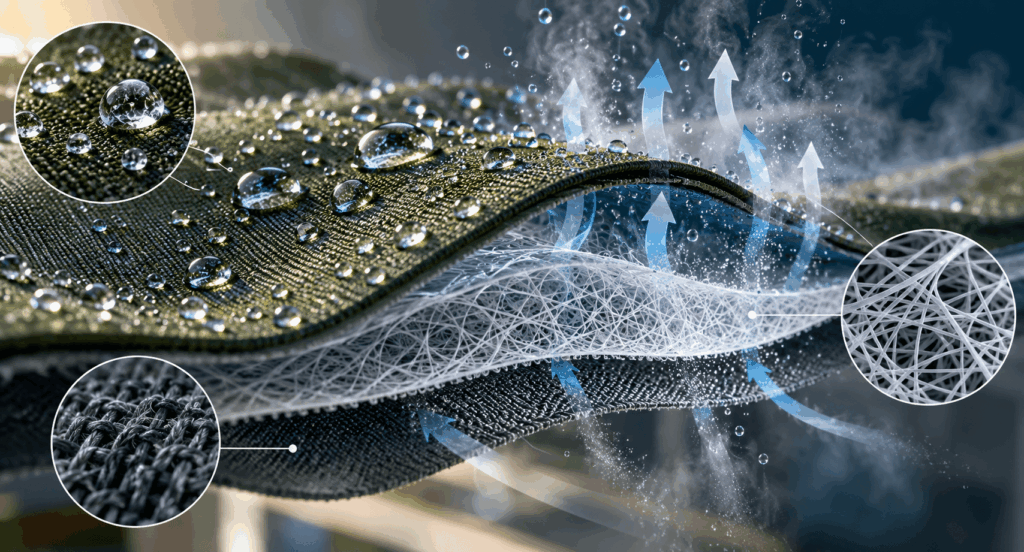
Polartec describes AirCore as a three-layer non-PFAS fabric using recycled polyester face and back layers around a functional nanofiber membrane.
The membrane is created through electrospinning. A polymer is formed into microscopic fibers that create a very fine network capable of resisting external moisture while allowing air and water vapor to move through the material.
That structure is particularly relevant to cycling because riders generate substantial heat and sweat while moving.
Why Breathability Matters So Much on a Bicycle
A rain jacket can keep external rain away and still leave a cyclist soaked.
When a rider is climbing or riding hard, the body produces heat and water vapor. If that moisture cannot escape, condensation forms inside the garment.
This is the familiar “boil-in-the-bag” feeling associated with some waterproof shells.
For cyclists, weather protection therefore requires a balance among:
- Water resistance
- Wind protection
- Moisture-vapor transfer
- Air permeability
- Stretch
- Weight
Polartec publishes an MVTR figure of approximately 25,000 g/m²/24 hours for AirCore under its specified test method and an air-permeability range of roughly 0.4 to 1 CFM.
Those figures are laboratory measurements rather than guarantees of comfort for every rider, but they illustrate the material’s design priority: moving moisture outward while preserving weather protection.
The Gabba Pro Shows How the Technology Is Changing Race Apparel
The Gabba has historically occupied a unique position between a jersey and a traditional rain jacket. It is intended for high-output riding in cool, wet conditions where aerodynamics and breathability matter as much as complete storm protection.
Castelli’s current AirCore collection now includes the Gabba Pro and Perfetto 4 among a broader selection of weather garments.
The approach reflects an important change in apparel design. Instead of treating every wet ride as a reason to use a fully sealed shell, manufacturers can tune different fabrics for different combinations of rain intensity, temperature and rider effort.
This also connects with our Wet-Weather Downhill Tech 2026 article, where equipment choices similarly depend on the exact conditions rather than one universal rain setup.
AirCore Is Water Resistant, Not a Universal Replacement for Every Shell
This distinction is important.
Polartec positions AirCore as highly breathable weather protection and publishes an initial hydrostatic resistance level above 4,000mm under its specified testing method.
A fully waterproof expedition shell may use a substantially different construction and prioritize sustained rain protection over airflow.
That means cyclists should match the garment to the ride.
A highly breathable race jacket may be ideal for fast riding in intermittent or moderate rain but may not be the best choice for standing in a multi-hour downpour.
GORE-TEX ePE Takes Another Route to PFAS-Free Protection
Expanded polyethylene, commonly called ePE, represents another major transition.
GORE-TEX says its next-generation ePE membrane is made without intentionally added PFAS and is designed to retain waterproof, windproof and breathable performance while reducing material mass compared with predecessor membranes.
The ePE membrane is used inside laminates with selected face and backing textiles to create complete waterproof fabrics.
Unlike AirCore’s deliberate air-permeability approach, a GORE-TEX waterproof shell is generally positioned more strongly around sustained waterproof protection.
Both technologies can therefore be PFAS-free while serving somewhat different performance priorities.
2026 Cycling Jackets Show the ePE Transition Is Already Mainstream
PFAS-free waterproof fabrics are no longer limited to prototypes.
Rapha’s 2026 Brevet GORE-TEX Rain Jacket, for example, uses a lightweight three-layer GORE-TEX fabric with an ePE membrane. Rapha positions it as a fully waterproof, highly packable shell for long-distance riding.
This creates a useful contrast with highly air-permeable rain-or-shine garments.
One cyclist may prioritize maximum packability and waterproofing, while another may prefer greater airflow during hard race efforts.
PFAS-Free DWR Changes How Riders Should Think About Wet-Out
The membrane is only one part of a rain garment.
The outer face fabric typically uses a durable water-repellent treatment, or DWR, that encourages droplets to bead and roll away rather than soak into the textile.
When the face fabric becomes saturated, the membrane may still prevent water from reaching the rider, but the jacket can feel colder, heavier and less breathable.
Non-fluorinated DWR treatments can behave differently from older fluorinated chemistry.
Polartec explicitly notes that non-PFAS DWR may lose surface repellency sooner and recommends appropriate washing and low-temperature tumble drying according to garment instructions to help restore performance.
Garment Care Is Becoming Part of Weather Performance
Modern technical jackets should not simply be worn until they stop repelling water.
Dirt, oils, sweat and detergent residue can interfere with the face fabric and moisture transfer.
Correct washing can therefore improve performance rather than damage a garment, provided the rider follows the manufacturer’s care label.
A typical care strategy may involve:
- Closing zippers and fasteners before washing
- Using the recommended detergent
- Avoiding fabric softener
- Rinsing thoroughly
- Drying according to the garment instructions
- Refreshing the DWR when necessary
The exact instructions vary by membrane and garment, so the manufacturer’s guidance takes priority.
Fit Matters as Much as Fabric
A technically advanced membrane cannot compensate for a jacket that fits poorly on the bicycle.
Road cyclists typically need:
- Longer rear coverage
- Shaped sleeves
- Close cuffs
- Minimal flapping
- Room for jersey pockets
Commuters may prefer a more relaxed cut that accommodates normal clothing, while gravel riders may want pockets and additional durability.
Our Urban Cycling Commute Optimization and Infrastructure 2026 guide discusses how rain protection, visibility and full-coverage equipment affect everyday wet-weather commuting.
Packability Is Another Performance Metric
A jacket that performs perfectly in rain but is too bulky to carry may be left at home.
Road and gravel cyclists often prioritize shells that fit into a jersey pocket or small frame bag.
This is why low material mass matters. Lightweight membranes, thin woven face fabrics and minimal seam construction can reduce packed volume without eliminating protection.
However, very light fabrics may sacrifice abrasion resistance, so bikepackers and mountain riders should consider durability alongside weight.
PFAS-Free Does Not Mean Every Product Uses the Same Chemistry
The phrase “PFAS-free” can describe several different material strategies.
AirCore uses a proprietary electrospun polymer membrane. GORE-TEX ePE uses expanded polyethylene. Other garments may use polyurethane membranes or different non-fluorinated laminates and DWR systems.
Manufacturers also use slightly different wording. GORE-TEX defines PFAS-free membrane claims as being made without intentionally added per- and polyfluorinated substances while noting that trace amounts may be present.
That is why riders comparing products should look at the manufacturer’s specific definition rather than assuming every PFAS-free label describes identical chemistry.

Regulation Is Accelerating Innovation
The transition is being driven by more than consumer preference.
Textile regulations in jurisdictions such as California are creating deadlines and disclosure requirements for products containing regulated PFAS.
That encourages fabric mills and clothing brands to develop replacement technologies sooner rather than later.
For cyclists, the useful outcome is greater choice. High-performance weather clothing no longer depends on one membrane chemistry or one approach to water repellency.
Sustainability Still Depends on Garment Lifespan
Removing intentionally added PFAS does not make a disposable jacket sustainable.
Materials, manufacturing, transport and eventual disposal still create environmental impacts.
A durable jacket that lasts through years of riding may be preferable to one that must be frequently replaced.
This connects with the lifecycle approach discussed in our Sustainable Smart Bicycles 2026 article.
For apparel, maintenance and repair are important parts of the same idea.
The Future of Cycling Rainwear
The most interesting development is that PFAS removal is forcing brands to reconsider what cyclists actually need from weather clothing.
Future garments may become increasingly specialized around:
- Air permeability for high-intensity racing
- Maximum waterproofing for endurance riding
- Ultra-low packed volume
- Improved non-PFAS DWR durability
- Recycled face fabrics
- Zone-specific membranes and ventilation
Instead of one jacket trying to solve every wet-weather problem, riders may see clearer choices optimized around intensity and conditions.
Conclusion
PFAS-free cycling rainwear in 2026 is becoming one of the most important material transitions in performance apparel.
Polartec AirCore demonstrates how highly breathable, air-permeable nanofiber membranes can provide wind and moisture protection for hard riding, while GORE-TEX ePE shows that next-generation PFAS-free materials can also support fully waterproof cycling shells.
The transition comes with new considerations. Riders may need to pay more attention to DWR maintenance, washing, wet-out, garment type and the exact level of rain protection required.
But the broader direction is clear. The cycling industry is learning that moving away from long-lived fluorinated chemistry does not require abandoning technical performance. Instead, it is creating a new generation of fabrics that approach weather protection in smarter and more specialized ways.