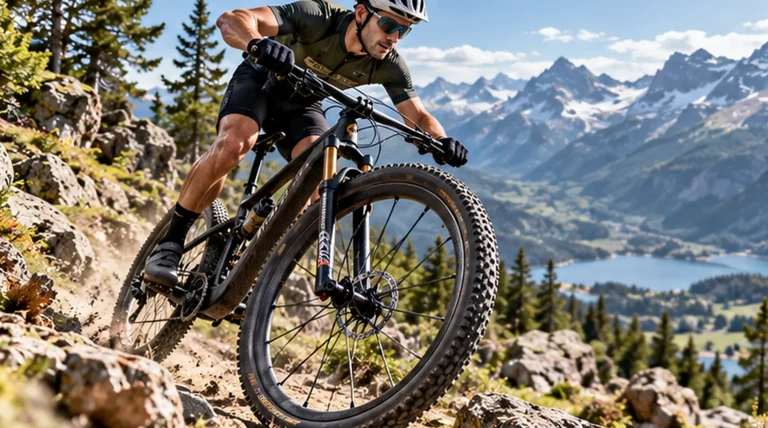
Cross-country mountain bike racing has become faster, rougher, and more demanding on equipment. Courses now mix explosive accelerations with rock gardens, steep climbs, technical corners, and repeated impacts. That is why carbon-spoke XC wheels in 2026 are attracting attention: engineers are trying to deliver quick acceleration without sacrificing steering precision or impact resistance.
The freshest example is the CADEX Max XC WheelSystem, announced in October 2026. CADEX, Giant’s high-end component brand, says its first mountain bike wheels combine carbon rims, spokes bonded into the hub flanges, a fast-engaging rear hub, and reinforced rim edges. The wheelset weighs a claimed 1,248 grams with valves and tape installed. It is an ambitious entry into the premium XC market, not proof that every rider needs an integrated carbon wheel.
Why Carbon-Spoke XC Wheels Are Trending
The latest XC bikes are engineered as complete racing systems. Frame suspension, tire casing, wheel stiffness, gearing, and even riding position affect how much speed a racer can carry. BikeRadar’s October Max XC report explains how CADEX is using bonded carbon spokes to emphasize drivetrain response alongside low weight. Unlike a conventional wheel built primarily around steel spokes, this design connects carbon spokes directly to carbon hub flanges
That is a more specific development than the broader trends covered in our Bike Wheel Technology and Aerodynamic Rim Design 2026 guide.
What Makes the Max XC Construction Unusual?
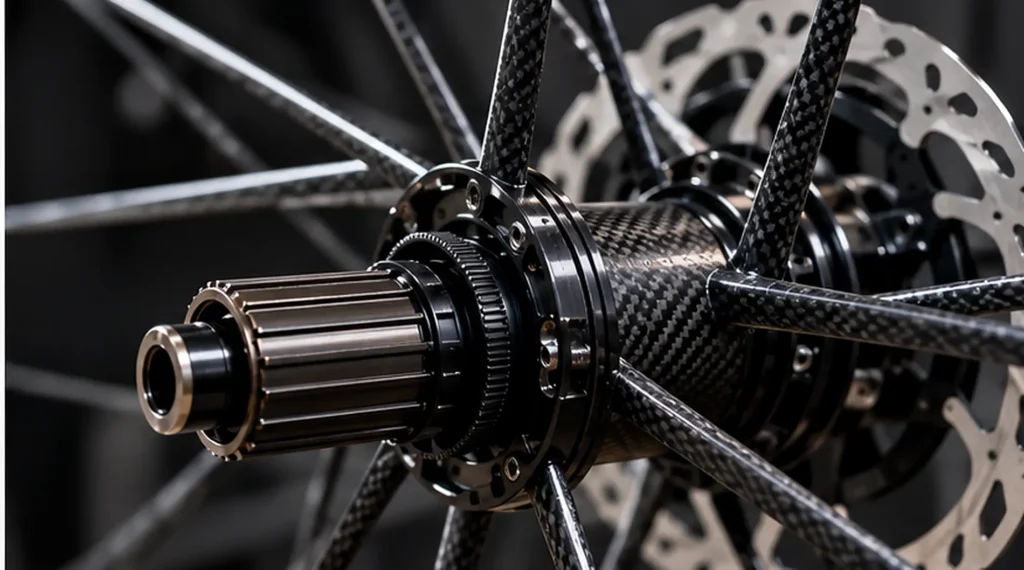
A conventional bicycle wheel typically relies on individual metal spokes attached to a separate hub. CADEX uses high-tensile carbon spokes bonded into the hub flanges. The manufacturer calls this an integrated hub-and-spoke design. The arrangement is meant to resist twisting and lateral deflection as the rider drives hard through the pedals or steers through irregular terrain.
Crucially, the design still allows individual spoke tension adjustment through hidden alloy nipples at the rim. This distinguishes it from some fully molded wheel structures that can be difficult to true by familiar workshop methods. Pinkbike’s launch coverage emphasizes that the construction is integrated without making normal tension adjustment impossible.
Carbon Spokes and Dynamic Balanced Lacing
Spokes are not simply thin rods keeping a hub in the middle of a rim. Their angle, tension, elasticity, and connection points determine how a wheel behaves under braking, pedaling, cornering, and landings. CADEX pairs its carbon spokes with Dynamic Balanced Lacing, or DBL, which uses a wider bracing angle and is designed to balance tension under pedaling loads.
The Max XC uses 20 front spokes and 24 rear spokes. Lightweight titanium-threaded ends help connect the carbon spokes to their adjustment hardware. The aim is a wheel that reacts promptly when a rider sprints or changes direction. The potential downside is that unusual components can be more expensive and less widely available than traditional spokes.
Transmission Stiffness Versus Lateral Stiffness
Manufacturers often describe wheels as stiff, but the direction of that stiffness matters. Lateral stiffness measures resistance to side-to-side deflection. Transmission stiffness concerns how much a wheel twists between the driving hub and the rim under torque.
CADEX claims a substantial transmission-stiffness advantage over a competing wheel in its own controlled tests. BikeRadar examined the comparison and noted an important nuance: the competing wheel was considerably lighter, and CADEX’s own data did not show a superior lateral stiffness-to-weight ratio. Those figures should be treated as manufacturer test results, not independent proof that one wheel is faster on a racecourse.
On the trail, performance also depends on tire pressure, suspension, wheel compliance, and rider technique. A wheel can be extremely stiff yet still feel harsh or difficult to control in some conditions.
A 120-Tooth Hub for Faster Pedal Pickup
The Max XC rear hub uses a 120-tooth Helical-Bevel Ratchet Drive. That corresponds to a nominal three-degree engagement angle. Small engagement angles are useful when a rider pauses pedaling over obstacles and then needs power again with minimal crank movement.
CADEX’s technical overview describes the M1-C120 hub, its wave spring, and the helical ratchet configuration. Fast engagement can be attractive on awkward climbs, although hub drag, durability, and sound are also relevant buying considerations.
There is also a revealing contrast with our Anti-Pedal-Kickback Hubs 2026 article. Some gravity riders deliberately add freehub float to reduce drivetrain feedback while coasting; XC riders may instead prioritize rapid engagement during technical pedaling. The best setup depends on discipline.
Why the Rims Are 30mm Wide Internally
Wheel weight receives the headlines, but rim width often has a larger impact on everyday setup. The Max XC has a 30mm internal hookless rim, intended for compatible mountain bike tires approximately 2.2 to 2.6 inches wide. Wider internal rims can support a tire’s casing and change its shape under cornering loads.
They can also help riders use appropriate lower tire pressures for traction and comfort. That does not make the rim automatically compatible with every tire. Always check approved tire dimensions, hookless compatibility, maximum pressure, and the wheel maker’s instructions. Our Bike Tire Technology and Tread Pattern Innovations 2026 guide explains why tire construction and inflation interact with rim choice.
Reinforced Edges and Rim-Strike Protection
Modern XC racing can destroy lightweight equipment. A wheel must handle sharp impacts, not merely weigh little on a scale. CADEX uses what it calls Wide Guard: reinforced rim walls around five millimeters thick, designed to reduce sharp tire pinching at the rim and improve durability during hard impacts.
Bikerumor’s October launch report places the design in the context of increasingly technical World Cup racing. CADEX also publishes a compression-test advantage over its chosen competitor, but laboratory load results should not be interpreted as guarantees against rock damage or punctures. Tire choice and riding conditions remain critical.
Do Ceramic Bearings Make a Real Difference?
The wheels also feature ceramic bearings, which manufacturers often promote for reduced rolling friction. In practice, bearing sealing, lubrication, contamination, alignment, and maintenance can matter as much as ball material. A small laboratory friction difference should not be confused with a guaranteed race-time saving.
For muddy XC events, reliability can be just as valuable as theoretical efficiency. Riders should ask whether replacement bearings and specialist service are readily available in their region.
How Much Do These Wheels Weigh?
CADEX lists the pair at 1,208 grams without valves and tape and 1,248 grams with those items fitted. Both figures are claimed specifications. The wheels are 29-inch only, use Boost axle spacing, and support common Shimano Micro Spline and SRAM XD freehub configurations.
Those details matter before making a purchase. Wheel diameter, axle standards, cassette interface, rotor mount, and the intended tires must match the rider’s existing bicycle.
How Expensive Is Cutting-Edge XC Integration?
The Max XC WheelSystem is positioned as a flagship product. Pinkbike reports a launch price of $4,000 in the United States. That makes it a highly specialized racing upgrade rather than a sensible default for most recreational mountain bikers.
At this level, riders should examine crash-replacement terms, warranty restrictions, spare-spoke availability, and local workshop expertise. The integrated construction has real engineering interest, but convenience and serviceability also have value.
What Riders Can Learn From the Launch
The larger lesson is that wheel design is no longer simply a contest to remove grams. Engineers are combining rim shape, spoke architecture, hub engagement, tire support, and impact resistance to target the stresses of a particular race discipline. Carbon spokes may make sense for riders chasing marginal gains, but a durable conventional wheelset may still be the better investment for varied trails and tight maintenance budgets.
Watch for independent long-term riding tests covering spoke tension retention, bearing wear, repairs after crashes, and measurable performance on complete bikes. Those will say more about practical ownership than launch-day weight and stiffness claims alone.
Conclusion
Carbon-spoke XC wheels in 2026 are entering a more integrated era. The CADEX Max XC demonstrates how bonded carbon spokes, rapid hub engagement, wide rims, and reinforced edges can be designed together for demanding cross-country racing. Its premium price and proprietary architecture also underline the trade-offs. For now, it is an exciting example of race-focused engineering, not a universal replacement for well-built conventional mountain bike wheels.