Mountain bike tire design is becoming increasingly specialized as modern enduro, downhill, and electric mountain bikes push traction and durability requirements to new levels. In 2026, moto-inspired MTB tires are attracting attention as manufacturers borrow engineering ideas from motocross to improve cornering support, braking control, and high-speed handling.
One of the most interesting developments comes from Dunlop, a company with extensive motorsport experience. Its Geomax MB34 and MB53 mountain bike tire families translate aspects of motocross tire development into lighter, bicycle-specific products.
Although Dunlop introduced the range earlier in 2026, the company confirmed wider dealer ordering availability on October 14. The company’s October availability announcement explains how the MB34 and MB53 are designed for different combinations of terrain, speed, and traction.
Why Motocross Technology Matters for Mountain Bikes
Motocross and mountain biking share several fundamental challenges. Both require tires to generate lateral grip, tolerate repeated impacts, and communicate changing traction to the rider.
However, the two sports place very different forces on the tire.
A motocross motorcycle weighs much more than a mountain bike and uses engine power that can apply significant torque during acceleration.
Mountain bike tires must also remain light enough for pedaling, comply with bicycle rims, and respond naturally to rider weight shifts.
Therefore, transferring motocross ideas is not as simple as making motorcycle tires smaller. Engineers need to reinterpret tread geometry, rubber compounds, and casing support for bicycle speeds and loads.
Dunlop Geomax MB34 Prioritizes Traction
The Geomax MB34 is Dunlop’s more traction-oriented mountain bike tire platform.
Dunlop describes the MB34 Enduro as a tire designed for loose surfaces, mixed soil, rocks, roots, and wet conditions.
Its tread uses aggressively shaped blocks intended to penetrate softer terrain and maintain predictable contact during braking and cornering.
The MB34 is particularly interesting for riders who value grip and control over minimum rolling resistance.
This may include downhill racers, technical enduro riders, and e-MTB riders negotiating steep, unpredictable trails.
The Front and Rear Tires Have Different Jobs
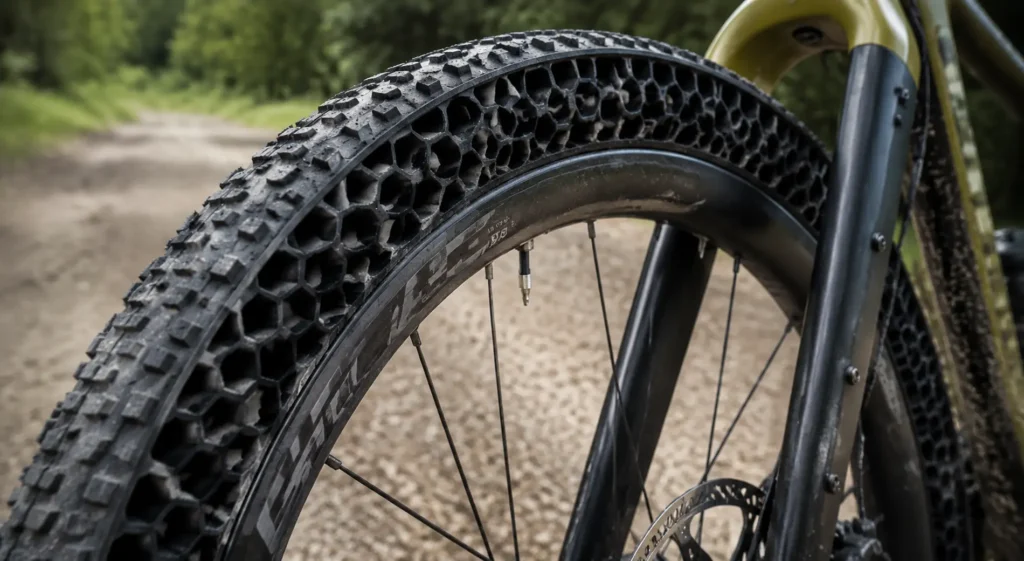
One of the distinctive elements of the Geomax range is its dedicated front and rear tread designs.
The front tire must provide dependable steering response and lateral support. Riders depend on it to identify how much cornering grip remains available.
The rear tire has a different job. It must handle braking forces, forward drive, and the rider’s efforts to control acceleration or sliding.
Dunlop designed its MB34 front pattern for predictable steering and mid-corner stability. The rear version emphasizes driving edges, braking traction, and lateral engagement.
This makes the tire pair a coordinated system rather than two identical tread patterns installed at opposite ends of a bicycle.
The MB53 Targets Faster Trail Conditions
The Geomax MB53 follows a different philosophy.
Instead of prioritizing maximum grip in soft conditions, it aims to maintain speed across firmer ground, rocks, and flowing trails.
Dunlop’s MB53 Enduro specifications describe a faster-rolling compound and tread arrangement intended to balance efficiency with progressive control.
The rear pattern uses offset knobs designed to maintain rolling efficiency while providing predictable engagement as the bicycle leans.
This could appeal to riders who frequently alternate between high-speed hardpack, rocky sections, and loose corners.
Why Progressive Cornering Blocks Matter
Dunlop promotes a technology it calls Progressive Cornering Block Technology.
The idea is to manage the transition between upright rolling and increasingly aggressive lean angles.
When a mountain bike enters a corner, different portions of the tire’s tread begin contacting the ground. If the transition is abrupt, the rider may experience a sudden change in grip.
Progressively engaging tread blocks attempt to make that transition more predictable.
The concept is especially relevant to downhill racing, where riders continually switch between straight-line braking, corner entry, maximum lean, and acceleration.
Enduro and Downhill Casings Serve Different Needs
A high-grip tread pattern still needs the right casing underneath it.
Dunlop offers Enduro and Downhill versions of the Geomax tire families.
The Enduro construction uses a single 60 TPI ply designed to provide a more compliant ride with less rotational weight.
The Downhill construction uses two 60 TPI plies to improve support and durability during harder impacts.
The MB34 Downhill specifications detail a reinforced casing and ultra-soft compound targeted at aggressive gravity riding.
The trade-off is familiar: heavier casings generally offer greater resistance to deformation and impact damage, while lighter constructions can improve acceleration and trail sensitivity.
Rubber Compound Affects More Than Grip
Many cyclists focus on tread design while overlooking rubber behavior.
A softer compound can conform more closely to irregular surfaces, potentially improving traction on roots, rocks, and other difficult features.
However, very soft rubber may wear more quickly or generate greater rolling resistance.
Dunlop uses compound combinations suited to the intended role of each tire.
The MB34 favors grip-oriented compounds, while the MB53 offers firmer, faster-rolling options.
Manufacturers must also consider rebound characteristics. The speed at which a rubber tread block returns to shape after deformation influences how it interacts with repeated irregularities.
Why E-MTBs Increase Tire Demands
Electric mountain bikes introduce additional considerations because their motors can deliver substantial torque to the rear wheel.
This increases the importance of traction during climbing and acceleration, particularly on loose surfaces.
E-MTBs may also carry additional weight because of their battery and motor systems.
That can increase tire loading and make supportive casings more attractive for aggressive riders.
The appropriate tire still depends on riding style. A lightweight trail e-MTB may benefit from different casing choices than a full-power gravity-focused machine.
The MB53 Can Deliver a More Progressive Drift
Not all mountain bike riders want maximum grip at every moment.
Experienced riders sometimes prefer a tire that communicates the approach of its traction limit gradually.
Dunlop’s MB53 Downhill description specifically discusses a more progressive sliding character during faster riding.
The intent is to allow riders to manage the bike’s movement through a corner rather than encountering an abrupt loss of traction.
Actual behavior will vary with soil, moisture, tire pressure, riding technique, and other equipment.
Tubeless Compatibility Remains Important
Both Geomax tire families are available in tubeless-ready configurations.
Tubeless systems allow riders to run appropriate lower pressures without the traditional tube pinch-flat mechanism.
Sealant can also help close small punctures during a ride.
However, riders should always confirm tire and rim compatibility and follow the manufacturer’s pressure specifications.
Heavier downhill casings and lighter enduro casings will not necessarily perform best at the same pressure.
Choosing the Right Front and Rear Combination
Because the Geomax families have different priorities, riders can evaluate their tire setup around the terrain they ride most often.
For particularly loose terrain, traction-oriented patterns at both ends may make sense.
On faster hardpack trails, a more speed-oriented rear tire could potentially improve rolling efficiency.
Some riders may prefer a grippier front tire for steering confidence and a faster-rolling rear, provided the manufacturer approves the chosen combination.
The key is ensuring that tire size, casing, compound, and tread all work together.
How the Geomax Range Compares With Mud Tires
Aggressive tread does not automatically make a tire a specialist mud spike.
Dedicated mud tires usually feature taller, widely spaced knobs designed to penetrate very soft ground and release accumulated mud.
The Geomax MB34 targets a broader mixture of loose soil, roots, rocks, and technical terrain.
For a closer look at specialist wet-condition equipment, see our Wet-Weather Downhill Tech 2026 article.
What About Weight and Rolling Resistance?
Weight and rolling efficiency should not be ignored when evaluating aggressive tires.
Rotational mass affects acceleration, particularly during repeated speed changes.
A heavier, reinforced casing may feel less lively than a lightweight trail tire, but it can also provide stability and protection during high-speed impacts.
Likewise, a soft compound may use more energy on smooth ground while delivering valuable traction elsewhere.
Riders should evaluate the complete ride rather than assuming the lightest tire is always the fastest.
Do Moto-Inspired Tires Change Mountain Biking?
Motocross-derived thinking is not entirely new to mountain biking, but Dunlop’s introduction illustrates how established motorsport manufacturers can apply specialized research to bicycle equipment.
The most relevant developments include dedicated front and rear tread patterns, purpose-specific compounds, reinforced casings, and controlled cornering behavior.
These ideas could encourage manufacturers to offer increasingly specialized tires for different riding disciplines.
Conclusion
Moto-inspired MTB tires in 2026 demonstrate that mountain bike traction technology continues to evolve beyond simply adding larger knobs or softer rubber.
The Dunlop Geomax MB34 emphasizes grip and predictable control on challenging terrain, while the MB53 targets faster rolling and progressive handling.
With dedicated front and rear designs, multiple casing options, and motocross-influenced engineering, the range highlights the importance of matching tire construction to the rider’s actual terrain.
The best choice will depend on conditions, riding style, and the balance between speed and traction. What works on wet roots may not be ideal on fast hardpack, and downhill racers will often prioritize different qualities from casual trail riders.
For mountain bikers, the broader lesson remains consistent: tire selection can influence confidence and control as much as many more expensive bicycle upgrades.